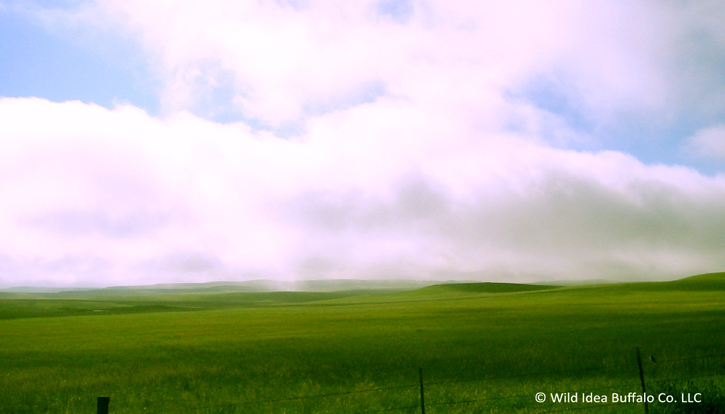
The north end of our ranch is part of a many thousand acre, level piece of ground known as Phiney Flat. By the county soil maps I know that the Flat is a fertile place for this part of the world and, in the places where the native, perennial grass still grows, it does extremely well. But people have been trying to farm other parts of the Flat since homesteading began in the early part of the twentieth century. For the most part, the efforts of these farmers were not successful. When we moved to this area, the neighbors with farming tendencies joked sheepishly that they only got a crop every three or four years, but that the federal government paid out for these “disasters” and so farming was profitable. Some of them would not meet your eyes when they talked like this but some actually winked.
We are not crop farmers, we are farmers of grass. We know that plowing up native grasses destroys an ancient ecosystem of plants, animals, birds, and insects that have evolved here for thousands of years. Along with the plants, animals, birds, and insects goes the unique system that pulls CO2 from the air and, with the help of some microbes in healthy soil, splits the carbon (C) away from the oxygen (O2) and deposits it in the ground where it can’t create havoc in the atmosphere and cause climate change. As a happy side effect, the native grasses expire those two atoms of oxygen and make them available for us to breath. The reason that the native, perennial grasses do such a good job of this nifty trick is that sometimes 90% of a perennial plant’s mass is below the surface of the soil. It keeps growing every year and carbon builds with the root system. Of course, when someone plows up such a plant and root system and replaces it with an annual plant, which only lives for one year and has no time to build an extensive root system, the ability to sequestering carbon is reduced by a huge percentage. The fertility of the soil is hauled away in grain trucks each fall and the carbon is released into the atmosphere.
Many people would disagree, but one of the lucky things about the American Great Plains is that, for the first hundred years of settlement, there was seldom enough rain to grow grain. The Great Plains was always considered one of the world’s greatest grasslands, but a poor place to farm. From the time of the buffalo right up through the era of the cowboy it has nourished countless herbivores. The buffalo, elk, antelope, cattle, and sheep grazed on the renewable grass and the fertility and the carbon stayed in the ground where it belongs. But now, in the first quarter of the twenty-first century all that is beginning to change.
To get the whole picture you have to understand a few things about farming: Farming is about nurturing a single kind of plant and destroying all other plants that can compete with that chosen plant. In places where moisture is in short supply a farmer’s job is to make sure that the crop that he chooses to grow gets as much of the rainfall as possible. On most of the Great Plains, crops like corn, beans, wheat, and sunflowers do not get enough water to grow unless all the competition is killed. We call the other plants that try to grow in a farmer’s field weeds, and for generations the only way to get rid of them was to mechanically remove them. In a garden we call that process hoeing but in large fields it requires plows, disks, and other cultivators pulled by powerful tractors. Because every living thing has a penchant for staying alive, weeds are difficult to kill. Mechanical removal never worked very well because the weeds just keep coming and, as they come, they suck up the water that is needed for the anointed crops to grow. That is why on many twentieth century agricultural maps there was a precipitation line on about the 100th meridian that marked the frontier of profitable farming. That line saved the Great Plains’ grasses that harbored most of the living things, pumped oxygen into the air, and sequestered billions of tons of carbon each year.
A second way to control the weeds in farm fields is to poison them with chemicals. If before a farmer plants his crop he sprays the field with a powerful herbicide – usually a product called Round Up – he kills many of the weeds that threaten to steal water from his crops. But weeds that have not yet begun to grow when the crop was planted jump out of the ground and, because Round Up will kill the crop too, use the valuable crop as protection. The weeds figured out to way to get enough water to live and hurt the farmer’s yield enough to make farming on the Great Plains a marginal enterprise. The precipitation line moved a little bit to the west, where the climate was drier, but still managed to keep farming from destroying huge portions of America’s grasslands.
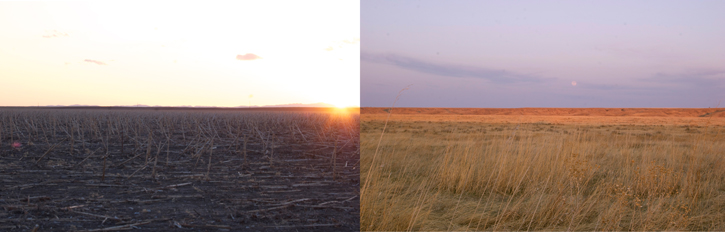
Then came genetically modified organisms – GMO’s. Scientist figured out a way to change the genetic makeup of certain crops so that Round Up, and other chemicals normally poisonous to all plants, had no effect on these genetically modified crops. This process dramatically increased yields by destroying the competition. It was lauded as a miracle that would help the world produce much more food by not only this increase in yields of existing cropland, but expand farming into areas that had never been able to economically produce crops before. All of a sudden the precipitation line that had protected the grass resources of our continent, and Phiney Flat, was pushed westward. In one generation it became profitable to grow farm crops by plowing up healthy grasslands.
GMO crops have been criticized for many reasons. Some call them Frankenstein plants complete with the allusions of monster plants creeping out of laboratories to prey on unsuspecting life forms. Others are concerned about GMO’s ability to cross pollenate with “normal” plants. Certainly they destroy biodiversity by creating sternal monocultures where nothing grows but the chosen GMO plant. They have been called the harbinger of a new silent spring and many worry about their effect on animals and humans consuming the grain that they produce. There are also legal questions about the ownership of seeds produced by GMO’s – do they belong to the farmer or to the chemical companies that created them? It is hard to measure the validity of these concerns but there is one concern that is undisputable – GMO farming threatens the biodiversity of our Great Plains and all the benefits that derive from them.
GMO technology makes profitable farming possible on our portion of Phiney Flat and so supplies an incentive for us to convert that grassland to cropland. This will never happen as long as I am alive but it is tempting. I can resist the incentive but there is also a penalty for not making that deadly conversion. It is a little known fact that, in many states, property taxes are calculated on a “best use value” not an “actual use value”. What this means is that our ranch is taxed on what the income could be if plowed up Phiney Flat and began farming it. Never mind the loss of biodiversity diversity, fertility, or the loss of carbon to the atmosphere. The tax differences are significant and the margins in ranching are slim. There is no question that GMO agriculture is driving loss of grasslands and those losses are not redeemable. This perfect storm of incentives and penalties is perhaps the greatest indictment against the use of genetically modified organisms. All of us who support GMO use by growing them or allowing them to be fed to animals are culpable for the inevitable grassland conversions that will necessarily follow.
Comments 35
Thanks!
I agree; very good and informative article. I am also trained as a wildlands manager(wildlife biologist) and understand your viewpoint.
Good luck with the bison
Dan,
Thank you for this article! If more people knew what was happening, they’d “maybe” do something about it!!
I’m President of the South Dakota Wildlife Federation and met you briefly at the SD Book Festival in Sioux Falls. My wife Jennifer is in charge of putting that together each year.
Don’t know if I’ll have time, or if you’d even be around, but I’m going turkey hunting in the Black Hills this weekend and was wondering how far your ranch is off the beaten path and if you’d like a visitor or two?
I ( AND MOST OF MY FRIENDS) REFUSE TO EAT ANYTHING GMO !!! THAT IS ONE OF THE MAIN REASONS THAT I CONTACTED YOU IN THE FIRST PLACE! IT’S GETTING HARDER AND HARDER TO FIND REAL, NATURAL, FOODS…WE HAVE DESTROYED OUR OWN FOOD SUPPLY.
Hi Dan,
Thanks for informing us of another area where GMOs can horribly harm us that I did not know about. This is a very bad development which obviously is against saving the grasslands that you are working so hard to save. On a trip through Nebraska a few years ago I was cooking my dinner in my camper trailer, and one of those huge Roundup spraying rigs came through saturating a huge field next to where I was cooking with Roundup.
I got the hell out of there as fast as I could go, not wanting to be exposed to the Glyphosate. I have studied this area for years, and I know there is a possibility that all the GMOs could end up making it not possible to survive on this planet. Sadly Monsanto is buying senators and congressmen all the time to put out bills in their favor with their money which is made from damaging the whole planet.
I contact them all the time in support of not using GMOs, but of course you know how that is going. The dioxins in 2-4D are what caused all the sickness of the soldiers in Vietnam, and soon that will be unleashed on us as well. The dioxins are contaminants caused by poor manufacturing of the 2-4D, and the stuff is being made all over the world with uncontrolled processes. Here’s hoping that your nearby lands are not wiped out by this new problem.
I put this situation in God’s loving hands.
We need some help from God on this one.
May the blessings be.
Love, Don
You do know that , “faith without works, is dead” don’t you? Putting it in God’s hands is useless and doomed to failure. You must get out of you head and put things into action and be an activist to aggressively bring about the change.
Shame on us for what we are doing for greed and money.Keep up the fight.
Dan I hope you keep the faith, you have a greater purpose then perhaps you realize.
THANK YOU FOR NOT GIVING IN TO THE GMO IDEA
WE APPLAUD YOUR EFFORTS AND RESPECT DOING WHAT IS RIGHT. SO MANY GIVE IN TO THE BOTTOM DOLLAR IDEA.
HOPE YOU ALL ARE AROUND FOR MANY MANY MANY MANY
MORE GENERATIONS.
SWITZER FAMILY
ALL CAPS AS LARGER PRINT EASIER ON THE EYES
Thank you for explaining this GMO issue so thoroughly for the public, since the Monsanto’s etc. of the world are only in it for the money and have full protection of laws and idiots in Congress. You must feel like Atlas at times but know there are many, many of us pulling for the needed protections of our biosphere, and your success!! Many Blessings to you and yours, Gina
Being a butterfly enthusiast, I learned early on about the dangers of GMO’s. I’ve read many articles on lne about the tragedies happening around the world, which you covered cautiously in your next to last paragraph. These stories, somehow, are missed by our news media. I do my best to only buy organic, non- GMO. My grocery bill doubles because of this. It is a small price to pay to help save this planet and its magnificent diversity. Thanks Dan for this most informative article! I learned more reasons to keep up the fight against GMO’s
Someday I hope you’ll put together a volume, or several volumes, of your monthly essays. I’d love to have some to give as gifts. Too many people are missing some excellent writing backed up by a wealth of knowledge. Thanks for writing them.
Thank you for the article! The more information read by the masses, the more likely we will get change.
Good points, hope to see you this summer to discuss, just reading “dakota cowboy” about 1905 cattle ranching in sd, what a mess,
cheers, ken
The GMO war has just begun……….but our earth may not survive the battle. I am always inspired and feel a wee bit of hope when I read that there are places where it’s working. Daughter identified Round-Up as an enemy in 1995 as a Master’s Biology/Toxicology student at Western Washingtion U and later as a PhD Tox student at Duke! I’ve been on board with her and watched the BIG Chem companies fund their lobby efforts and the food producers bought their words. Now we know about that which you discuss and the cell biology of the sub-soil creatures. It’s not a pretty story. Keep it up Dan……..educate, educate, educate! It’s the only way to create change! And down here in TX, I feel the same pressure to fight BIG Oil!
Dan,
You could put a conservation easement on the Phiney Flat ground, so it can never be farmed, only grazed. The county would then have to recognize that the highest and best use of the land is grazing, not farming, and so you should pay only the minimum grazing lands property taxes, which in Washington run about 25 cents an acre annually. Not sure about SD rates, but it seems reasonable that they’d be in the same ballpark.
You keep fighting the GOOD FIGHT on your end and we will do the same on ours. We fight the battle against pasture spraying around us on a daily basis, everyone wants to kill, kill, kill!!! Not taking into account that when you destroy one of God’s creations, whatever its description, you begin a chain reaction against all things above it in the chain of existence.
Love your efforts and support you with prayer and purchases!!!
DAN,
I AM NOT A FARMER, BUT I UNDERSTAND YOUR POSITION. THIS ALL BOILS DOWN TO ONE THING….”GREED.” CORPORATE GREED. ECCLESIASTES 1:4 TELLS US “THE EARTH REMAINS FOREVER.” THE EARTH HAS GREAT RECUPERATIVE POWERS, IF MAN LEAVES IT ALONE. KEEP UP THE GOOD WORK EDUCATING. IT IS THE TRUE CHANGE AGENT.
This makes a very compelling case against GMO’s. I love the grass prairies and they are so necessary. Why do we have to keep repeating disastrous history again and again? This sounds like another Dust Bowl scenario in the making. I’ve never liked GMO’s and this information has definitely added to their long list of offenses.
Can you add a “share” button? Would like to post information and entire articles like this to my FB page and broaden awareness…..
Alissa & Nancy – Thank you so much for wanting to spread the word on GMO”S. You should be able to share by highlighting the browser info, copying it, and then pasting to you Facebook page. If that doesn’t work, I just posted it on Wild Idea Buffalo Company’s Facebook page, so you could share from there as well. Hope it works and thanks again.
I would like to post this on my FaceBook as well. Not very computer literate, though, so I would need instructions and I guess permission from Dan O’Brien.
You can share a link to facebook by copying the URL from the address bar in your browser, next to the back button, and pasting it into Facebook’s post status message box. I’m not Dan, but I’d imagine that he’s happy to have as many people read this as possible. And I came here from Facebook, so it’s definitely on there already 😉
Share it!
Thanks Dan, we love what you’re doing for all of us.
Good grief! I’m sending this article to everyone I can think of. Have never had this issue explained so simply and so well. Thanks from Minneapolis!
Great Educational Article that is important to remove the Fencing and Cattle and allow Bison to Roam to AGAIN provide the important Biodiversity where the Prairie Grasses evolved. Great Work and Continue The Process of Reclaiming the Prairie for Important Natural Species!
Dan,
You really hit the nail on the head! I hope all the other buffalo ranchers get to read this, needs to get in all the “Great Plains” newspapers!
dan,
you provide great information, but big business has most people brainwashed that chemicals are better than natural methods. i love the idea of conservation easement on phiney flat ground. is this possible? i love your great tasting healthy bison meat,that i buy when i can.
thank you for fighting the “good fight”
Oh my God. Dan , I have been signing every petition against GMO’S . I THANK you and the ethics of your family. I will email this out to everyone and post on sites. Love to you and yours, including all the bison. Thank you for standing your ground, we will fight this battle together. Dan, please post” your” post on facebook site millions against Monsanto. I’ll try other sites. I never knew about these crazy ways they try to make you conform to their evil or pay. I will pray for guidance and help for you. God Bless You All, Cyn
So much of the GreatPlains has already been destroyed in the planting of grain crops. GMO crop planting and the use of so much herbicide on the land threatens to destroy much of the rest. Preservation of natural ecosystems and plant/animal habitat is of major importance in not only Phiney Flat but the rest of the world as well. Corporate profit lines do not recognize or care about those aspects of a sustainable future for the Earth. We are with you, Dan.
This essay needs to be widely distributed.
This essay should be widely distributed
My wife and I just drove from Murdo SD to just north of San Antonio TX. The majority of the the route went through what used to be the heart of the great plains prairies. It was sad to see just how much of it was gone…covered with monoculture crops from road ditch to road ditch, with wind farms springing up everywhere like noxious weeds. At times we would run across fragments of what it used to be like and it was hard to imagine what a grand sight it was when it stretched from horizon to horizon, uninterrupted for hundreds of miles. Much of what is left was severely overgrazed (especially in the sandhills) but there were ranches that proved a healthy prairie could coexist with livestock. Thanks for preserving this fragile ecosystem and encouraging others to do the same.
Recently, I read in a NON GMO article: “Most developed nations do not consider GMOs to be safe. In more than 60 countries around the world, including Australia, Japan, and all of the countries in the European Union, there are significant restrictions or outright bans on the production and sale of GMOs.” It baffles the mind, as to why we – in the USA – are lagging so far behind. Excellent article, Dan; thank you and I agree, with a previous commentator that this article needs to widely circulated.
Dan, my hat is off to you and all the other ranchers in your group. After 71 years of life I’m convinced that mankiind has evolved into a reactionary animal. In the name of progress just do it then react to the out come, i.e. shoot the buffalo for sport and greed.
The masses need to be fully educated about the potential out come of the GMO’s and greed. I get very upset when I hear of another politician working to further thier career and political contribution. The maasses have to stop assuming that big govement knows how to protect, they also need to remember that goverment is made up of humans.
Legal steps need tobe put into play to stop crop farming on those lands. I like the reply from Doug Pineo from Washington state on changing the taxabiliy of the land to reflect a conservation easement which could reduce the taxes, that would be a big help. I can’t imagine you haven’t looked at some sort of legal actioin to fight off his GMO thing. Needed is the formation of a powerful group of people who can stand up to the lobbist, politicians and the Monsanto’s of this contry. Somehow we who truely care need to find a way to help.
P.S. Your product is top shelf and I have to agree with Jill that the round heel cut is my favorite too.
Take good care.
Dan, I am permanently disabled but your essays and books help me run free and wild on our beloved grasslands. I can hear my paint snort and see the body heat rising off the backs of the bison in the morning sun. God bless your efforts to protect our native lands. By the way, JUST SAY NO TO GMO!
Bonjour Mr O’Brien
Je viens de finir votre dernier livre. J’ai pendant quelques heures eu l’impression de vivre chez vous et de participer à la merveilleuse aventure qui est la vôtre depuis tant d’années. Merci pour tous vos livres qui m’ont permis de visiter vos grandes plaines du Dakota,peut-être mieux que si je les avais arpentées. Bonne chance et bravo à toute votre équipe