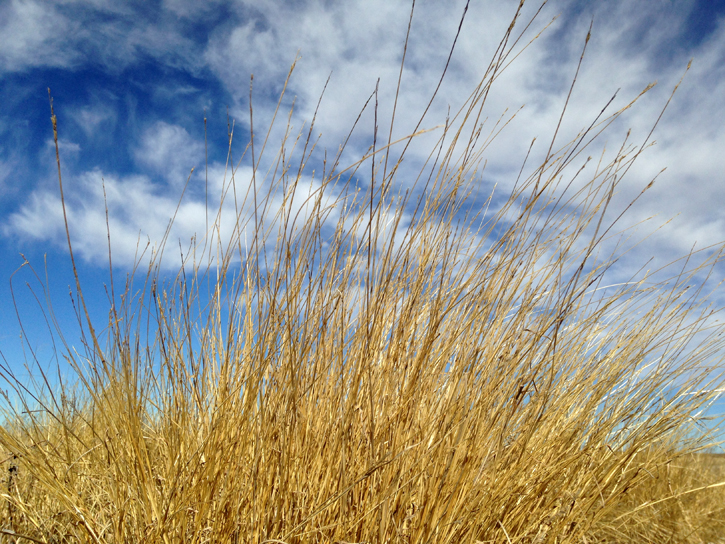
There is a tiny adobe cabin nestled in the sand dunes of far eastern New Mexico. No real road leads to it, just two faint tracks among the mesquite, love grass, blue stem, and cholla cactus. The dimensions are 16 feet by 20 feet with a small courtyard on the south side. A faded blue doorway, three windows, and a small stove pile protruding through the roof. For water, we tapped into a buried stock-tank line that ran behind the dying elm trees of the original homestead. There is a simple shower in the northwestern corner of the cabin, but there is no indoor toilet. By any standard it is Spartan living, but that is the way we planned it.
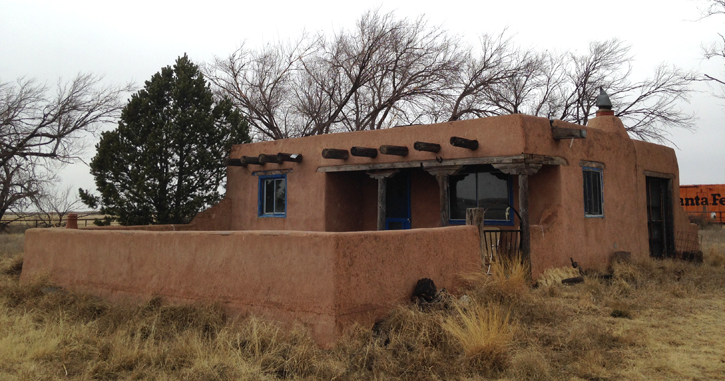
The plan was drawn up in 1987 on an old, oak, kitchen table that I still use as a writing table. Erney, my oldest friend, and I built the outhouse in portable sections in the workshop on the old Broken Heart Ranch, where we lived together for twenty-five years. The vegas, bond beams, and the fourteen inch square column that holds up the roof came from a little sawmill in the Black Hills. It all fit into a battered horse trailer that made it to New Mexico with only two flat tires.
The building site was on Jim Weaver’s newly acquired ranch where I had been spending part of each winter since sometime in the late 1970’s. Jim’s New Mexico Ranch is not what most people picture when they think of New Mexico. There are no mountains in sight. No fancy Santa Fe architecture, arts colonies, ancient pueblos, or timeless Spanish culture. This is hardscrabble Roosevelt County, New Mexico, settled by Arkansas homesteaders in the late 19th and early 20th centuries, organized in 1903, and dried out before 1930. The population had risen to 12,000 by 1910 but was only 6,500 in 1920. When Jim found this place in the 1970’s the land had been long ruined by homesteaders, ignorant of the needs of the fragile landscape. They scratched out farm fields in the sandy soil and begun communities, but by mid-century those fields had blown into massive sand dunes that supported very little life. Most of the people had moved away. The few that remained on the land were practicing a brand of farming that depended on government subsidies and a personal austerity seasoned with skullduggery. There was very little to recommend Roosevelt County, New Mexico to entrepreneurs. But for a few people interested in birdlife it has always been a Mecca.
I was in my early thirties, working seasonal jobs and toiling over my second book about bird migration and the Great Plains. The idea of the book was to travel south with the lark buntings, raptors, waterfowl and meadowlarks. I’d made the trip many times before and I knew that, when I got to Jim’s ranch most of the birds that had left South Dakota, would be there waiting for me. In addition to the migrants there would be the year-around residents: birds like bobwhite quail, road runners, thrashers, white necked ravens, and probably the world’s greatest concentration of lesser prairie chickens. In those days there were tens of thousands of prairie chickens on Jim’s ranch alone and, in my naiveté, I could not see that it would not always be that way.
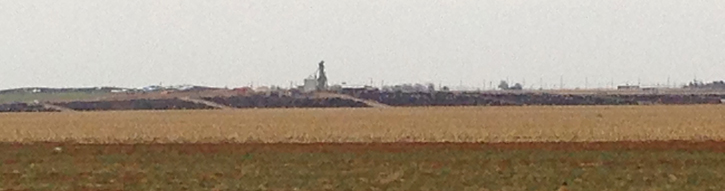
But, of course, environments are always in flux. The few circle irrigators that I passed on my early, eight hundred mile trip from South Dakota to New Mexico seemed like insignificant straws drilled down into the immense and inexhaustible reservoir known as the Ogallala aquifer. The cattle feedlots of Kansas, and the panhandles of Oklahoma and Texas seemed ugly and cruel but necessary to feed the nation. On most years there was at least some water in the playas that the southern plains are famous for. The playas harbored the same sand hill cranes that passed over my home in South Dakota. Of course there were dry years, but there had always been dry years. At first, what was happening over the Great Plains did not register. Few of us understood the ramifications of man-made climate change or the stress that land-use changes can bring.
For the two winters of preparation for building the cabin, I continued to sleep on the ground or on the floor of the abandoned farmhouses. Part of each day was dedicated to tearing down what remained of the homestead where I dreamed my little adobe writing shack would someday stand. I remember laying in a sleeping bag, wearing gloves, as I read “Lonesome Dove” when it first came out. The old buildings were full of packrat nests and gallons of mouse droppings. A little of the old house and barn was salvageable to use on the cabin but most was burned. The days were long and limited only by the shortened sunlight. But mixing physical labor with reading and writing has always been good for productivity. It never occurred to me that I was tearing down what remained of someone else’s dreams to make room for my own.
The next year, after the summers’ work, the drawing of the building plan, and the stacking of the wooden beams into the old horse trailer, Erney and I headed down to New Mexico. There we met Jim Wilmarth who had some experience working with adobe. I flew my falcon at the clouds of prairie chickens and worked with Erney and Jim until I had to go back to a job at some university that I can no longer remember the name of. Erney and Jim went on working and flying their falcons until a rough version of the cabin was completed. We called it the prairie chicken house and I used it in that state of partial completion for several years, until Jim finished and perfected the work. That was in the late 1980’s. It was still raining then. The grass grew in profusion and the prairie chickens were uncountable. Life was good, indeed.
But gradually the rains dwindled. On my path down the length of the Great Plains the irrigation increased. I saw my first cotton field. The landscape of the Plains began to change and the prairie chickens, all over their massive range, began to contract. For two more decades I made an annually pilgrimage from the Northern Great Plains to the Southern Great Plains and watched the line of circle irrigators move north. The feedlots doubled in size. Tripled. The natural playas dried up. I went years without seeing a single sandhill crane. Cotton became the most prevalent crop in the lower part of the trip.
And I began to change too. Some years I was too busy to spend more than a few days with Jim and later his wife Kris and their children. After eleven months with no one using the cabin, the yard would be over grown and mice would invade so that it took longer to get things cleaned up than I had to spend. I was no longer interested in fighting my way through midnight brush to get to the outhouse. The water lines would plug with tree roots. Wasps would come to life as soon as a fire was built in the kiva fireplace. The prairie chickens were all but gone and Jill and I were happier spending our time in Weaver’s comfortable guesthouse with hot water and an indoor toilet.
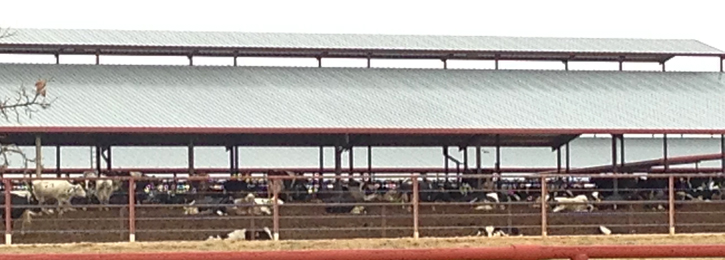
This year we managed to spend two weeks with Jim and Kris. The children, sand hill cranes, and prairie chickens were gone, but much remained the same. Jim and Kris, a host of northern raptors, meadow larks, and quail. But the Weaver ranch is a protected place, for three quarters of the trip down, there was nearly no grass, only huge irrigated mono-cultures of corn, wheat, and cotton. The feedlots smoldered on either side of the road – their fumes creating waves in the prairie light. We traveled hours without seeing a single bird. The towns were peopled with immigrants and seemed dirty and desperate.
But at the edges of his oasis of grass there are now huge, irrigated dairies in all quadrants. Over the last few years they have been lured from California’s central valley where the health and animal welfare regulations are stricter. Their lights rob the night of stars. This year I was finally old enough to measure a difference: bobwhite quail were being replaced by scaled quail, ring-necked doves honked from the mesquite trees, prairie chickens and cranes were mythical beasts.
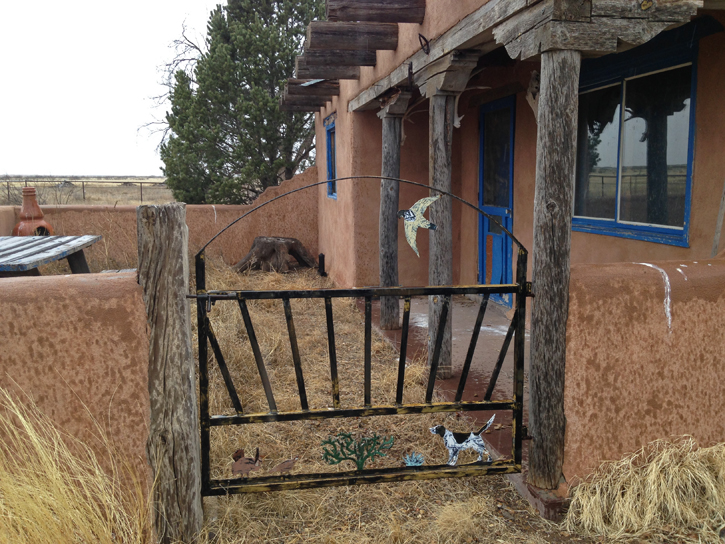
From a distance, the cabin looked unchanged. But the vegas that protruded from the stucco were beginning to rot at the junction with the adobe. One of the wooden corbels had deteriorated and threatened to give up support of one corner of the porch. I had to knee the custom-made yard gate to get it opened. It had all stood for nearly thirty years with a minimum of maintenance and it is well known that a house goes to hell if it’s not lived in. The little courtyard was over grown with Russian thistles and the corner of the once bright, blue front door had been chewed. The rats were beginning their reoccupation.
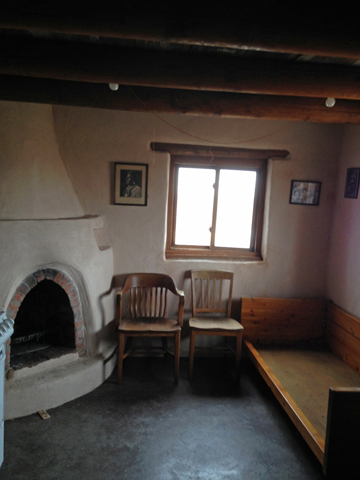
I’d come with a pickup full of cleaning supplies and a few basic carpentry tools but I wasn’t prepared for the mess that met me at the door. A pair of barn owls had taken up residence on the porch. There was a pile of whitewash on the doorsill and a billion dead wasps on the concrete floor. The mice and rats had had their way with everything on the kitchen shelves, the cushions on the couch, and all the bedding. A wave of hopelessness washed over me – what was the use in fighting deterioration. As Neil Young said, “Rust never sleeps.” But neither does the human spirit. This little chicken house was a benign and sustainable incursion on a land where human incursion is almost always devastating.
Four of us built the chicken house. Erney has long since been crippled by a stroke. Jim Wilmarth is dead. Jim Weaver and I are stiff and slow. But I had at least one more heroic effort left in me. Though I was fully aware that heroes are always characters in tragedies, I knelt on the floor of the chicken house and began sweeping up the rubble. I would throw away what the mice had fouled, patch the holes in the door, and fix a broken pane of glass. I would give the place one more afternoon of love, repair the parapets, and bolster the dream for another year.
Comments 17
I met Jim Wilmarth when I worked a hacksite in Montana for the P-Fund, and I think I remember him mentioning this place. I know I’ve read about it in your writings, even details about the gate. Never expected to see photos. I’m sorry to know that it’s deteriorating (“Things fall apart. the center cannot hold…”), but so glad you shared this with us. Long live Weaver’s cabin.
Love it…
would love indoor plumbing tho..
Sad. Beautiful but sad. Thank you for letting me go there with you in spirit.
I love the land and to hear you describe things is almost as good as being
there. I wish I could do more to preserve it or be rich enough to protect a portion of it as you have. Please keep writing. Blessings to you and yours.
Hi Dan,
From the few photos and your vivid description, I love the cabin. Your article really hit home with me, as my husband built a beautiful concrete cabin on our ranch. It’s warm and homey, and I don’t want to ever think of it becoming somewhat abandoned and overrun with critters. Ours is only a few miles from our home, so we are able to use it easily, but find we do not do it as much as we should, so have offered it to friends and relatives to use. It’s benefited both us and our friends and families. They of course love to connect with nature and are awed by the starry night skies, and we find that we do more cleaning up so they can really enjoy the beauty of the cabin. Your article reminded me how much we love our little getaway place, and though we may have started to take it for granted, we will do that no more. Thanks.
Dan,
Your writing gives me great peace and solace. I need to read more of your works, Buffalo for the Broken Heart is still on my bedside. I picked it up at Marlene’s in Tacoma last fall. I so believe in what you are doing at your ranch and am fascinated how the bison bring back the native ecosystem.
The Badlands is such a special place. When I would drive from Illinois visiting my parents, I would go nonstop till I reached The Badlands, sleep on the ground and wake up at sunup on a beautiful morning in that great country. I would love to visit your ranch!
Your latest essay is so descriptive of places I love and also sad. I too have seen the changes in about the same amount of time you have, making the round-trips west to east each summer to see family. First from western Wyoming and now from western Washington.
Humans, at least in western culture, see ourselves as immortal and I believe push that same thought on Earth. Obviously. I was recently encouraged and excited about a series on PBS/Nat.Geo, “EARTH, a new wild” with conservationist, Dr. M. Sanjayan. Maybe his approach and reporting on positive work around the globe to show that humans can work with the nature to the benefit of both will be a renewed call to the public to work for conservation.
I do my best to spread the word, I teach 6th grade.
Thank you again for all the work on your ranch and your writings that allowed me to have a much closer look into the plains landscape and the way of the buffalo.
My dream to always have a cabin!
Dan and Jill, thanks for the two lovely stories. It was a welcome respite this am from the daily routine. So glad to know a little bit more of you both and I so appreciate your great company. Will be trying the Mushroom Compote tonight.
Hi Dan, Wilmarth was a great guy, thanks for rekindling fond memories of adobes, grass, and birds. I’m hoping to visit you on the ranch this summer and see some of my meat while its still grazing. Enjoy the rest of winter. John
Thank you for another inspiring message. Having been involved in restoring an old scout camp (Old Kia Kima), this thought came to mind and to share, while reading your message:
“We shall not cease from exploration.
And the end of all exploring
Will be to arrive where we started
And know the place for the first time.”
… T.S. Eliot …
Heartaches but with hope. Cannot help but think about “The Worst Hard Time” that I just finished reading about The Great American Dust Bowl. Seems some lessons linger while we have ignored important lessons. Thank you for your beautiful words and the pictures they provide.
I live in New Mexico and am well aware of the devastation of the
unregulated dairies. Funny how all the meat, produce and dairy factories(they are not factory farms – they have nothing to do with farming) are in the most remote, poor parts of states with few regulations. They are managed as factories, and the animals are treated as numbered items that produce pounds of this, pounds of that. If these “food” factories were located in and around the people that eat this “food”, suddenly appropriate regulations would be written that would drive them out of business. As long as these horrid facilities are hidden from view, the polluting and emptying of the aquifers will continue. I am so sorry for you – and all the wildlife that surrounded your adobe oasis. You wrote to me once and said “keep up the good fight”. Well, the fight is exhausting, and ultimately in ten minutes a bulldozer can destroy a thousand years of land and water health.
I am so happy that you have your ranch in South Dakota -rich, diverse,
complex, vibrant. Please do keep fighting the good fight…..
For rent?
I would like to see the rough drawn up floor plans. I enjoy seeing how people’s dreams become reality. Thanks.
I remember this little home away from home well. Great article the pictures brought back fond memories for me of times tracking chickens and living in your cabin. I will never forget that wonderful experience. Thank you, Shelley
Dan, I’ve just read Buffalo For The Broken Heart, and it has restored my heart! Your beautiful words of the Great Plains and the Buffalo who deserve them give me hope that the future will be so much better.
Thank you, thank you!
Dan’l., I’ve been re-reading all four of your books on my bookshelf: Autumn Ritual, Equinox, Buffalo for the Broken Heart and Wild Idea. I greatly enjoy periodically inhabiting your world. I am particularly happy to see this essay as it gives me more of a true image of the Grouse Ranch, which, actually, I first came across in one of Steve Bodio’s books, probably On the Edge of the Wild. It was really neat to find two writers who knew and worked with each other, and how I discovered each of them independently. If I were younger (I’m your age Dan and Stephen’s) I’d take up falconry. But alas, I came to know it too late, as with many other things. What age does to a man is to close the door on many pursuits that were never began, and now never will be. But vicarous pleasure can be had until the very end. Thank you Daniel for your being you. And telling us about how it is in those non-fiction works of yours. Give my best regards to your lady. She is a great one.
Correction: Rites of Autumn and Grouse Camp!