Buffalo Bone Broth
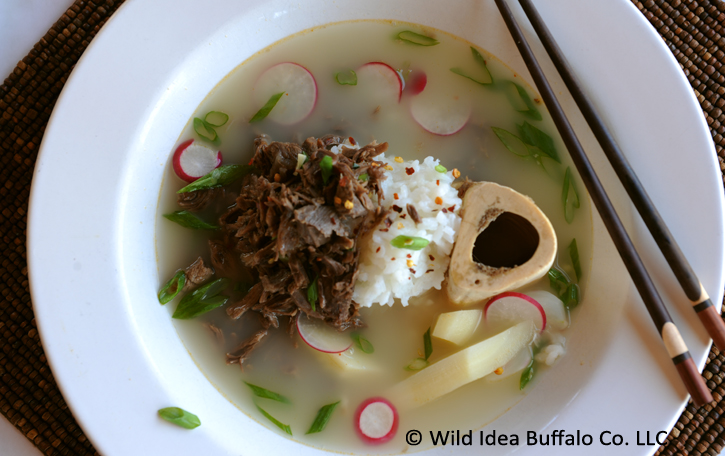
Customers often inspire me to come up with recipes. A couple of weeks ago I was visiting with a women on the phone who was ill, and her doctor had recommended buffalo broth. He suggested boiling the bones for hours because what was inside those bones was what she needed. The health benefits of consuming this magic elixir continue to be proven, including lowering blood sugar levels for those who live with diabetes. Wild Idea Buffalo has a strong following of customers who use the bone broth as preventive medicine. This recipe is a bit of a lengthy process, and will take you two days to make. But, it’s worth it, and it’s the only way to get the maximum benefits of all of the vitamins, minerals, antioxidants, and amino acids inside the bones. You won’t be sorry for the time invested, as the end result is not only healthy, but also super delicious! For preparing, you will want a larger pot as you simmer at a higher heat. This will help keep liquids in the pot. You will also want a heavy lid to keep the steam from escaping. Enjoy the broth alone, or serve over rice with the shredded shank meat.
Ingredients:
- 1 – 3.5 lb. pkg. Wild idea Buffalo Shank Steaks
- 1 – 2 lb. pkg. Wild Idea Buffalo Soup Bones
- Water
- 2 large Daikon radishes, peeled and quartered
- 1 onion, quartered
- 2 cloves garlic, halved + 2 cloves garlic, chopped
- Salt (to taste)
Garnish Options: - 1 bunch radishes, sliced
- fresh grated ginger or pickled ginger
Instructions:
- Wash bones and shank meat under cold water.
- Soak bones and shank meat in cold water for 2 hours.
- Rinse bones again under cold water.
- Bring 4 quarts of water to a boil, add washed bones and shank meat, bring to full boil. Boil for 20 minutes.
- Strain bones and meat and rinse under cold water. Rinse pot thoroughly to remove any fat particles.
- Return bones to pot and add 4 more quarts water. Bring to a boil, and boil for 30 minutes. Add the radish, cover, reduce heat to medium, and simmer for 3 hours.
- Strain liquids into a container, cover and refrigerate. Pull meat from bones and reserve for a later use.
- Return the bones with onion to pot and add 3 quarts of water. Over high heat, bring to a full rolling boil. Reduce heat to medium, cover and simmer for 3 hours.
- Drain the bones, reserving the milky broth. Cover and place in refrigerator.
- Remove the first reserved liquids from refrigerator and skim fat off the top. Return Bones and first reserved liquids back to pot. Add 2 cloves garlic and 3 quarts of water, and bring to a boil. Reduce heat to medium, cover and simmer for an additional 3½ hours.
- Strain bones, reserving broth. Cover broth and refrigerate overnight. (Optional: You may want to save bones for serving.)
- Remove both containers of broth from the refrigerator and remove any fat from the top. Marry both gelatinous broths into one pot, and bring to full heat.
- Season with salt to taste, starting with a little and adding until milky broth has full flavor.Meat Option: While bones are simmering, mix 3 Tbl. Bragg Liquid Aminos (Natural Soy) or Soy Sauce, 3 Tbl. Sesame Oil, 2 Tbl. green onion, chopped + 1 bunch of green onions, sliced, ½ tsp. black pepper and 2 tsp. red pepper flake together. Toss mixture with reserved Shank meat. Add shredded meat to bowl.
Comments 3
Could you help me understand this process? Why so much rinsing? Are valuable nutrients being diminished by the constant rinsing? Also, would it be ok to put the soup bones in a crock pot to cook? This is how I do my chicken to get the best broth. It does take me two days to cook my chicken because I like to skim the fat off the top, plus let fresh herbs marinate in the broth. I’ve never cooked buffalo bones before so your explanation would be greatly appreciated.
Thank you.
Hi Jennifer – The soaking and rinsing process is to pull the blood from the product. The first boiling step removes any remaining blood as well as helps eliminate the frothy grayish film that will rise to the surface. This is a Korean technique which is used to achieve a nice milky broth. You could certainly skip step 4 if you were worried about eliminating nutrients, but the initial soaking and rinsing I feel is important. Anoher option would be to roast the bones first, this would give you more of a brown stock. Thank you for your interest. Cheers!
Hi Jill,
Thank you for the explanation and also the roasting idea. I will give it a try.