*This essay appeared in Patagonia’s recent catalogue focused on falconry. It is reprinted with permission from Patagonia, Inc.
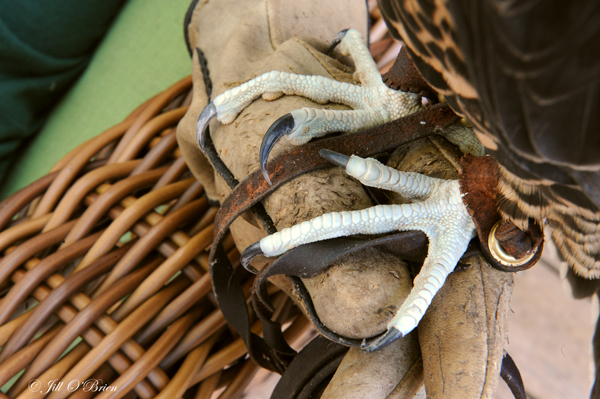
For fifty years my days and dreams have been haunted by falcons, eagles, and hawks. I have been fortunate enough to live close to them. I know the strength of their talons and have felt their surprising weight on my fist. I’ve studied the perfect intricacies of their feathers and smelled their sweat, clean breath.
But anyone who has spent much time out-of-doors knows them too; a dark streak across your path, a spot circling high in a limitless sky, a rush of wings behind an accidentally flushed duck. If you are lucky, you have experienced a frozen instant through a car window, when your eyes meet a cold stare from a fence post. In that breathless flash it is sometimes difficult to tell if the eyes are ferruginous, goshawk, or merlin. There is no recollection of color pattern or body shape. The guidebooks fail us, but we know it was a bird of prey. We can feel it.
Of course we are connected to everything. But with the birds of prey, our connection is uniquely one of envy. Of the great triumvirate of human allies – dogs, horses, and birds of prey – only the birds of prey have remained rooted in the natural world. Our relationship to these three species was originally based in hunting for human survival. These are the species with whom we became partners and the holdover from those ancient days is that dogs are valued for their loyalty, horses for their strength, and birds of prey for their ability to inspire us with a wildness that we have forsaken. While mankind has moved away from their environment, birds of prey have remained part of it.
It is not happenstance that the symbol of many civilizations is a falcon, eagle, or hawk. Their images are cast into coins, shields, sculptures, and elegant jewelry. In his book, “Birds over America”, Rodger Tory Peterson put our relationship with the peregrine falcon into provocative terms. “Man has emerged from the shadows of antiquity with a Peregrine on his wrist. Its dispassionate brown eyes, more than those of any other bird, have been witness to the struggle for civilization, from the squalid tents on the steppes of Asia thousands of year ago, to the marble halls of European kings in the seventeenth century.”
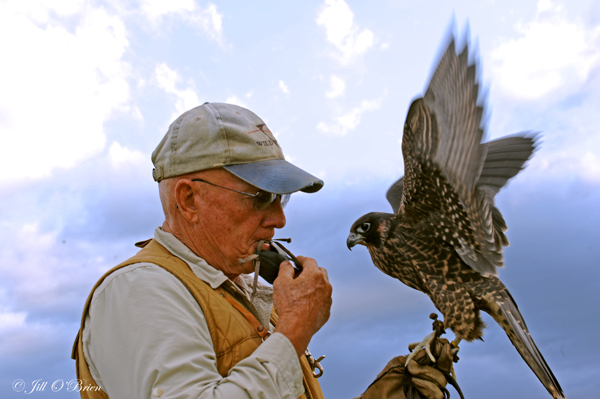
The eyes that Peterson wrote about in 1948 continue to witness our struggle for civilization. While they still observe conquest, invention, and human exertion toward truth and beauty, they have taken on an additional role. In these days of the great environmental crisis, birds of prey have become our conscience and our guides. They choose not to not live in crowded, polluted places. They thrive on pristine landscapes and lead us to what is right and good about the world we are threatening to destroy.
I am forever amazed at the number of environmentally conscious people who were led to their realization of our place on Earth by birds of prey. From childhood I have spent many days at the top of cliffs waiting for a tiny glimpse of a golden eagle or a prairie falcon. I’ve walked endless white-sand beaches and New England woodlots. I’ve cruised the Great Plain in winter, hoping to see gyrfalcons or rough-legged hawks. There have been many companions who have blossomed into scientists, philosophers, visionaries, and eco leaders. Over the years our conversations have been far ranging but, when we found the bird of prey that we were looking for, words always failed us. A thousand times I have been struck speechless to observe a feat of aerobatics, a gesture of dignity, or a sense of nobility beyond the power of man.
Birds of prey are confident and at ease where the Earth is still wild. Follow them into their world. Notice them. Study them. They will call you back to who you really are and bring you to the quiet, beautiful corners of Earth. They will remind you why those corners matter.
Comments 8
Dan: Terrific! When I go out to explore wilderness areas I run into lots of folks who would benefit from help in understanding what yo stated. I tried as a guide several years ago with little success! Your place and you as well as your local contacts would be a terrific place for this as a “sidebusiness”. With some marketing of it the word would get out fast and folks would be beating at your door! Cheers! Jim Hrrick
Such engrossing writing as usual, Dan. They are such magnificent animals. Just received a paperback copy of The Rites of Autumn as a gift, and your article has made me even more anxious to read this book. Thanks for sharing your life. I can always feel the spirit and freedom of nature when I read them.
Dan, My health issues have temporarily curtailed my trips out to your ranch to visit you and Jill, or go rock hunting with my good friend Ernie.
I have been like a buffalo wallowing, except mine has been wallowing in self pity. I cherish the beautiful country out there that you and Jill have been so kind as to let me commune with nature, and I want you to know how much that means to me!!
Also, on an interesting note, we live on a busy street in the heart of Sioux Falls so this was even more amazing. Last week I was filling out bird feeders and I noticed a raptor land in our boulevard maple tree. I sat down and closely scanned the top to the tree with a telephoto lens, and to my delight it was a falcon!!! She was accompanies by a young one that I assume was her young of the year. They sat in the tree for several minutes then she swooped over the street and nailed a dove in our neighbors yard. Then her small offspring flew across to join her and I got to watch them consume their prey. What a gift from nature to observe something so profound in this urban enironment!!
Best wishes to you, Jill, Erney, and the rest of your family, Jim Peacock
I saw the essay in the Patagonia thing, and I’m happy to see it reprinted here. I’m fortunate to live in Montana, west of Missoula, surrounded by farmlands, and I’m only a half mile from the Clark Fork River. All year long, but especially in the winter, every other pole on my morning drive (in either direction) will be occupied by a raptor of one kind or another; red-tailed hawks, rough-legged hawks, etc. Osprey are ubiquitous (even our local baseball team are named the Osprey). And just the other night, waist deep in the river with a fly rod in my hand, a big bald eagle flew over low enough that I could practically count its feathers if I wanted to.
These interactions are always exhilarating, and I never, never take them for granted.
Hello Dan,
I share your appreciation of the great birds of prey. I lived in Iowa until moving to NM 11 years ago. When driving back to Iowa to visit earlier this year I amused myself on the 1100 mile trip by counting hawks and eagles…and I’m happy to report counting 64 on that trip!
You might enjoy an art print called “Spirit Watcher” by Marie Buchfink. It’s hard to find but you can see the images on Google.
I have had this image in my living room for over twenty years and never tire of looking at it!
Have a great hawk-watching day!
A timely essay, Dan. I just sent off a letter protesting the 30 year “take” permit granted to the wind industry to kill raptors at industrial wind sites. Here in Maine our special corners and wildest places have been “claimed” by industrial wind development, thanks to Maine’s Expedited Wind Law. We are lining our ridgelines and mountain tops, the raptor’s air space and migratory pathways, with five hundred foot tall machines. The mortality rate is becoming increasingly problematic, considering these are protected species; hence the special 30-year “take permit” granted to the wind industry by our government. In 30 years, who knows how much wild we’ll have left? We shouldn’t have to destroy all we love in order to protect the planet. We have to speak up for the raptors.
Dan, we live on the Big Sur coast and down here have condors. Once you see a condor flying, you know you have been touched by God. My husband had 5 of them fly over his head whiling hiking one morning and he has never been the same. Rachel Mueller
We love them too. New Jersey is a regular raptor alley, I have seen the whole guidebook in my suburban town, and most of it in my yard. (no golden eagle in the yard, but they do come through here spring and fall).
I have had a peregrine stoop right over my shoulder at shorebirds I was watching right near here.
In the winter our bird feeders are for seed, suet, mealy worm , and bird eaters…..