I am sometimes astounded by how little people know about agriculture. But when I stop to think about the immense demographic changes in the United States since its founding, I begin to see how such a tragic loss of human knowledge could come about. From a country of nearly all farmers we have become a nation of 83% city dwellers. Our rural population declines by about 1.5% every year and with that decrease comes an erosion of the intimacy with land that makes us human.
Before 1960, most farms were small, integrated operations growing a garden and some small grains with a few cows, hogs, chickens, maybe a couple turkeys and sheep. Those animals would roam around the farm all summer, choosing their diet from the vegetative biodiversity offered up by the land. They ate a diet that they had evolved to eat – a lot of grasses, forbs, and sedges that came ripe depending on the weather in that particular year and at that particular location. They ate leaves, and seeds, and insects, and nuts, and berries they found growing on their farm. In the winter they ate forage, mostly in the form of dried grasses that the farmer called hay. The forage was cut from local fields during the growing season. The animals ate excess or waist grain that the farmer couldn’t sell or use for food for his family. They didn’t eat much grain; they did not get terribly fat. The animals moved around their farm and spread their manure (sometimes with the help of the farmer) across the land so that the sun and rain could break down nutrients and dissolve them back into the soil. Energy from the sun worked its way through the plants and animals on the farm, from the microbes in the soil to the final product the farmers ate or sold. Things staid in a rough equilibrium and the biodiversity of the farm was not threatened. That is the way grazing operations like Wild Idea still work.
All that should be common knowledge, but we have visitors to the Wild Idea ranches who ask where the buffalo’s food comes from. Do we replant the grass every year? What do all the birds, prairie dogs, antelope, and deer eat? Of course the only additives to our ranches are sunlight and the nitrogen that the plants pull from the atmosphere. Everything on the place evolved to eat the grass or something else that eats the grass. Our brand of agriculture could be described as the maintenance of the natural biodiversity of the landscape.
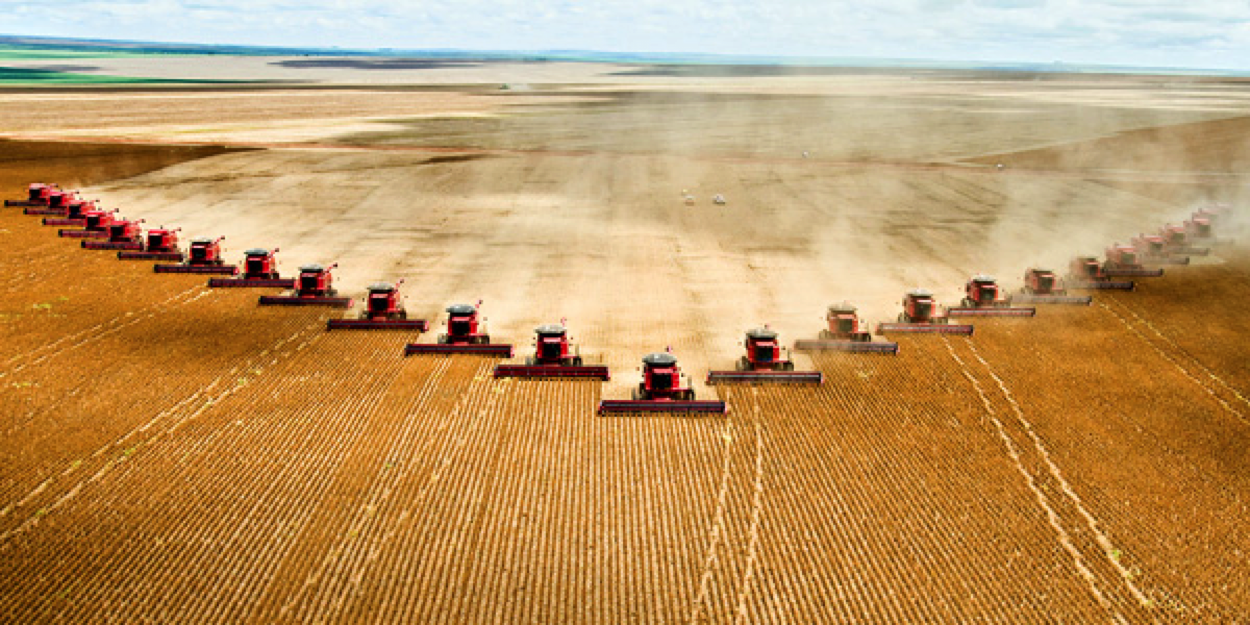
Industrial monoculture farming. Image credit: Beyond Revolution
Then came the use of the technologies that made industrial farming possible. For the most part those technologies had to do with ways to manipulate the natural flora and fauna. Suddenly farmers had powerful tractors to plow up the ground and alter it from a bio diverse farm to a field, where only one species could grow. All other plants, animals, or insects could be destroyed with chemicals or mechanical cultivation. If the natural fertilization systems were destroyed in the process, they could be replaced by chemical fertilizers. Fertile farms became monocultures where tremendous amounts of one crop were grown. Driven by the machinery and chemical companies, legislation was passed to make this transition from fertility to sterility easy and profitable for farmers. They were able to exchange the lifestyle of farming for the businesses of industrial agriculture. The age of the row crops was born.
Row crops can be about any plant that is planted in rows with space left between for cultivating out the wild competitors that steal water and nutrients from the desired plant. The plants are mostly grains. Wheat, corn, soybeans, cotton, millet, milo, and sunflowers are a few that we know well. For a millennia before the explosion of farm technology, humans had been cultivating the soil with hoes and simple tools, but not in the wholesale fashion made suddenly possible by huge hydrocarbon burning machines. Small scale farming of row crops was not as destructive to the environment because it did not have the power to challenge the natural order and functions that landscapes had evolved for millions of years. But in a matter a few decades, hydrocarbon farm technology driven by enabling state and national legislation began to eliminate thousands of species in favor of one or the other of the anointed row crops. It wasn’t long before huge surpluses of these row corps – corn, soybeans, and wheat – were building up in grain bins across the heartland of an increasingly environmentally impoverished America. In the 1950’s and 60’s the huge grain surpluses threatened to destroy the farming economy. Until some economic planner of questionable brilliance and no foresight, decided that the answer to this farm crisis was to feed the surplus to animals. Never mind that they didn’t eat it naturally, they could be forced to learn. No need for a diversity of plants and animals, technology could pull fertilizer from the atmosphere, and herbicides and pesticides could be made from oil. Sure, we sacrificed species of plants and animals, but the markets for food and commodities would sort out the right proportions of inputs hauled to the farms by the millions of tons.
The people who come to visit the Wild Idea ranches are not sure that the markets can be trusted to sort those proportions. They want the worldwide relationships between farming, human health, and the environment to be as simple as they are on the Wild Idea ranches.
The big difference is industrial agriculture’s penchant for dramatically increasing the production of some plants while eliminating the growth of others. This is the age-old battle with what we humans call weeds. Of course one species’ weed is another species life-line and so industrial agriculture’s goal is as much to reduce growth as it is to increase it. It is, in fact, engaged in the unnatural selection of species to maximize profits. The goal of cultivation is to kill unwanted plants and animals. The perfect soybean field has only soybeans in it – no grass, no sunflowers, no insects, no rodents, no birds. This kind of agriculture can accurately be described as the premeditated reduction of bio-diversity. Of course policies that reduce biodiversity are not sustainable and will eventually lead to total collapse of ecosystems.
Jill and I just returned from The North American Sustainable Food Summit. A lot of smart people were there who were trying very hard to figure out a better way to produce healthy food. Much of what they had to say revolved around the labeling of food, and informing the consumer about the sustainability of food. Who among us wouldn’t like to have a simple label on every can, bottle, and package of food that told us if the production of that product was contributing to the destruction of the planet or actually helping to sustain it? There were organizations present that would certify Organic, Free range, Natural, Shade Grown, Humane Certified, Vegetarian, Vegan, Gluten Free, Non-GMO, and more. But there were no certifying authorities that offered to certify the biodiversity of the farms on which the product was raised. What if, at the bottom of every food label, there was one number – expressed as a percentage of the natural biodiversity that remained on the farm after the product was produced?
A package of Wild Idea buffalo meat would read very close to 100%. A bag of genetically modified soybeans would read 0%.
Comments 8
Great Article. You don’t always think of these things as you are scarfing down a bag of chips etc.
Hi Dan,
I enjoyed your monthly writing as usual. I have for 29 years been researching alternative health information for my own survival, I have of course come across all the same issues that you have. Dr Mercola has interviews a good number of the finest agricultural scientists over the years, and I keep on top of all of that. The fertilizers and the pesticides have been killing all the soil organisms for years, and of course they are all necessary to allow the plants to absorb the minerals in the soil which are crucial to plant health, and also to those of us who eat the plants.
Many studies have been done showing that assays of crops of all sorts canned in 1900 had far more mineral contents than today. Apparently there are only 2-5% of the minerals in the crops today that were in the canned stuff from 1900.
GMO corn and soy comprise about 95% of the corn and soy crops now, and all of it is being sprayed with Roundup. The Glyphosate residues in the plants are about 20 ppm now, and the FDA is thinking about raising the limit to 30ppm. Those are HUGE amounts of residue in foods, and the glyphosate is killing more good intestinal bacteria more than bad intestinal bacteria. Glyphosate also causes damage to the intestines of both animals and humans, and sperm counts apparently are about one half of what they were before the GMO foods became prevalent. It looks like animals fed GMO are sterile after 2 or 3 generations. Insects in general, and pollinators in particular, are taking a huge hit, and that in itself is going to be a major problem too.
So everything out there says that you are the farmers of the future out there paving the way for others. I particularly like the fact that your work is supporting the Indians to continue growing buffalo too, by providing processing and marketing for them.
You guys are paving the way to a better future, and may God Bless all of your wonderful efforts.
May the blessings be.
Love, Don
Don,
One your comments really struck a chord with me: “Glyphosate also causes damage to the intestines of both animals and humans, and sperm counts apparently are about one half of what they were before the GMO foods became prevalent. It looks like animals fed GMO are sterile after 2 or 3 generations.” Here in Virginia I grow a very large organic vegetable garden for home use. Last spring I found a new local source for composted horse manure, a nearby riding stable, and I applied it liberally. MY ENTIRE GARDEN FAILED and I was baffled until I learned that the stable fed those horses hay cubes made from alfalfa grown in monoculture fields. Apparently the residues of glycophosphate and other herbicides passed intact through the horses’ intestines and remained toxic enough in the manure to kill my vegetable plants. I don’t know how long it will take for my raised beds to recover, or if they even can. And I wonder if I can trust the advice I will be getting from the local County Extension office.
Dan, one of yr students from Carleton ’09 spring here, & so grateful for this piece.
This is something I’ve been thinking around since I put my experimental garden to bed for Ohio the winter. I’d done the Ruth Stout mulching method using only pine needles & leaves from the yard, & I just uprooted the plants + tucked them in under the composting mulch, which was loaded w/all kinds of neat insects, good moisture, & whatnot. I’m down in the SW for the winter months, & have been up on I-5 in California recently… & there’s, as I’m sure you know, complaints from farmers about lack of water posted next to these endless rows of mono crop w/no companion plants, no grass, no mulch, nothing. Acres, miles of tilled Earth baking bare in the sun.
I went to Native Seeds/S.E.A.R.C.H. last week to start connecting into the ‘scene’ here in Tucson. I talked w/the guy about how most folks in my home food production community rely almost solely on bringing in seeds from growers elsewhere rather than save adapting seeds, consider perennials & self-seeding plants, and paying close eye to what’s already growing there. Underneath, in my mind, I also thought about how much emphasis is placed, preached even, on making big square dark soil widely spaced raised beds, with instruction for spaciousness & orderliness. I had so much fun goofing around w/companion planting this past summer, while my parents continued their years-long effort to cultivate local plants that sustain birds + pollinators throughout the season.
Hm. What I mean to say, really, is I’ve been looking at the organic labels on things in my kitchen (which is me admitting I’ve slept through lots of farmers markets) & being like, “This is not the information I want.” I want to know whether the thing was monocropped, whether the farm has animals hanging around, what folks mean by “ranch”, if the grower is holding a long view for the land & the creatures who also live there.
So thank you so much for articulating this. You continue to be a beacon of a role model for me on my agricultural journey, & we mention the ranch + your story with some regularity in my family home.
A wonderful essay! This is exactly what all farmers on earth should do. There is, however, one final fact that needs to be understood. If all agriculture was done retaining 100% of the natural biodiversity of the land it would it would support far fewer people then are currently on the earth. Far, far fewer people!
Another excellent essay, Dan. Thank you.
Don Meyer’s comment really struck a chord with me: “Glyphosate also causes damage to the intestines of both animals and humans, and sperm counts apparently are about one half of what they were before the GMO foods became prevalent. It looks like animals fed GMO are sterile after 2 or 3 generations.” Here in Virginia I grow a very large organic vegetable garden for home use. Last spring I found a new local source for composted horse manure, a nearby riding stable, and I applied it liberally. MY ENTIRE GARDEN FAILED and I was baffled until I learned that the stable fed those horses hay cubes made from alfalfa grown in monoculture fields. Apparently the residues of glycophosphate and other herbicides passed intact through the horses’ intestines and remained toxic enough in the manure to kill my vegetable plants. I don’t know how long it will take for my raised beds to recover, or if they even can. And I wonder if I can trust the advice I will be getting from the local County Extension office.
So sad! Most of humanity isn’t getting it.
I am dissappointed to read that Germany and the European Union are just about to cave in and allow GMO corn. The Greens are fighting it, do not want American hormone- drenched steaks, chlorinated chickens and genetically altered cornflakes thru the US-EU free trade agreement.
Pingback: Wild Idea Buffalo – Sustainable Practices? | My Meals are on Wheels