Almost fifty years ago I was a freshman at Michigan Technological University. I did not go to the Upper Peninsula of Michigan for academic reasons – not interested in philosophy, mathematics, or engineering like almost everyone else. Those years spent way up north – actually on the Keweenaw Peninsula in the heart of an important copper mining region and hence the home of what was begun as the Michigan School of Mining and Technology – were actually a sort of placeholder for my life. There wasn’t much time for studying. The Vietnam War was raging and a lot of the energy that remained after girls and beer was absorbed by our conflicted feelings about the war and a changing society.
My career as a college athlete did not last much past the first football season and since I had only enough interest in studying to get by, any extra time I found during that first snowy winter and all the falls and springs to come found me outdoors. In the autumn, my friends and I hiked for ruffed grouse and sat stone still, staring into the yellow, orange, and red treetops for black squirrels. In winter, we snow-shoed and cross-country skied. In the spring we canoed and fished the Sturgeon River. Years later, when I finally read Hemmingway’s famous short story, Big Two-Hearted River, I was convinced that the Sturgeon River was indeed the Big Two-Hearted River that kept the hero of the story, Nick Adams, sane in the face of war.
Forty-five lightening years passed before I revisited the Keweenaw Peninsula. I was lured back by local fraternity brothers who, like me, had scattered to all corners of Earth but, in retirement, were filtering back into the Copper Country. Jill came along to see if the college stories had any basis in fact and to see the soggy, forested countryside that had had such a powerful effect on this self-confessed denizen of the treeless, dusty Great Plains.
For two days we ate and drank way too much. The stories of glory days gone by were told, edited, and told again. By the morning of the third day I was 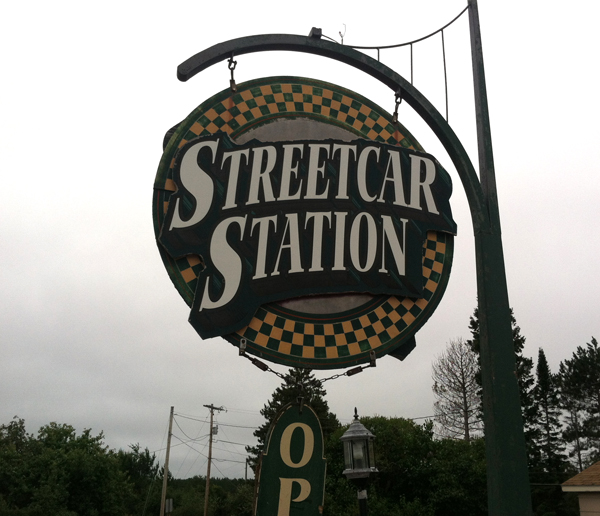 longing for peace and quiet. I could have sneaked away and re-read those Hemmingway stories or the Upper Peninsula stories of Jim Harrison but had only brought along Doris Kearns Goodwin’s book, The Bully Pulpit. It is a great book, but just then, it seemed all wrong. To paraphrase the Cross Canadian Ragweed band – it’s too damned serious and way too long. I needed to get away to the dark, cut-over, white pine forest where there were shady game trails paralleling the Big Two-Hearted River and moss-covered foot paths that might be the very ones that led Brown Dog to the Lake Superior shore. I suppose Jill could see it in my eyes and that is why she came up with a way to get off by ourselves. “We have a Wild Idea customer in Ahmeek.” She said this, seemingly out of context when everyone could hear. “We should go visit them.”
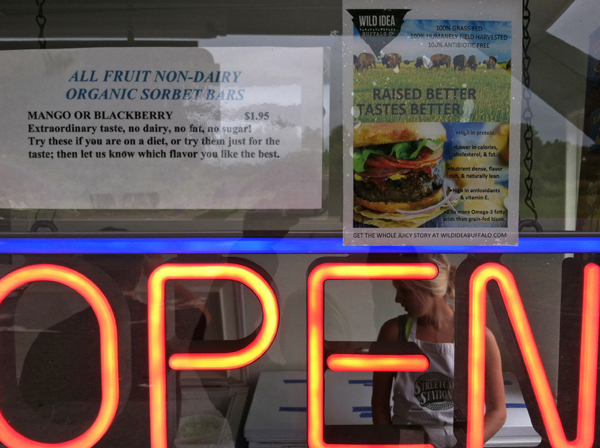 Only twenty miles away was the small Keweenaw community of Ahmeek. It looks like it has seen more prosperous days and that the population has dwindled since the era of big copper. But there are signs of the bustling commerce of yesteryear, a burgeoning tourist trade, and, just beyond the old frame houses, is the wild Upper Peninsula that I hoped had survived the commercial onslaught of the last fifty years. Among the faded houses is the historic Ahmeek Streetcar Station, which features Wild Idea Buffalo meat and delicious, locally-made ice cream. Although the Ahmeek Streetcar Station had always been a small-volume, seasonal customer, they had tenaciously ordered our buffalo meat for years. As soon as Jill and I stepped inside the station we knew why.
Unbeknownst to us, the Ahmeek Streetcar Station is the nerve center for a tenacious conservation group called the North Woods Conservancy. The first person we met was Evan Griffith who had just come indoors from a fifteen mile run. He was a smiling, sinewy, sweating young man who was about to return to Grinnell College to begin training for the cross-country season that would begin in couple weeks. His name rang a bell “You must be the son of the owners,” Jill said.
“I am,” he said. “Jane and John Griffith.” He walked over to a counter covered with literature about the North Woods Conservancy and picked up a familiar pamphlet. It was Wild Idea Buffalo Company’s latest brochure, complete with Jill’s food photography. “Are you Dan and Jill?” he asked.
We sat outside in a cool day that was threatening rain and Evan tried, unsuccessfully, to contact his parents because he thought they would be happy that we came to see them. The meeting didn’t work out, but Evan assured us that they would be sorry to have missed us. After Evan explained that Jane and John were environmental biologists who worked seasonably in California and that they retreated to the Upper Peninsula in the winter, and that they started the North Woods Conservancy to save a few acres of forest and a sizable stretch of Lake Superior lakeshore from development, I was the one who was who was sorry we weren’t able to meet.
We ate buffalo burgers and ice cream and listened to Evan explain that there was very little public land in Michigan. He told us that developers and wealthy people, mostly from Chicago, were buying up the lakeshore and cutting off access to the lake. He brought out pamphlets of the three properties that North Woods was protecting and, as I read about each one, I realized that North Woods was a very small and underfunded conservancy. It was nothing like the multi-billion dollar conservancies that I was familiar with. By my reckoning, North Woods owned or eased only about 230 acres of land – if it was grassland it would be enough for about seven buffalo. Still, it had been a struggle. They had been enveloped legal battles, had a big mortgage to pay off, and their board of directors was made up of only Jane and John. It was the old David and Goliath struggle I had been reading about in The Bully Pulpit – Teddy Roosevelt and a handful of crusading reporters stood up for common men and fought the capitalist trusts. Teddy, and the press that backed him, were a tiny band of souls but huge and powerful when compared to the North Woods Conservancy. North Wood’s had no paid staff, nature-loving volunteers, handled everything.
Evan was bright and passionate about his parents’ battle that he planned to join as soon as he graduated with a degree in Biology. He was earnest and articulate and, even though I knew the complications in his life that would follow his career choice, his energy gave me hope. When we left the Ahmeek Streetcar Station I asked Jill if she was up for a little hike. It was spitting rain but we agreed that we had to drive out to Seven Mile Point, one of the properties that the North Woods Conservancy was working to protect.
We traveled down a gravel road with the U.P. forest closing in a continuous archway overhead. To our right there was nothing but pine trees and ferns, to our right freshly built driveways peeled off toward the shore of Lake Superior. At the ends of those driveways we caught sight of very expensive vacations homes with no sign of life. These were the people that fought the North Woods Conservancy. It was a kind of corruption that stole access to solitude and beauty, instead of the corruption that steals money.
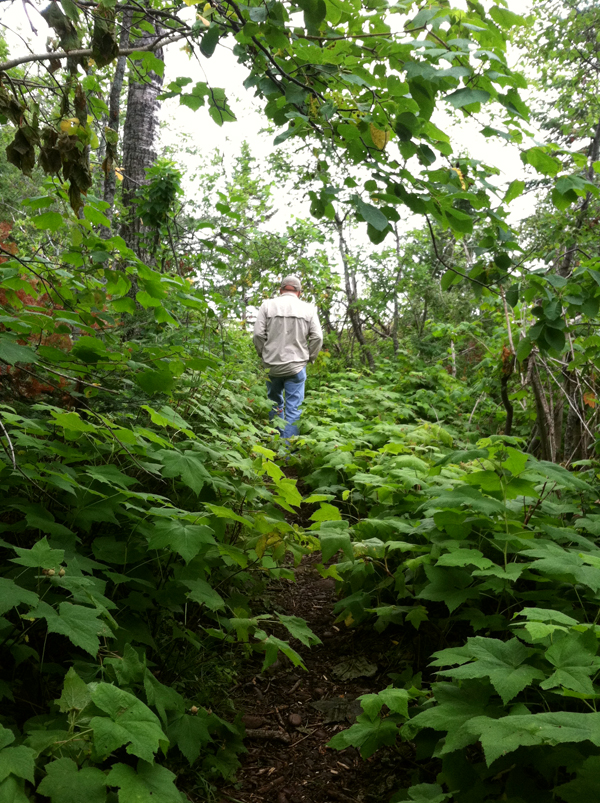
Seven Mile Point was at the end of the road that formed the trailhead for the paths that led to the lake and a cabin that was available to rent from the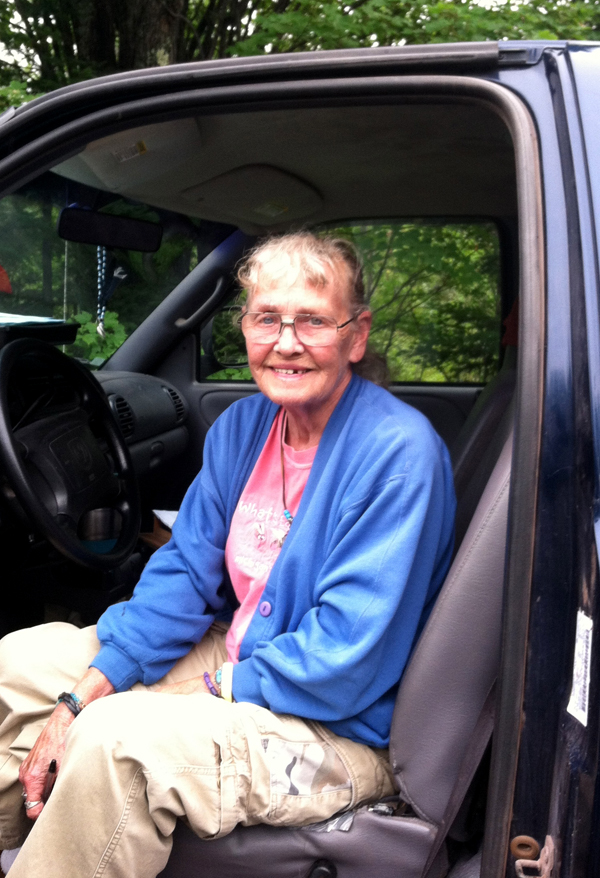 Conservancy. There was nothing but a clearing in the woods, a portable toilet, and an old woman sitting in a pickup truck. Sandy was a North Woods volunteer and she wanted to know if we had paid our entrance fee at the Streetcar Station. We had not paid but, when told her that we had contributed to the Conservancy, she lit up. We only wanted to walk out to Lake Superior and spend a little time on the beach. She beamed to have a couple customers. “You might see an eagle,” she said. “Blueberries everywhere. Heck you might see a loon, or wolf. Deer, bear, ravens all over the place.” She told us about the fork in the trail and that the right leg led to the sand beach and the left to the pebble beach where agates were common. “No,” she said, “no other visitors today. You won’t run into a soul!” She smiled like she was giving us the keys to a copper mine.
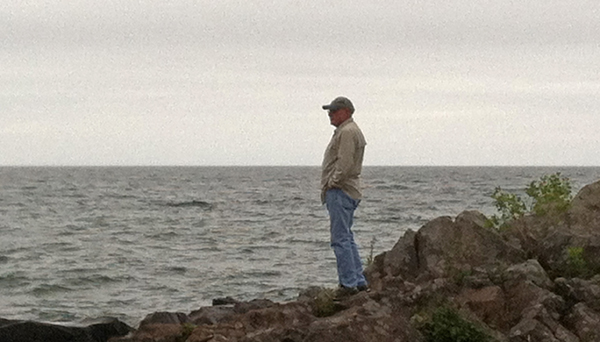
We walked on the beach of Lake Superior between the water and the dark forest. We sat on a huge black rocks and watched the waves crashing against the shore. I thought about Teddy Roosevelt and The Bully Pulpit. At the turn of the last century the railroads, cops, construction companies, and unions were robbing people of their money. Today the descendants of those grafters are robbing the rest of us of some of the things that make life worth living. In the first decade of the twentieth century Roosevelt and a handful of reformers took on the abusers. Maybe change begins with tiny alliances like the North Woods Conservancy, with people like Sandy, and
Jane and John Griffith. Maybe it begins with kids like Evan and Michigan Tech freshmen who need a place to escape to.
For more information on the North Woods Conservancy go to: http://www.northwoodsconservancy.org/NWC/Home.html
Comments 6
HI Dan – Your lovely article brought tears to my eyes, and love to my heart. I too love the wild places, and am aghast at all the harm we are doing to our lovely green planet. More power to you and Jane and John and Evan and all the others like you doing anything they can to save our planet. All the oil fracking and the GMOs are my biggest worries right now. The idiots are going to start using 2,4D in addition to Glyphosate now to kill the weeds. The dioxins from 2,4D are apparently what made all the soldiers sick in Vietnam, and what is wrong with the executives at Monsanto and Dow Chemical who are doing all this bad science which kills the soil and us too. About all I can do is send lots of emails signing petitions to further the good and stop the bad which comes in from all my connections on the internet, and write to my senators and congressmen to fight the bad stuff and help the good stuff. I still hope to someday visit all of you on the ranch and meet you in person one day. I just love all of you, and thank you so much for all that you are doing. My best to all of the folks who work with Wild Idea Buffalo Company.
Love, Don Meyer
I venture from SE Michigan into the Keweenaw as a volunteer pilot for a group called Wings of Mercy, bringing patients to and from places like the University of Michigan in Ann Arbor to get treatment unavailable in the UP. Your recounting of your recent trip was beautifully written and your sentiments are appreciated. It is amazing to me how often my locally-based copilots have rarely been in that part of world — a 10-hour drive from Detroit. Whenever possible (after grabbing a pastie, which someone should make with buffalo!) I fly them low and slow (and quietly) around the Keewenaw Penninsula then up along pictured rocks. They are stunned that this part of their home state has always been there, yet they never knew. Thanks for your sharing your experience with us.
I loved your article about Michigan’s Copper Country. My husband of almost 50 years and I met on Isle Royale in 1963. We’ve loved the Island and the Keewenaw ever since and try to travel there every summer. We live in Grinnell, Iowa, the home of Grinnell College, of course, and have been cusomers of your for quite a few years.
We shall find Evan Griffith and learn more about North Woods. Next time we head for Houghton, we will be sure to include Ahmeek on our itinerary and have a buffalo burger at the Ahmeek Streetcar Station. We’ll also be donating to the conservancy. The work the Griffiths are doing is so important.
We have a group of “Isle Royale friends” who will be interested in this information, too. I’ll see that they get it.
Thank you for bringing well deserved attention to these hard working unsung heroes; it does give hope for the future.
Dear Dan and Jill,
We were so glad that Evan was at the Ahmeek Streetcar Station when you dropped by this summer, and disappointed that John and I were not able to get up to Ahmeek to meet you. Your business model at Wild Idea Buffalo perfectly matches our personal (conservation biologist), professional (Griffith Wildlife Biology), and business (Ahmeek Streetcar Station) philosophy! We are familiar with Dan’s books on peregrine falcon recovery (we work with endangered songbirds in the southwest), and had considered buying a buffalo ranch in the Black Hills before moving to the Keweenaw in the late 80’s. I’d say we have a lot in common.
Thanks for spreading the word about the North Woods Conservancy and Seven Mile Point. We and others (we have a 5 member board, with 3 active board members currently) have been working on protecting parts of the Keweenaw since 1992. Our biggest project successfully protected the Gratiot River County Park and Addition (over 200 acres and 8,000 feet of Lake Superior shoreline) at no cost to Keweenaw County. This includes the mouth of the Gratiot River, which has traditionally been a favorite picnic and camping spot for Michigan Tech students.
Other successful projects include Merganser Pond, a 400 acre wetland east and south of the entry roads to Seven Mile Point (you caught a glimpse along the first 1/2 mile of Sunset Bay Road), and Conglomerate Falls, 120 acres with 3/4 of a mile of the Gratiot River and the upper falls and conglomerate hole complex, and the rental cabin.
All in all our small local conservancy has helped protect over 1,000 acres and more than two miles of Lake Superior wild shoreline. There are nesting bald eagles (two young raised this year), merlins, and sandhill cranes, loons, mergansers, geese, ducks (including wood ducks), the occasional visiting peregrine falcon, bears, wolves, fishers, pine martens, river otters, foxes, coyotes, beaver, (too many) deer, turtles, frogs and all types of habitat, from cedar dominated forested wetlands, upland red and white pine forests, mixed boreal hardwood transition, to beaver floodings/marshes, and red osier dogwood/sweet gale/alder/mountain maple swamps. And of course the basaltic bedrock and agate-rich cobble along the shore, as you and Jill saw at Seven Mile Point.
Seven Mile Point will most likely take another decade to protect. Thanks to donors like you and the Tabberts, we are inching towards our goal of 500 donors of $120 each for 2014. Our SMP 500 Heroes donate $100-$125 annually and help pay down the mortgage; at this rate it will take 10-15 years to give the Point full protection. We are into year 3 and so far so good!
We look forward to seeing the O’Briens in the Keweenaw again; you are welcome to stay in our Ahmeek Streetcar Station vacation apartment anytime. And I have a feeling Evan will be visiting your ranch.
All the best,
Jane Griffith
Thanks so much for these thoughts. No surprise, but it is really great and validating that you so deeply “get it”. We had no idea that you had any connection to the Keweenaw, or that you were the author of “The Rites of Autumn”; we just wanted to serve buffalo at AhSS and discovered WIB and loved your philosophy and wanted to help re-wild (re-buffalo) the Great Plains. Seems like our paths crossed unknowingly several times, so it was just great that you and Jill stopped by. Thanks for suggesting it Jill. Very sorry to miss you, but maybe it was better that Evan was there, so that you could hear it from him (if I had been there, well, you would have heard it from me!). I am inspired by Evan and Kate (2 years older, volunteered full time for the NWC in 2012-2013) and their cohort – lots of energy and caring and action among them.
The NWC has 5 Natural Areas (total = 715 acres with 2,354’ of Lake Superior shoreline): Dore Woods (80 acres), Gratiot River North (83 acres with 500′ of LS shoreline), Merganser Pond (400 acres, including an extensive rich wetland complex), Conglomerate Falls (120 acres with about ½ mile of the Gratiot River), and Seven Mile Point (32 acres with 1,854’ of sand, bedrock, and cobble LS shoreline). We also like to claim the Gratiot River County Park (222 acres with 8,489’ of LS shoreline) – the NWC got GRCP for Keweenaw County at no cost (to the county); it’s where most of our debt ($677,000) came from. So our “total” is nearly 1,000 acres and just over 2 miles of lakeshore. For more details visit: http://www.northwoodsconservancy.org/NWC/NWC_Natural_Areas/NWC_Natural_Areas.html
The NWC currently owes about $845,000, which is A LOT for our little group, but almost nothing compared to the market value of what we’ve protected, and miniscule with regard to the ecological or long-term value. Also a rather small amount in any other location, but remember Keweenaw County has about 2,200 residents. Total. Really.
The debt was supposed to be retired with federal conservation grants that were awarded to the NWC (after state-wide and nation-wide competition/ ranking) and that only needed to be “passed thru” the MI Dept of Natural Resources, but the state gov changed and the MDNR refused to pass thru the funds. Major setback.
At that point, the NWC could have sold SMP and retired the debt, which of course would be contrary to the whole idea/purpose/philosophy of the NWC, so after much deliberation the NWC Board decided to try to pay off the (unexpected) debt over time, like a standard mortgage. Jane and I put up our own property and co-signed the loan to make it happen. We figured that with so many people around who love the Keweenaw (MTU alums and all), we could pretty easily find 500 people to donate $10/month each to service the mortgage, and for 3 years now we have done so, but it’s been harder than expected. The first 300 are pretty easy; after that there is increasing effort and diminishing return. Right now we’re short about $18,000 (150 $120 donors) for 2014. We thank you so much for helping to spread the word.
Some very minor clarifications to your blog, just for the record: 1) there is much public land in the UP, but very little in the Keweenaw Peninsula itself (because it was all private timber company land that is now out of stable long-term management ownership and is being sold off/ developed, especially the parts used by the public for years). 2) As detailed above, we have protected about 1,000 acres (32 buffalo?). Still very small, still very underfunded. And we are, as you point out, an all-volunteer organization, which means that 100% of any donation goes to land acquisition. 3) Several of the owners of the big homes on Seven Mile Point Road are NWC members / supporters. 4) The NWC Board includes me, Jane, Robert Pence, and Ruth Mohr. There are 3 vacancies. 4) The NWC cabin for rent is at Conglomerate Falls, not at SMP. The cabin rental proceeds help pay the mortgage.
http://www.northwoodsconservancy.org/NWC/CF_Cabin_Reservations.html
Also want to comment on a major area of agreement (one of many!): Without accessible wild places, we will lose the public will to help protect them (or even care about them). Many MTU students spend a night or weekend down at the “mouth of the Gratiot” (GRCP), which would not exist without the NWC, and the experience changes them. So yes, as you say change does begin with tiny alliances and “escape” experiences. If everyone protected their own backyards and just did what they can, in the face of seemingly insurmountable problems… working together, big changes are possible.
In that vein, the NWC needs help, and we welcome all support. I hate to always be beating the donation drum, but… If you’re reading this, can you be one of the 500 and pitch in $10/month? Just click on the “Donate” button on the NWC home page, fill out the “Donation amount” (any amount), and check the “Make this Recurring (Monthly)” button if you can. Or just do $120 annually (for me, $10/month is painless). I know that I get a lot of satisfaction knowing that these places exist, and that I am contributing to keeping them intact. I literally lie awake at night sometimes and am calmed by picturing what is going on at the NWC Natural Areas. As a conservation biologist involved in endangered species recovery and management, I know that what exists is very very difficult to try to reproduce once it is gone. Trying to put a value on a single black-throated blue warbler nest, or otter den, or stand of ladyslippers, or turtle nesting bank, or bald eagle nest, or pine marten (all of which and much more exist at NWC Natural Areas), with all the ecological processes and habitats necessary to make their existence possible, is next to impossible. It is a wonder that these places and the plants and animals on them even exist. That we have a chance to acquire them is amazing. That it takes only 500 of us giving $10/month… so doable.
Dan, thanks so much for coming up to the Keweenaw. Sorry we missed you and Jill, but glad you met Ev. Thanks for your thoughts and for featuring SMP and the NWC. We are energized and gratified by your thoughts and support for the NWC, and by your life’s work. Hope to see you in SD sometime!
John
P.S. I found out about your blog/ this post from Barbara Tabbert, who lives in Grinnell! Also a WIB customer, and someone with ties to Isle Royale / Keweenaw, and a new NWC member : ) Talk about small world / full circle!