The trip back from a grazing seminar took me right through the center of the Black Hills. Jill was in the seat beside me, but we didn’t talk much. We were all talked out from spending most of the week in a classroom setting considering a holistic way of looking at buffalo grazing on the Great Plains. There were a dozen other people in attendance and so there was a lot of talking.
It was a late winter afternoon and the roads were deserted. We were content with watching the Black Hills grow larger in the windshield. When Jill fell asleep, I turned on the radio but could only find a few country stations. I fiddled with the dial until I found one that played the old, classic stuff. Johnny Cash was walking the line, Bob Wills was singing about the yellow rose of Texas, and I was flipping back through the ideas in the grazing seminar. A lot of the topics concerned how grass grows and how buffalo eat it. That process is more complicated than you might think – it has a lot to do with the symbiosis that results from co-evolution. There had been a few “Christians” in the class and I wondered how they squared their professed faith with the evolutionary bedrock of life on the Great Plains.
Soon after Jill and I entered the Hills, we passed through an 83,500 acre area of forest that burned in 2000. It was called the Jasper Fire and it burned hot and fast through country that I had surveyed 30 years before for peregrine falcons. That evening we drove through miles and miles of barren slopes. The hills looked like the Land of Oz where the wicked witch lived, but I noticed scores of white-tailed deer grazing on the grassy slopes between the charred remains of ponderosa pines. We did not find peregrines back in the 1980’s but we spent weeks walking the bottom of Hell Canyon and, in all that time, I didn’t remember seeing a single white-tailed deer.
The Jasper and Hell Canyon area isn’t a grassland, but some of the same concepts that we talked about in our grazing seminar 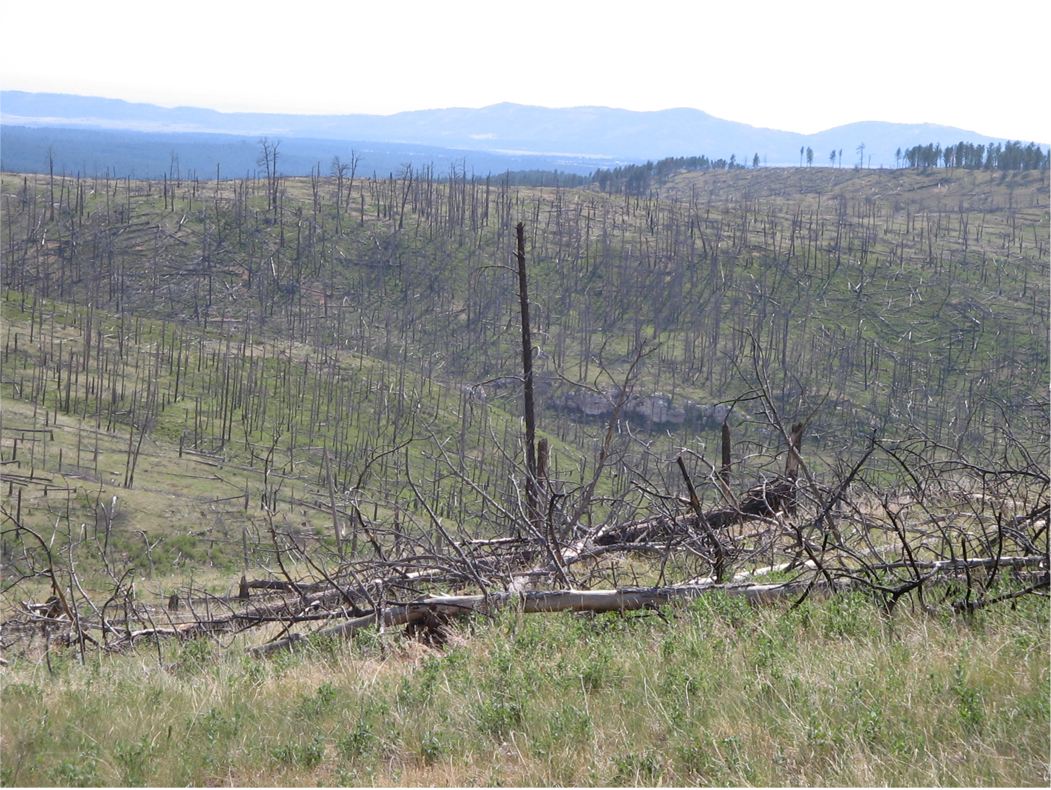 applied. Plants and animals have a natural succession in the way they regrow after devastating events that are common in natural settings. In the eyes of humans, fires, floods, and droughts are catastrophic, but nature simply begins again. Life forms with the lowest requirements stand ready to lead the charge. Years before, the Jasper fire area had begun its comeback with small annual plants. Those plants began to stabilize the soil with their roots and more complicated plants had gotten toe-holds in an empty environmental niche. The perennial grasses that the white-tailed deer were munching on came next. Now they were giving way to small brushy plants that would eventually allow the ponderosa pine to re-start. It was the same with The Green, Green Grass of Home that Porter Wagoner was singing about on the radio. Most prairie plants respond to stress by growing vigorously. One of the main concepts of the grazing seminar was that Great Plains grasses need the grazing stress from large herbivores. Those grasses were originally dependent on the pressure of the buffalo as the buffalo were dependent on them.
The wolves and grizzly bears were dependent on the buffalo, and the coyotes were dependent on the larger predators. Everything broke down the sun’s energy that was stored in the plants and animals – the prairie dogs, the snakes, the toads, frogs, and all the ground nesting birds. Even microbes preform the job of getting that energy back into the soil so it is available for the grass roots. The last hour of the grazing seminar we talked about biodiversity and it didn’t seem like enough time.
The rest of the week was spent figuring out the best way human beings can siphon off enough of that energy to survive. The takeaway of the seminar was that, for better or for worse, corporations and small businesses had become an indivisible part of the process. I couldn’t help wondering if business had become part of the diversity of processes on the Great Plains?
I was saved from my thoughts by the Statler brothers, singing about Flowers on the Wall. That song has been making me smile for 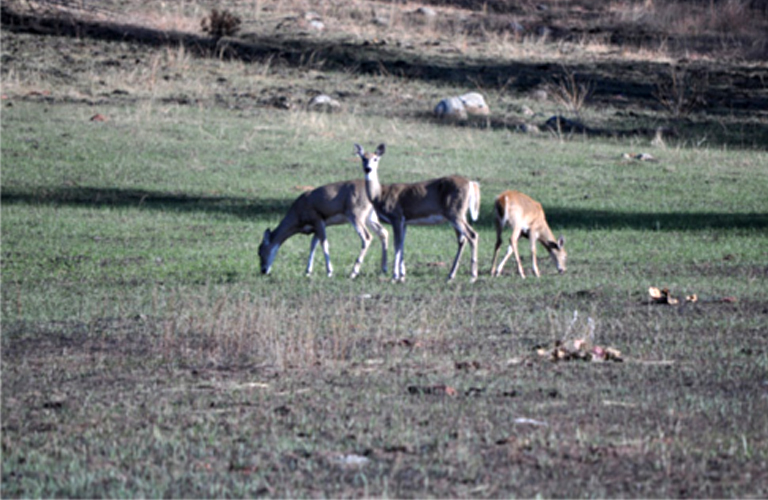 forty-five years. Like so much of what is humorous, a song about a lonely man “counting flowers on the wall” has its dark side. “Smoken’ cigarettes and watching Captain Kangaroo” is something too many of us can understand and it had me singing along until we got to the chorus about “playing solitaire ‘til dawn with a deck of fifty-one”. That line stopped my singing. It was as desperately defiant and foolhardy as living on the Great Plains with part of the diversity missing.
It was pitch dark and we had made it to the east side of the Black Hills where the prairies begin again. I know better than most that all metaphors are crippled expressions of important ideas, but the image of the Great Plains as a deck of cards will not leave me. It takes every card to have a chance at being successful at the game of life on the Great Plains. It just won’t work if someone is destroying cards. And I don’t think it will work to substitute business cards for aces and kings.
Comments 14
I enjoy reading your writings on your website. You always have been a thinker!
what a surprise to see your comment. love you JW
Love this, Dan. The old songs and their metaphors of the Great Plains. So apt.
I always enjoy your thought process and am absorbed in the style of life you want to live. Sadly not enough people are listening.
Hi Dan. I always look forward to your monthly stories and love what you guys are doing. I hope that you will continue to elaborate on what you are learning about sustainable grazing practices for bison. I’ve read many books that discuss holistic grazing practices as it relates to domestic livestock but never for bison or mustangs. I love how sustainable practices can re weave the web of life and bring back a slice of what has been lost over the years. The prairies were once the American Serengeti and supported millions of creatures, not just cows and corn.
Read this aloud to my husband as we sat before the fire and dreamed of another trip to the Black Hills. Always share your writings on the website.
Good to see some familiar names, and nice to know I’m not the only one that remembers the Staler brothers. Appreciate the comments and support.
Started my morning reading this insightful blog. I was startled by how closely it synced with the new series “Cosmos” that aired last Sunday. Everything is connected and related. You are ultimately giving a gentle hand to the cosmos with your work. Thank you from California.
Reading “The Spine of the Continent” right now. It’s giving me a lot to think about and ponder just like your essays do.
thanks!
The line from the song, …”playing cards until dawn with a deck of 51,” made me think of how we are blindly going hot and heavy on the fossil fuel bandwagon, cheerfully ignoring the fact that it isn’t going to work out in the end.
Thank you from Washington state.
Your inturration of the Statler Brothers song is great Dan, Ilove it thank you. My wish is that science and those at the top would get their act together and solve the Brucellious problem in Yellowstone and keep those acient genes of those bison to add to the meat we get from Wild Idea. Thanks a bunch
Bob
As usual, mesmerized by your use of ‘words’ and also by your reverence of the ‘earth.’ As an observer of global warming and it’s still unknown impact on all we know and love, see and eat, and collaborate with, it is coming whether we understand it or not. It will be an interesting unfolding as we and then our children’s children learn to live with what transpires, just as we have done with the destruction created by our own antecedents! Keep writing and keep thinking!
Dan (and Jill),
This article caught my attention. I’m a retired forester(and soil scientist) now living in Florida. The wildfire that burned hot enough to wipe out those Ponderosa probably burned too hot to allow for any pine seed to survive. Have you noticed any natural pine regeneration?
So Dan, it is. Business, religion, they are all now part of the energy flow diagram. It is just a much, much larger tribe.
So, are we a card short, or is there just an intentionally “missing” card. Who has the card that seems to be missing? A thief perhaps. How can we get it back?
So that leads me to the most critical question of all. How is the grass. Seems like a lot of water all over lately. It starts with the grass.