The Sunday after Thanksgiving, just as the sun was lightening the sky, I sat in my pickup truck on an enormous flatland above the Cheyenne River. I had just finished flying my gyrfalcon, Sally, and she was happily having her breakfast on the ground beside the truck where I could keep an eye on her and frighten off predators that might see her and move in for an easy meal.
Usually, I sit beside her in the grass as she eats, sharing a little time with her. She enjoys taking her meal in the fresh, clean, Great Plains air and every morning that I could, I tried to be with her, to simply be quiet for an hour before my day got crazy. But that day, I sat in the truck for two reasons: first, Thanksgiving had assured in a blast of cold air that I was not yet acclimated to, and second, there was a story on NPR’s Weekend Edition that I wanted to listen to.
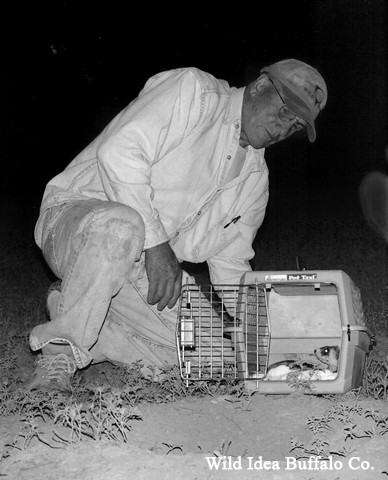
Releasing Black Footed Ferret
Being an arctic bird, Sally was loving the fifteen degree temperature and the fifteen mile per hour wind. She stood proud and defiant, facing the wind and clutching the last of this year’s migrating mallards. Her eyes were large, solid ebony, slightly squirted, and unblinking into the sun that was now a full hand above the horizon. On that distant horizon, on the other side of the Buffalo Gap National Grasslands, in the area called the Conata Basin, one of our buffalo herds moves through native grass like a couple hundred tiny, black phantoms of the forgotten past.
At six o’clock that morning NPR had gotten my attention by mentioning the very land that I was looking over. They had promised to talk about the black-footed ferrets of South Dakota’s Conata Basin. Now, as I watched Sally watching the very land that Elizabeth Shogren was talking about, I began to recognize names of people and places that I knew well. Randy Griebel, Travis Livieri, Dean Biggins, Badlands National Park, an assortment of mesas and drainages. Elizabeth Shogren was talking about the center of our nation – my stomping grounds – a place where I could travel, literally for days without seeing another person. I’ve never been shipwrecked but now have an idea what it must be like to be rescued.
Thirty years before, I drove the same trails and ridges that Elizabeth described with a biologist who only found a few ferrets in his entire career. In the first six years of this century, when the ferrets were doing well, I rode them again with biologists Randy Griebel and Travis Livieri. We drove in total darkness listening to the likes of Eddie Van Halen and watching for green eyes. I helped trap them, measure them, and give them physicals. I touched them and smelled their musky scent. I stared at them and tried to understand what it would be like to teeter on the edge of extinction.
Here is what I learned about ferrets that some people may not know: Thrilling as it is to spot the green flash of their eyes, magnificent as they are to behold, they are most precious for what they represent. They stand in for all that is wild; the coyotes, the swift fox, the burrowing owls, the badgers, and thousand other species. They are a piece of something much greater than anyone alive today has ever seen. And, when our Wild Idea partner bought some ranch land in the Conata basin and began running Wild Idea buffalo on it and the associated federal land leases that supported the ferrets, another piece snapped into place.
Now, when I look east from where Sally caught that last duck of 2013, there is nothing but active ferret and buffalo habitat far beyond the reach of my 10 power binoculars. Buffalo and ferrets both love prairie dog towns and now, over a 100 years later, they share those prairie dog towns once again. It will not be easy, but soon a myriad of other species might coalesce like a farmer’s market coming back together after an explosion. If they do, Wild Idea Buffalo will be part of that happy reunion.
I loved Randy and Elizabeth’s voices when they saw the flash of green eyes in the blackness of the Conata basin. It is impossible to not be excited when you see that vital, unique pinpoint of green. It is very like the eyes of buffalo in the inky night. It is wildness and it holds a special place in the annals of American conservation thought. Aldo Leopold famously described it in his essay, “Thinking Like a Mountain.” It was a different time and he was a different kind of biologist. He was a pioneer of conservation and, in a way, the great grandfather of Randy and Travis. In those days the equations were simple and often wrong. Back then, it was common for biologist to shoot wolves in the mistaken belief that less wolves meant more deer. Leopold was one of the first to correct the equation. The last wolf he shot showed him something different. “We reached the old wolf”, he wrote, “in time to watch a fierce green fire dying in her eyes. I realized then, and have known ever since, that there was something new to me in those eyes – something known only to her and to the mountain.”
If you substitute Conata Basin for mountain, you get the sense that I got on that first morning after Thanksgiving. I heard the excitement in the voice of a sophisticated NPR commentator when she said, “I spotted a flash of emerald green”. I felt that a corner had been turned. Maybe someday the Conata Basin will be interesting to more than just a few lonely biologist and a tired old falconer. Maybe someday more people will come to realize the importance of seeing that fierce green flash in the eyes of black-footed ferrets, and the revival of swift fox, burrowing owls, badgers, antelope, and the buffalo.
Comments 13
Y’nailed it again, Dan. Thanks.
My daughter in NC and I in Texas both listened to that show and emailed each other about how good it was and how excited we were when we were privileged to see one of the ferrets during our trip to the Badlands a 18 months ago. It is so good to hear others in all manner of careers and exposure appreciating the efforts of so many conversationist (including Wild Idea Buffalo) in this amazing collaboration as the plains return to health.! Cudos to all of you!
Dan — thanks so much for your vision and your art. I’ve handled falcons, been engaged in protecting prairies, even trapped a ferret. My mind and heart know and feel how precious these wild things are, but the voice you give to them is so unique and incredibly inspirational.
Dan..the Badlands of SD are right at the top of our favorite places in this wonderful state we call home. We try to drive through each time we travel across the state…looking for anything live..but also the beauty of the place..different every time we are there. I look forward each month to your writings.
Once again you raise my awareness. Thank you, Dan. Love the writing and what you do for all of us.
Wow Dan!
Another incredibly uplifting and beautiful article. May the green eyes fire your heart until your last day on earth. Keep up the good work my friend.
I just finished eating my dinner of organic veggies and Wild Idea Buffalo Stew Meat, which is the purest protein left on the planet.
I put you and all your dear ones in God’s loving hands.
May the blessings be.
Love, Dan
Thank you Dan , for your all your writings ,difficult for me to translate because I am French,( i live in the center ,département de l ‘Allier ) , but even I can’t understand something ,I can feel the emotion and the love of nature in your articles , because you are a great writer .
Your books have enchanted my life and I wait for the newsletters every month, thank you for your exemple and all you do for us.
Just amazing. Wonderful. Let us be Leopolds no matter if we have small backyard gardens or thousands of acres.
I’ve spent much of my time studying and marveling the resilient flora and fauna of Conata Basin, and I have experienced that magnificent “green flash” and felt that thrill. I so support and celebrate these words.
Pingback: Thinking like a Mountain | Michael Forsberg Photography
My throat is choked and my eyes with tears as once again I read your magnificient renderings of wildness. I am very thankful for you and what you are doing to preserve this earth. The return of the plains to “life” is such a great endeavor. I, like so many others, look forward to this respite each month.
Think of you guys often, for good reason!!
Dan, the Leopold passage prompted me to re-read the passage in Spirit of the Hillsabout the Egan’s killing and attempting to bury the wolf.
When my students read your novel in the 90s, I’d like to think their attitudes about wild things were changed in lasting ways as they understood why McVay cuts down the wolf’s body and races away with it. Thanks, for reminding me, Dan.