Keynote given at the National Museum of the Bison on National Bison Day – Nov. 2, 2013
It’s an honor to speak to you here at the National Museum of the Bison. Good to see old friends and colleagues in the audience. It’s like a homecoming: federal and state biologists, TNC folks, bison producers and supporters that I’ve known for decades. Good to see you all. And a special tip of the hat to Susan Ricci who started the museum here in Rapid City – what a year and half ago. It took a lot of guts and she’s done a great job of explaining the Bison’s story. If you haven’t already looked around at all this information, do it before you leave. Thanks Susan, this is a real service to all of us who are connected to bison.
National Bison Day is a special day for all of us here, but also for the entire country. This is not a day honoring just another animal or kind of meat. This is not like national chicken day. This day honors, yes, an animal but also a spirit, an idea, a way of life that is uniquely American. We are here to honor an integral part of our North American ecosystem – an emblem of wildness, the Great Plains, and the very life of North America. 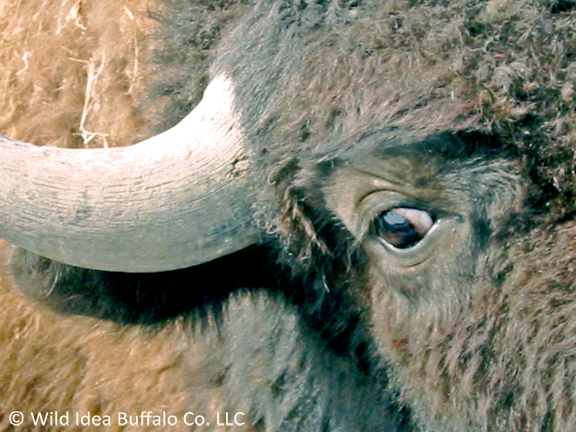
Bison have always been the connective tissue between the humans and the rugged land where we all live. Some nights, when I step out onto my ranch house porch, I am met by the immense, roiling waves of color from the northern lights. But in other seasons I find coiled rattlesnakes or perhaps a wind so cold that skin can freeze in minutes.
By any economic ciphering, choosing the Great Plains for my home has caused me to slip behind my contemporaries who chose New England, or California, or the hills of Georgia. Still, like loving a drunk, I had little choice. For over forty years the prairies have been my home and I’ve shared them willingly with all of the species that also called them home. It took many years for me to understand that this place is not only a chaotic jumble of species clawing at each other to assert themselves, but a complex web of life clawing to keep its balance. I love the wind that stokes me as I sit on my front porch, even when it is too cold to endure. It is the wheezing breath of a single, huge, living thing, and I am a part of it.
For the years between 1972 and 1990 I worked with endangered peregrine falcons and we were successful in helping to bring them back to the midsection of the US. In the mid 1990’s, after a summer of releasing captive raised baby falcons into the wild I came back to my little ranch on the northern edge of the Black Hills and took stock of my life. I sat on my front porch and looked southeast toward where Bear Butte rises up from the prairie floor like a sentinel guarding the Black Hills. The butte looked lonely and the sight of it made me wonder what I would do with my life from that day forward. It would be five years before the wheels of the US Fish and Wildlife Service worked through the red tape and removed the peregrine falcon from the endangered species list, but it was already clear that the peregrines that lived on the eastern shoulder of the Rocky Mountains would be with us for at least a few more generations. The immediate crisis had passed.
The sun was going down and putting on a show for anyone who would take the time to watch. The colors in the autumn grasses pulsed with the breeze and the individual blades cast shadows on each other. As the grasses waved, the colors moved from gold to red, and I thought about all the life that depended on that mosaic. I thought about the mammals, from rodents to deer and antelope. I turned my best ear to the breeze and imagined that I could hear the movement of the billions of insects that supplied the base-line protein for the ground nesting birds for which the prairies are famous. The falcons were again preying on those birds and, at least for a while, all those wheels would continue to turn.
There were plenty of other species that were endangered or threatened and it occurred to me that I could become involved with black footed ferrets, eagles, swift fox, or any number of insects or grasses. But over the proceeding eighteen years I had learned that concentrating on a 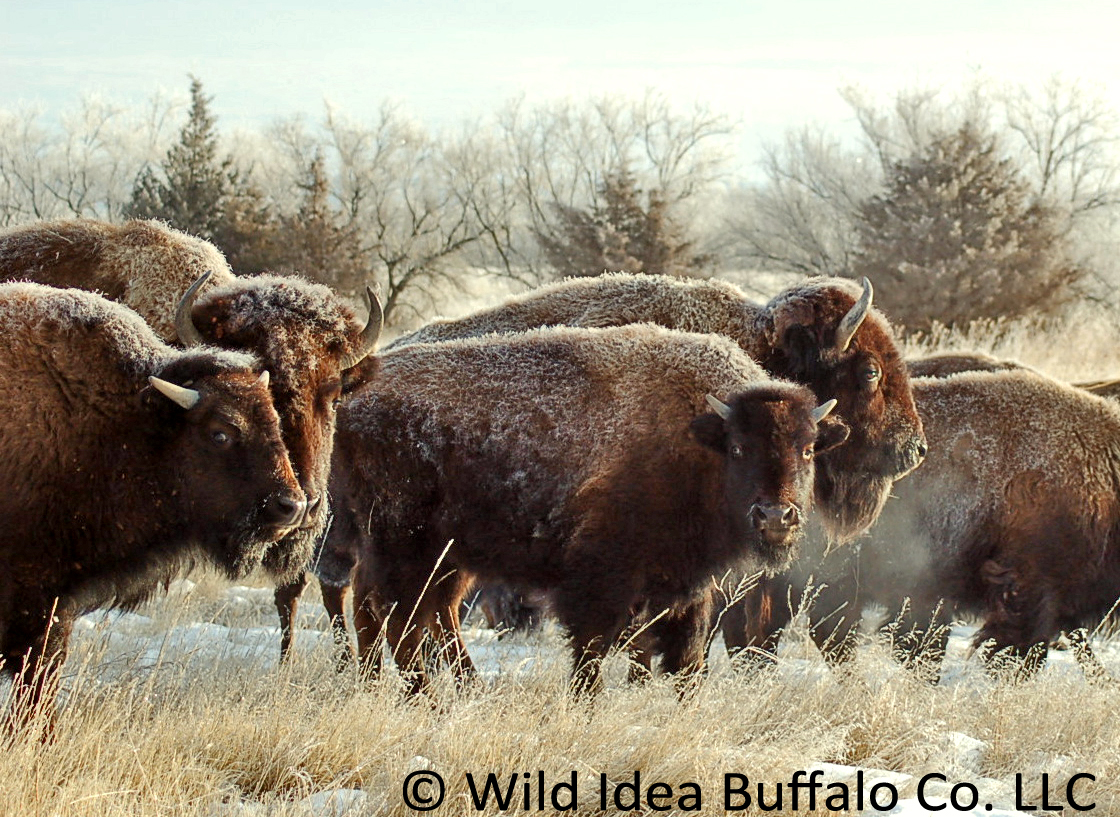 single species was only treating the symptom of a problem. The cause of a species’ distress was almost always a compromised ecosystem. I sat on my porch contemplating the rest of my life and I recalled much of what I had seen while I traveled back and forth across the High Plains. Blowing top soil, stinking feedlots, subsidized crops irrigated with precious water, and all the ancient, non-human inhabitants forced to eke out a living on the edges. The stars came up and, because it was autumn, Orion rose in the gap between Bear Butte and the Black Hills. It was one of those magic nights when time seems to slow to the speed of moving constellations.
My thoughts came to buffalo. They have long been an icon of this waning wilderness. During the last half of the nineteenth century, in one of the great human disgraces of all time, we slaughtered all but perhaps a thousand of the world’s buffalo – for sport, a few body parts, and to help decimate the Natives. We nearly lost a unique species that thrived only in the center of the American continent. I thought hard about that as I sat on the front porch with a million stars moving across the sky in front of me. It made me sick to think of the injustice and before Orion’s sword had swiveled to point at Harney Peak, I knew that my future would involve at least an attempt to put things right on the Great Plains and that buffalo would be part of that attempt.
In the nearly twenty years since that decision I have done my best to heal the portion of the northern grasslands for which I am most responsible, and in that time I have come to some conclusions: One of those conclusions is that if bison are to return to their natural haunts, they will have to pay their own way. The task is immense. No individual, well-intentioned non-profit, or government agency has the financial capacity to handle the job without the help of the bison’s old nemesis – capitalism.
I hate this fact. After all, unbridled capitalism is one of the big reasons for the devastation of bison, native grass, other native animals, and native peoples. — So it is difficult not to see my “realization” about capitalism on the Great Plains as “capitulation”.
But all that is good and natural about the Great Plains is not going to come back with simply good intentions on the part of a few people. If we are ever to have a chance at putting things right we will have to be smart, creative, industrious, and willing to sacrifice – not only sacrifices of time, labor, and money – but also sacrifices of our closely held beliefs. We owe it to the bison to be more than sentimental idealist or inflexible ideologues. We owe brave and selfless action to the bison – we owe it to ourselves.
It took all the power of 19th century to bring the bison to the edge of extinction. It will take the most powerful force of the 21st century to bring them back. I say turn capitalism against itself. Lakota belief tells us that the covenant between buffalo and humans has always been one of kinship. Out here we have always believed that if we care for the bison, they will care of us. In the 21st century, care of bison means helping them find space to move and native grass to eat – care of humans means connecting them to their wild roots. Bison have always bartered their hides and meat for human respect and kinship.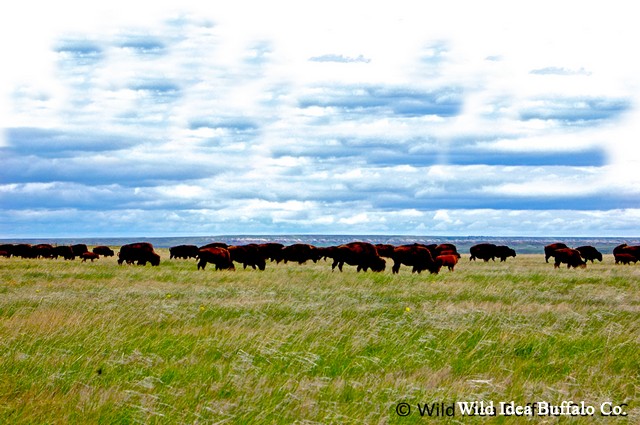
We must never turn bison into just another commodity. But for welfare of us all we should celebrate and facilitate the bison’s dignity, uniqueness, and indeed their very flesh as a sort of sacrament that can finally bring every person on Earth to a new way of honoring and valuing the ecosystem of the free-roaming bison. This day, and this modest museum, is a good place to begin the revolution – back to sanity. I am proud to be a part of it. Thank you.
Comments 8
Greetings from the hills of Georgia. Well said my friend, a nice message for all of us to ponder. Kathy and I hope that you, Jill and the bison are doing well, and the winter will be kind to all.
bill day
Dan..someday we hope to meet you and your family, your workers and the rest. We have enjoyed your books and your opinions and this “speech” was on target! We hope that many will come to know and believe in your values when it comes to the great prairie in South Dakota.
Paul and Tress
Dan,
You are truely doing Gaia’s work as you work to bring back the American Bison to the Short Grass Prairies. I applaud your words and your spirit, but most of all your ACTIONS! As we have seen in our Georgia Sea Turtle Program, a few people can, and have, made a difference in sea turtle conservation … and you are doing the same to conserve the Bison! Keep up the good work – and watch out for Old Man Winter!
Dan,
It’s good to hear your thoughtful story from the heart.
What a fine thing it is to admire and love a wild place like the view from your front porch! Sounds like quite a number of people have joined you to help restore the buffalo, as well as so much of the Great Plains, and those of us who rarely or never get there love to hear what you are doing.
Starr Foster
Hi Dan,
Very good speech indeed, and may God bless all your efforts to restore the buffalo to the place it deserves. I sure like it that you make it possible for a lot of native Americans to keep raising buffalo too. I too hope that I can come by sometime and meet all of you folks in person, and see the buffalo too.
May the blessings be.
Love, Don
May the blessings be.
Love, Don
Mass immigration was the instrument the US government used to destroy Native American culture and bison. Let’s all be glad the immigration “reform” bill passed by the US Senate earlier this year failed.
As our country fills up with newcomers (The 2010 Census reported 70% of population growth is due to citizens of other nations coming here to live, as Americans are only replacing themselves with births) let’s tell our elected officials we want our govenment to have a population policy. Some people today are just as land hungry (remember land rushes?) as they were 150 years ago. People and their needs will trump plants, animals and ecosystems any day of the week. Laws protecting preserves and national parks may be made ineffective 100 years from now.
World population is twice what it was as I went from high school to college (1960’s/70’s) and because population increases geometrically rather than arithmetically, the doubling will eventually happen in only a 20 year period. At 7 billion people, Earth is rapidly approaching her carrying capacity. The United State of America is not immune.
eloquent as always!
Well said Dan. Your thoughts are only outdone by your actions. Amazing how much impact one person can have when they get the bigger picture of their world around them. The bison belong where we have abused the land. Thanks for helping to bring them back.