This is a short keynote address given to the Mill City Farmer’s Market in Minneapolis on Sept. 8, 2013.
A dozen years ago, during a semester when I was teaching at Carleton College, I wandered down to the Co-op to see what it was all about. I had never been inside a food co-op and I was curious to know what drove the people who worked there. I found the vegetable guy way in the back stocking the coolers. He had been one of the founding members and he knew a lot about food, the food industry, and how tough it was to compete with the factory farms. He was an older, hippy-type that barely raised his head to look at me as he stocked the lettuce, green beans, squash, and rutabagas. He wore his graying hair in a ponytail with a hair net. “The big food companies just do everything as cheaply as they can,” he said.
“That’s kind of the idea isn’t it?” I’d been thinking a lot about business lately and I was sincere in what I said, but he looked up at me with deep exasperation in his grey eyes.
“Your view of business is the standard party line: Markets will work everything out.” My comment had touched a nerve. “That idea only works if you add in ALL the costs.” He had a rutabaga in his hand and tossed it up and down like a pitcher contemplating a fast ball. “At the top of Monsanto’s list of crimes, misdemeanors, sins, and oversights is the accounting error of grabbing profits while pushing the costs down the line.”
“Like to the next generation.”
“Like to the next generation. Bull’s eye.” He was still tossing the rutabaga up and down. “Now take this humble vegetable. It was grown about six miles from here. No pesticides, herbicides to worry about cleaning up. No water stolen from some imperiled fish.” He stopped tossing the rutabaga, held it in front of his eyes like Hamlet considering the skull of Yorick. “This is a rutabaga that comes with no I.O.Us. It is what it appears to be. A simple rutabaga. No future medical bills attached. No animals, plants, or microbes have been abused in its production. The world has not changed because it has come to be.” He tossed it into the air one more time, caught it neatly, and placed it on the growing pyramid of rutabagas.
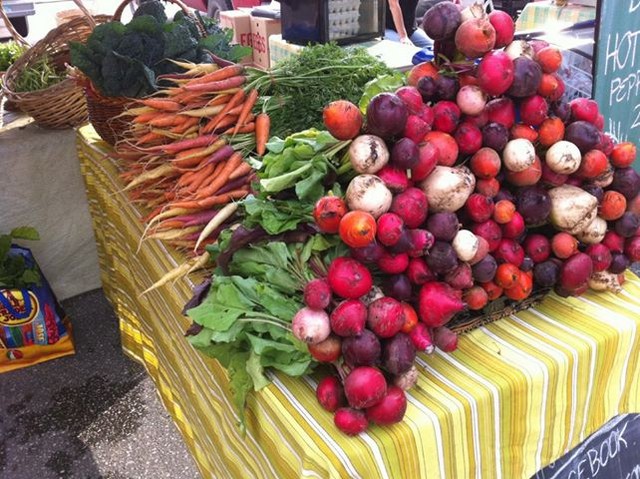
Mill City Farmer’s Market
The vegetable guy told me that he had been in the sustainability business since the late sixties when he dropped out of college to join a commune in New Hampshire. “Been at it a long time,” he told me. “Composting, biological controls, organic, free range, local, polycultures, CSA’s, farmer’s markets.” He waived his free hand to indicate there were a lot more labels that he just couldn’t think of right then. “You name it, I’ve been there.”
His eyes went wistful and his arms stopped moving. “Started off working with Caesar Chavez. I ran the mimeograph machine.” He gently picked up another rutabaga and I knew that he was thinking back over the years since he had first peeled himself away from the direction that American agriculture was heading.
I wondered how he thought of himself and the choices he’d made. “Are you doing any good?” I asked. He was dreamy again and it took a moment for him to come back to our conversation.
When his eyes finally found mine, they could not quite latch on. “I don’t know,” he said. There was a tiny shake of his head. “It depends on the day. If I stay in this store and keep my head down. If I don’t look up from the people who come in here to shop or to sell their products, I can feel like something is happening. But I don’t dare look up at the rest of the world.” His voice was trailing off, “Keep my head down,” he said. I could tell that I was losing him again. He went back to stocking vegetables. “One foot in front of the other,” he whispered. But he wasn’t talking to me.The vegetable guy was someone who desperately wanted help change the way we grow and market food. He had burned himself out trying, but he was someone I couldn’t help looking up to. He was someone every one of us here tonight should look up to because he was among the first wave of soldiers to hit the beach of sustainability.
We’ve come a long way but we have a long way yet to go. Here at the Mill City Farmer’s Market you are establishing a standard for the struggle to come. But don’t fool yourself into believing that this next phase will be easy because we are no longer below the radar of Industrial Agriculture and that iteration of our capitalistic system plays rough. Unlike the vegetable guy, we can no longer keep our heads down. We are going to have to stand chin to chin with them and say: Stop. Enough. Quit damaging the earth and threatening our children!
I’ve read Adam Smith’s book, Wealth of Nations – where capitalism was first described in detail. It is a big fat book and nowhere in it does Smith exempt capitalism from responsibility. And sustainability in ag is nothing more than responsibility among producer and marketers.
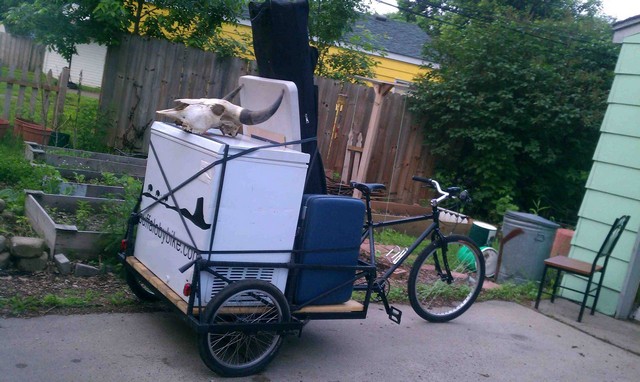
Buffalo By Bike – Nicholas Heimer Owner/Operator
You are all responsible people. You are associated with Mill City Farmers Market! You are the hope of all the generations to follow and you have the high ground. Don’t give in. And don’t give up. Don’t start talking to rutabagas like the vegetable guy. Let’s continue to be doggedly responsible. Let’s show the world a way out of our environmental crisis. Let’s be industrious, creative, energetic, innovative, and entrepreneurial. Let’s continue to advocate for new and better ways to produce and to market honest food. If we can do that, we can beat the bastards at their own game.
Comments 4
Thank you Dan for continually infusing us all with a little more positive energy to fight the good fight. I have been bothering my family for close to two decades now with the ideals behind why I choose the foods that I do. My attitude has vacillated between getting in their face and not causing a fuss,depending on the energy I can muster. My sister called me recently shocked to finally understand some of the atrocities that go into large scale farming leaving huge I.O.U.s for her children but also the robbing them of nutrients. It reminded me to find a space to encourage understanding when it comes to food choices. We all vote with our dollars, everyday. Encourage those around you to be informed with how they cast that vote!
Loved your story, Dan. WE love growing our own veggies but within the past four years discovered our area is one of the most polluted areas in the United States. One of my customers is a female scientist hired by the Fred Hutchs Assoc. to figure out why there are so many females getting cancer that is unusual for women. She discovered the pollution and recommended we not plant a garden as the pollution is in the air and soil. Now what do we do? A lot of veggies here in our stores are coming from South America and I doubt they are checked for anything!Now what do we do?
Hi Dan,
I switched cold turkey to organic produce in 1992 because I was getting more and more brown spots on my arms, and they were getting sore and starting to bleed. They stopped growing and bleeding, and began to go away. Six months later more started coming, and I switched to the first organic beef grower in Washington State, and they went away again and stayed away.
So they can’t tell me that pesticides are OK. I have continued to buy organic food ever since, and I think that is the best practical way to support the organic growing community. Big Ag tries every single day to compromise the organic standards, but the actual members of the NOSB that I have talked to over the years tell me that they are still pretty darn good. The more organic we buy, the more power organic growers will have in the marketplace, and that is why I buy your organic buffalo all the time!
More power to you, as I love what you are doing.
May the blessings be.
Love, Don
Farmers are not the culprits here. They are just trying to make a living off the land. The chemical companies are the ones that are feeding us the lie=Pardon the pun, trying to convince us “it’s OK”. A farmer cannot make it these days without chemicals. However, we are responsible for what we put in our bodies. Myself, I eat organic beef; vegetables whenever I can. It gets to be a vicious circle; the best we can do is take care of ourselves. Thanks, Dan, for your writings.