This Months visiting writer: Lindsay Wilson, journalist for Natural Grocers by Vitamin Cottage
In its commitment to offer customers the highest-quality products available, Natural Grocers by Vitamin Cottage® continually strives to partner with family-operated, small-scale, sustainable producers. The following article is about a sustainable buffalo ranch that meet, or exceed, our standards for naturally-raised meat. Natural Grocers is proud to support these ranches, their owners, and their products. In this article, we are happy to introduce Wild Idea Buffalo Company.
There is a saying among the Native Americans of the Great Plains that buffalo will offer themselves to those who have a pure heart. If that’s the case, then Dan O’Brien must have a heart of gold. A wildlife biologist, falconer, writer, and buffalo rancher, O’Brien’s deep respect for the grasslands of the Great Plains and the wildlife that thrives there led him to buffalo, or depending on how you look at it, led the buffalo to him.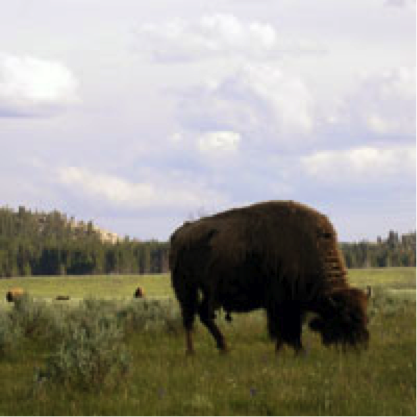
It all started with a little herd of thirteen orphaned runts that O’Brien bought from a neighboring ranch after helping with the annual roundup. You could say that it was an impulse buy, as O’Brien had been a cattle rancher for twenty years and hadn’t thought much about raising buffalo, although he had struggled to make ends meet as a cattle rancher and his intuition told him that cattle just weren’t suited to the grasslands of South Dakota. But in this little derelict herd, O’Brien saw salvation. “I was desperate to rediscover purpose in my life…and those thirteen imperiled packages of fur and sinew seemed kindred souls. I wanted us all to move on to a better life, I wanted my ranch to be as balanced and healthy as it could be,” O’Brien recalls in his memoir Buffalo for the Broken Heart: Restoring Life to a Black Hills Ranch. And so it began with those thirteen pint-sized buffalo, dubbed the “Gashouse Gang.”
That was twelve years ago, and now O’Brien’s herd has grown to more than 600 and his business, Wild Idea Buffalo Company, is thriving. As much a conservationist as he is rancher, O’Brien’s philosophy is to “take care of everything out there, not just the product, because it’s all connected. The reason we’re doing this is for the grass. When the grass is healthy, the whole ecosystem is healthy.” To O’Brien, the buffalo are more than a commodity; they are the key to bringing the grasslands he loves back to their native state.
Where the Wild Things Are
When I arrived on his South Dakota ranch in early summer, it was clear that O’Brien’s mission was not that of a venture capitalist, but one of a preservationist. Nestled between the Black Hills and Badlands National Park and bordered by Buffalo Gap National Grassland, O’Brien’s Cheyenne River Ranch is more than just a buffalo ranch; it has become a nature preserve. During my tour of the ranch, I saw the prairie through a wildlife biologist’s eyes. As we passed through the sea of rippling grass, O’Brien pointed out a flock of baby grouse; a red tail hawk; a pair of white pelicans (which, to my surprise, are native to the Plains); two golden eagles; and a prairie dog town where we saw four burrowing owls emerge from the tunnels, which O’Brien explained don’t eat the little burrowing rodents, but cohabitate with them. The prairie was teeming with life.
And then there were the buffalo. In a small open-air, all-terrain vehicle, O’Brien drove us into the midst of the herd, so close I could smell their sweet musky smell. There’s something quite majestic about these beasts; they are at once wild, aloof, and sublime. And unlike cattle–which settlers brought to the Plains in the late 1800s after most of the buffalo had been slaughtered–they are native to the Great Plains.
“Buffalo may look a little like cattle, but they act very differently,” O’Brien explains. Take grazing, for instance. “The grasses out here evolved to be grazed by buffalo; the way the buffalo graze for a bit and then move on, this movement is what allows the grass to thrive, and when the grass is thriving, the birds are thriving, the bugs are thriving, the mammals are thriving, the microbes in the soil are thriving,” O’Brien says. “It’s all connected. But now the grasses are being grazed by cattle and that’s putting stress on the plant life, and in turn, the entire ecosystem.”
In addition to their beneficial grazing patterns, O’Brien explains that buffalo easily endure what he calls the “animal-stress triumvirate” of the northern Great Plains–heat, cold, and wind. For example, a cow will start to lose weight at about zero degrees Fahrenheit, but a buffalo can stand temperatures up to minus 30 degrees, about as cold as it ever gets in South Dakota; the extreme temperatures just don’t affect them. “The cattle can hardly survive in the cold, and the calves certainly can’t,” he says. “When you raise cattle–and I’ve done it–you’re forcing a species into an environment that they just aren’t suited to.” But the buffalo, they belong on this land.
O’Brien describes some of the changes he noticed in the environment once buffalo replaced cattle on his pastures in Buffalo for the Broken Heart:
Unlike cattle, which dwell under trees for the shade in summer and wind protection in winter, we never found buffalo spending time in the wooded draws. As a result, the ground was not compacted and barren under the trees. The rare wooded plants of the prairie were not stressed the way they were when the pastures were grazed by cattle. In just one summer of buffalo grazing the bushes grew more lush than I’d ever seen and our grouse and songbird populations seemed to soar. The buffalo also refused to stand around water holes like cattle insist upon doing. The grass around the ponds was thick and unsullied. The water was not fouled by animal waste. The ponds became better places for other animals to live.
But restoration of the prairie takes some time. “Everything doesn’t get better overnight,” he explains, “this is a long-term deal.” And O’Brien is in it for the long haul.
Honoring the Spirit of the Plains
Just as O’Brien has a deep respect for the grasslands, so he does for the buffalo that live there. He strives to raise his buffalo like the Plains Indians traditionally did–“buffalo that were allowed to fatten on native grass, killed with honor on the range where they were born, and never exposed to the chemicals that become necessary once they entered a feedlot.” Following this model, O’Brien’s buffalo never taste grain, are never administered antibiotics, and never experience the terror of a slaughterhouse. They feast on native grasses their entire lives, which makes their meat richer in the beneficial omega-3 fats and conjugated linoleic acid. And when the time comes for slaughter, the buffalo are humanely “harvested” on the open pastures.
O’Brien explains that because they are wild animals, a trip to the slaughterhouse creates a load of stress on buffalo–“they are fighting it the entire time.” In fact, he says that buffalo can lose up to 15 percent of their body weight from the pasture to the slaughterhouse just from the stress. Additionally, some animals get so stressed out that there is an overload of adrenaline in their bodies, which can affect the quality of the meat.
O’Brien never wanted to put his animals through that, so he decided to harvest them in the place where they are the most comfortable, when they are “calm and happy”–in their own pastures. “We think it’s the right thing to do for the buffalo,” he says, “It’s more humane, and it results in a better product, a better quality meat.”
His method of field-harvesting buffalo was so popular that O’Brien created the Sustainable Harvest Alliance, a nonprofit business whose stated goal is to offer a way for small buffalo producers, especially on the reservations of western South Dakota, to bring their grass-fed buffalo to market in a humane, environmentally friendly, and culturally acceptable way.
“The idea of a mobile harvest unit came from the Native American guys from the Rosebud and Pine Ridge reservations,” O’Brien explains, “They wanted us to come and deal with their buffalo the same way we did ours.”
And so the mobile harvest unit was born. A modified big rig truck, the mobile harvest unit serves as the always-present USDA-certified meat inspector’s office and has a walk-in cooler to store the carcasses for the quick trip to the packaging facility. When the time is right, the truck quietly pulls into whichever pasture the buffalo happen to be in, and only those buffalo that are ready are quickly and humanely culled from the herd (sometimes this can be as few as four or five). Surprisingly, O’Brien says that the other buffalo hardly pay attention, almost as if they accept this as part of the cycle of life.
After being inspected by the government inspector, the carcasses are loaded onto the truck and taken to a local processing plant, where they are broken down into specific cuts, packaged, and shipped. O’Brien himself recently opened his own processing and packaging facility.
“I raise and process buffalo with honor and respect for the animals and the land. As a result, this ranch produces the condensed essence of the northern Great Plains in the form of pure buffalo meat, and I take pride in that.”
“I love it, I love the way it all fits together,” O’Brien enthuses. “I think we’re all, on one level or another, trying to figure out how we can help the planet. This is my part and it’s the way I’m going to spend the rest of my life.”
RECIPE
The following recipe is courtesy of O’Brien’s partner and culinary genius, Jill O’Brien.
Buffalo Vegetable Soup
Serves 4-6
2 tablespoons olive oil
1-1 pound package ground buffalo
5 carrots, peeled and sliced
5 celery stalks, sliced
1 medium onion, diced
1-14 oz can crushed tomatoes
1 tablespoon black pepper
2 teaspoons salt
1 teaspoon paprika
1 teaspoon turmeric
1 teaspoon cardamom
1 quart vegetable or chicken stock
2 cups chopped spinach
Heat 1 tablespoon of oil in a heavy soup pot over medium-high heat. Add ground buffalo and brown. Transfer to a bowl. In the same pot, add remaining tablespoon of oil, carrot, celery, and onion. Sauté for 4 to 5 minutes or until veggies are slightly soft. Return buffalo to the pot and add seasonings; stir and sauté for 5 minutes. Add stock and tomatoes; bring to full boil, reduce heat to low, cover and simmer for 30 minutes. Add spinach and cook until just wilted. Adjust seasoning to taste. To make this a complete meal, serve with a large side salad with your choice of toppings.
*Based on government guidelines, this meal (served with side salad) provides about 3 to 4 servings of vegetables per person, per serving.
Comments 1
Lindsay – Dan and I enjoyed your story as much as we did your visit. It is so great to be able to share our little part of this world with people that hold the land and all living creatures in high regard. It is an honor to be represented at Natural Grocers by Vitamin Cottage.
All our best – Dan & Jill