We love the Black Hills region of South Dakota. Anyone in touch with their senses is struck with the majesty and enchanting charm of these hills and prairies. The land and water are precious, and should be cherished and honored. Some, however, see this beauty and only think about what they can take – what is in that water and ground that can be extracted – how much money is it worth?

Dakota Rural Action
A foreign-owned corporation, Powertech (one of 8 known uranium companies prospecting the region), is posed to start new uranium mining in the Black Hills near Edgemont. Powertech has applied for the first ever in-situ leach (ISL) uranium mining permits in the state of South Dakota. They seek (and very close to getting) permits for 12.96 million gallons of water per day ($0 per gallon) from Black Hills aquifers. To put that into perspective, this is much more than Rapid City (second largest in the state) uses daily. South Dakota remains in long-term drought. Our water is precious and finite. It should not be given away.
The waste-water from this operation would be disposed by both pumping it back into the ground and spray irrigation over 1,000+ acres of prairie. Powertech has applied for exemption from the EPA Safe Drinking Water Act because the water cannot be returned to baseline conditions. Though they would “treat” it, the water would still contain elevated concentrations of dissolved uranium daughter products like radium, arsenic, selenium, etc., which are harmful to wildlife, grazing animals and humans. You may be interested to note that two years ago, in response to Powertech’s lobbying, the SD Legislature abdicated the state’s responsibility for underground water regulation.
In addition, Powertech’s project plans also include two on-site processing plants to serve as regional processing mills to concentrate uranium into yellowcake. The Black Hills would then become a hub for trafficking uranium product. Accidents on these sites are expected, not to mention natural disasters.
A little about ISL uranium mining:
ISL uranium mining is a process of pumping a solution through numerous bore holes to dissolve the uranium and other heavy metals, leaching it out of ore-bearing rock. It is then pumped to the surface to be processed.
Uranium mining is a boom and bust business, prioritizing short-term extraction and exploitation for foreign gain, over the lives of people and resources. We can live without uranium. We cannot live without clean water.
If ISL uranium mining is allowed to take root in the Black Hills, the process would deplete local resources with little or no benefit to our local economy, community, energy production, and agriculture – while ultimately posing risks to all mentioned. It threatens natural resources, quality of life, public health, local economy, tourism, and agriculture. -Dakota Rural Action, Black Hills Chapter Campaign Statement
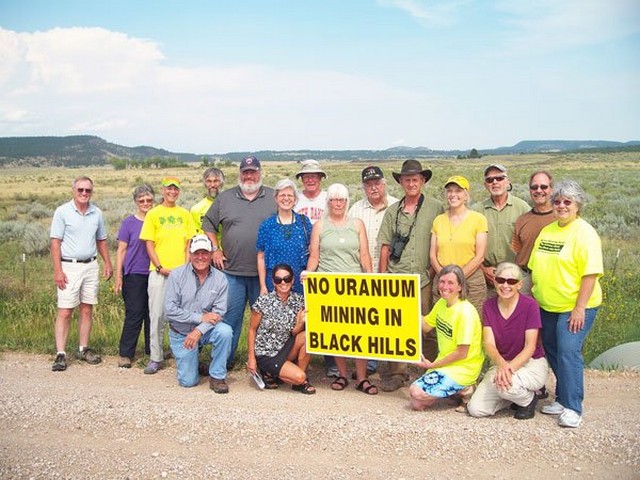
BHC-Tour-of-Dewey-Burdock
It would seem like a no-brainer to deny permits allowing a corporation with no history of uranium mining to open the first ISL mine in South Dakota. However, they are very close to being granted, and would have been already if hundreds of people didn’t object. The Large Scale Mine Permit hearings start on Sept. 23 and the Water Permit hearings start Oct. 7, 2013 at the Ramkota Hotel in Rapid City.
Please help us protect the water and life in the Black Hills. Sign the tourism petition (you don’t have to be local) and learn more at DakotaRural.org. http://org2.salsalabs.com/o/5706/p/dia/action/public/?action_KEY=13710
If you are local, attend the hearings. The board will hear public comments the morning of Sept. 23 – be there and make it clear this is a very bad idea.
DRA is a grassroots family agriculture and conservation group that organizes South Dakotans to protect our family farmers and ranchers, natural resources, and unique way of life.
Jillian Anawaty – Organizer Dakota Rural Action
Comments 5
Thank you Jilian for your great report! On a personal note the run off water would directly effect the Cheyenne River, which runs directly through the Cheyenne River Ranch. The ramifications could have a huge impact on all creatures great and small. Thanks again. Jill & Dan
Thank YOU, Jill. I am so glad you brought up the point of the Cheyenne River. That is a huge concern.
Do you have any links to studies on this?
Bruce,
Here are a couple of links that sum up and can refer you to studies if you’re looking for validating something specific. The first one is from hydrologist Dr. Robert Moran on the NRC website. The second is a collection of reports about the accidents, spills and long-term affects of uranium mining. This is a place to start – hope hope helps.
pbadupws.nrc.gov/docs/ML1302/ML13029A368.pdf
http://www.wise-uranium.org/
I guess the Upper Peninsula of Michigan, and Lake Superior aren’t the only folks under direct attack from these Greedheads! Rio Tinto and its affiliated, knock-off mining minions have arrived, shouting about “jobs” and how ‘clean and green’ they’ll be up here and over across the Lakes in Canada. Trouble is, the area is still reeling from mining turbulence and the environmental toxicity of over 100 years ago.
ALL of us, Tribal and ranch, need clean air, water and soil. Wild Idea works for this and also provides employment and solid, real jobs. It’s tasty, healthy and grass-based ranching. And, if you take a look at proposed mining and water use (actually abuse) as well as the unstable, dirt bag dumbing down and unhealthy frack-towns, you’ll see that this is simply a scam of destroying our lands and society. Yup.Society.
Good for you, Folks! You’ve thought it out, and are working hard to stop destructive behavior and intrusions. No amount of money can equal clean water, or healthy Prairie. I’m sharing your report with folks here in Michigan!