 The days are too hot and dry and nature shuts down after its spring frenzy and before the kinetics of autumn. The ducks are flightless this time of year and so the skies are oddly vacant. At this latitude, the only window of natural activity occurs just after four o’clock in the morning and lasts for only an hour or so.
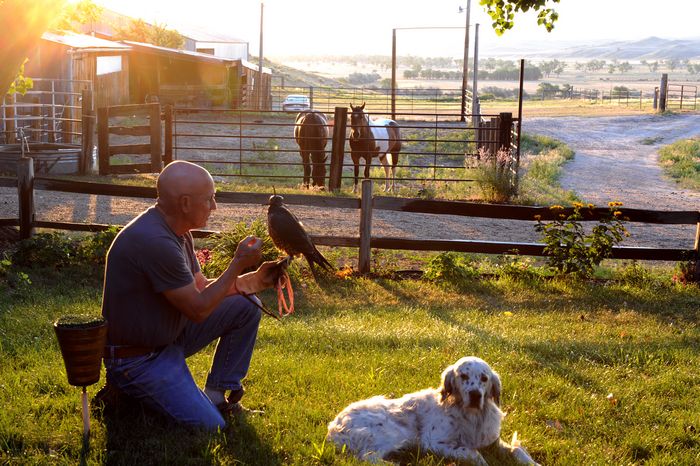
The bright spot in my July is that it is the time when young peregrine falcons learn to fly, the time that the birds destined to become hunting falcons form bonds with their primary hunting partner. It is the time that young falcons learn the ways of man and when men re-learn the rhythms of wildness. It is one of the few times that modern man is privileged to reconnect intimately with the greater world to which we all belong. This July I have again been fortunate enough to have a young peregrine falcon come into my life. We spend hours each day getting used to each other. I carry him on my fist, I feed him patiently, I ease the hood on and off a thousand times. He is the best part of my July. He is my swimming pool, my golf outing, my picnic in the park. He is my most immediate link to the 99.9% of this world that is non-human.
Rodger Tory Peterson was one of America’s finest naturalists. He was mostly famous for his series of Field Guides but he was also a teacher, artist, lecturer, winner of many honors and awards including nominations for the Nobel Prize. As Paul R. Ehrlich said, “In this century, no one has done more to promote an interest in living creatures than Rodger Troy Peterson.” I look up to Rodger Troy Peterson for many reasons, but mostly for penning this quote:
“Man has emerged from the shadows of antiquity with a Peregrine on his wrist. Its dispassionate brown eyes, more than any other bird, have been witness to the struggle for civilization, from the squalid tents on the steppes of Asia thousands of years ago, to the marble halls to European Kings in the seventeenth century.”
It is a quote from his 1948 book, Birds Over American, and I read and reread it every July that I am training a new peregrine falcon. I sit in the early morning shadows of our yard, coaxing the bird to take his meals on my fist and I wonder what those “dispassionate brown eyes” are making of this little buffalo ranch in the center of the Northern Great Plains of North America. I wonder if he sees this aging, bald man who offers him tidbits to win his trust as advanced beyond the Mongols of those squalid tents of Asia, or only a human with atavistic tendencies. What vision of the world do I share with this time traveler?
As modern humans go, I may understand more than most of what drives this pound and half thunderbolt with the laser eyesight and the ability to thrive in a savage world. We sit quietly in the front yard with the old English Setter, laying watchful not ten feet away. On the other side, two horses hang there heads over the coral fence. Their eyes are half shut and their tails are already beginning to switch back and forth, in anticipation of the buggy July day that is coming on hot. Here rests the great triumvirate of the first tier of the struggling civilization that Rodger Troy Peterson spoke about. Only slightly apart from the alliance of humans, dogs, and horses is the falcon – observant, wary, stubborn in its refusal to surrender its wildness. But beyond this quartet and indeed even inside of them, beginning with the microbes of their guts, seethes a caste of billions – grasses, forbs, insects, reptiles, amphibians, fish, birds, and mammals – every individual impacting every other individual. I believe that the falcon understands this better than I.
There is something other-worldly and judgmental about the stare of a peregrine falcon. He looks at me with the same deep penetration that he applies to the infinite sky. When he stares out to the near distance and finds buffalo moving across the valley below, is there recognition? Does he think something akin to, ‘Buffalo. Yes, of course. Finally’?
Rodger Tory Peterson speaks of peregrine’s witnessing the evolution of mankind only up to the eighteenth century, yet he lived in the twentieth century. Certainly peregrine falcons witnessed mankind’s struggle for civilization between, say, 1750 and 1950. The Japanese, Dutch, English, and Arabs all trained peregrines during that turbulent time in much the same way that I am training one this July. The ebony eyes of those birds were watching us too. Perhaps Peterson, the urban, American son of immigrants who somehow developed an obsessive love of nature even while his father worked in an early twentieth century furniture factory, was avoiding the thought of how a peregrine falcon might view the last two centuries of mankind’s struggle for civilization. But peregrines have been observing us forever. They have witnessed the loss of habitat for wild things due to human activity. They flew high above the great mechanical plow ups of grasslands, the clear cutting of forests, and the emptying of the seas. The wholesale use of DDT almost exterminated them.
This July there will come a judgment day. When I ease the hood off the new falcon for his first free flight over this ranch, where my influence is greatest, I will be choked with anxiety. If he rises to a thousand feet above the Cheyenne River he will be in position to see what this one human is trying to do. He will read in this land the evidence of my contribution to our struggling civilization. It is impossible to hide.
Comments 13
Dan,
When the peregrine soars over your ranch, I have no doubt that his judgement will be, “It is good. There is hope. You have done well.”
Best of luck as the training continues and you begin hunting this fall.
Chuck
Dan,
Thank you for a few moments of inspired reassurance in the beauty of good wholesome living. I see the peregrine falcon looking down and thinking, “I am lucky to share my life with such a good friend”.
Enjoy the summer and your quiet early morning moments.
inspired rich
I don’t think anyone could say it better than Chuck did…
The question is, will he return?
This is so beautifully written…Thank you for making me think beyond, beyond…and up close, to that little app on my phone-Peterson’s Field Guide to Birds…
Thank you for honoring creation…
Is it “Birds of America” you reference? 1950?
Great Post btw.
ken from fla
Dan:
In ecology, atavism expresses itself when two recessive genes combine. I hope that this intimate and intense connection to the natural world continues to be expressed in our human journey. You have given us an eloquent “throw back” to our best selves. Thanks for this excellent example.
warmth and respect,
Parker
Thanks again for what you’re doing and why you’re doing it. Here’s to the beautiful skies over South Dakota and the birds that fly there . . .
Hi Dan,
I enjoyed your story this month as always, and I too thank all of you for what you are doing to keep the plains and the buffalo alive, and helping the Indians to keep their way of life raising the buffalo too.
Keep up the good work, and know you are loved and appreciated.
May the blessings be.
Love, Don
Dan,
Thank you for this beautiful rumination on wildness in the face of civilization. In the late 1970s through the 1980s I operated my first free-range poultry and grass-only sheep farm in Wisconsin. I had a terrible problem with pocket gophers (Geomys bursarius) tearing up my pastures but I didn’t want to poison or trap them, so I explored the possibility of learning to use falcons to hunt them. I envisioned myself on horseback on my own land with a bird on my gloved fist… But I bought and read cover-to-cover Frank L. Beebe’s “Hawks, Falcons & Falconry” (1976, Hancock House Publishers, Saanichton, B.C., Canada) and talked with some Wisconsin falconers, and I came to understand the tremendous commitment that falconry demands. I finally had to acknowledge that time constraints would not allow me to honor these noble birds in the way they deserve so I did not take that approach to vermin control, although I became very good with a .22. Your evocative writing brings back those memories for me.
Anda Divine
Boones Mill, VA (in the Blue Ridge Mountains)
Dan
Back in 1997 I read a book entitled, Equinox. At that time I was being torn between the fast track corporate world and staying connected with the natural world I so much love. It’s all about priorities. As I look into the eyes of my Finnish Goshawk that is being tamed hacked this July, I see the the intensity of the natural world. Then he looks at me and turn his head upside down as if to say, “You still know nothing of my world”. But all we can do is try and look for the next slip.
Thank You Dan
Dan what a talent you have to bring me and apparently many others out of thier human managed world to a foundation that is so natural. Thanks for the talent you have to return me to a place that is so much more normal. It is a peaceful feeling.
I am so touched by the beauty of it. Perhaps there is hope. Thank you.
Hi Dan,
Hope to see you down in Kearney at the NAFA meet.
You can see Abbey as well. She’s definitely a great pup’