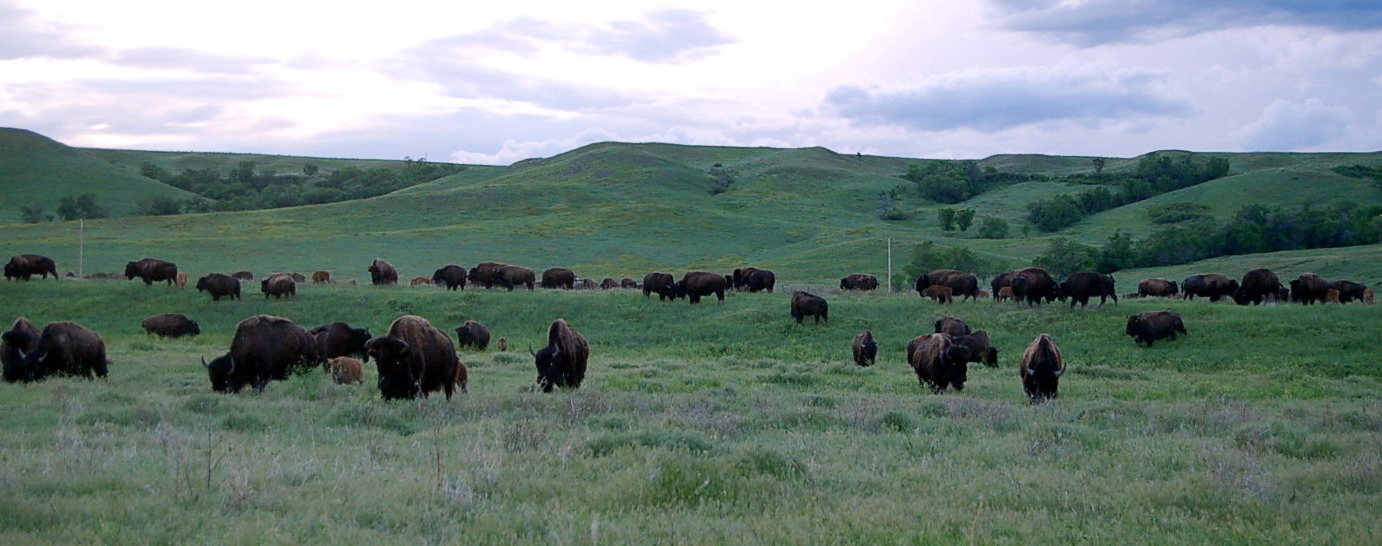
 The benefits of adding truly grassfed buffalo meat to our diets fall into three distinct categories: the health of our bodies, the health of our minds, and the health of our environment. The quick explanations of benefit in the first category are well known: relatively lower fat and cholesterol – increased omega 3 acids. The benefits to our minds have to do with a necessary human connection to wildness. The third category, environmental health, is the most difficult to qualify and quantify. The most complicated reason for supporting truly grassfed buffalo meat production and consumption falls in this last category. Try not to let your eyes glaze over but Carbon Sequestration, it may be the most important reason of all.
I know that very few people care to understand organic chemistry. I don’t know much about it myself, except to realize that talking about carbon sequestration is a great way to ruin a first date or a cocktail party. The details of common chemical transformations of elements and compounds are more than most of us want to wrestle with, but the overarching concepts and processes are vital to our survival. That is why I’m going to try to put down on paper my understanding of why the production of truly grassfed buffalo meat could have a positive global effect. Let’s call it, Carbon Sequestration for Dummies. It is a very simplified version of the science – and probably not exactly accurate – but it might get you through that that first date or that cocktail party, as long as you don’t hang out with organic chemists.
Start with the fact that living organisms are about 20% carbon. Once those organisms die, the carbon is retained in organic compounds that accumulate in the atmosphere, oceans, and soil until the compounds breakdown and the carbon is released. Excess, loose carbon is not a good thing to have flying around the atmosphere because it is a greenhouse gas that traps the sun’s energy and heats up the earth – Global Warming.
Billions of tons of carbon are tied up – sequestered – in and on the earth in the form of plants and animals, living and long dead. Coal and oil are little more than huge underground carbon banks, deposited over many millions of years, in the form of ancient plants and animals. For the most part they are held safely in the earth’s “carbon bank” until we extract them and put them through chemical changes that turn them loose to become greenhouse gases.
There is a second “carbon bank” of plant material that is not nearly as old as coal and oil deposits. That is the bank that holds living and newly deceased plant matter. Rainforests mostly girdle the earth at the equator and are the best known branch of this earthly carbon bank. Think of all those billions of tons of tree trunks, branches, leaves, flowers, fruits, and roots. They are almost all carbon – sequestered there in those forests where most of it will remain, unless humans turn it loose by breaking up the compounds that hold it in place. Rainforests are “HIGH PROFILE” carbon banks. They are like movie stars, they get all the press.
But if you move away from the equator to the earth’s temperate zones you find a lesser known, but even larger branch of the earth’s carbon bank called the temperate grasslands, in North America, where the buffalo have always roamed.
Where the buffalo thrive best is on the Great Plains, where the grasses are mostly perennial (continuing to live from year to year) instead of annual (living just one year) and this is very important. Annual grasses – including corn and many other grain crops – put most of their energy into the production of the seeds. It is these seeds that carry their genetic material forward in time. Of course, most of the seeds are eaten by birds and rodents, or harvested and carried away to be processed into some commodity or another. Either way, the carbon that is in those annual plants is dispersed and often ends up in the atmosphere where it can do a lot of damage. It is interesting to note that annual grasses die and come from seed every year, so a lot of these plants need to be planted every year. Running all that farm machinery with accompanying fertilizers made from other carbon compounds puts even more carbon into the air.
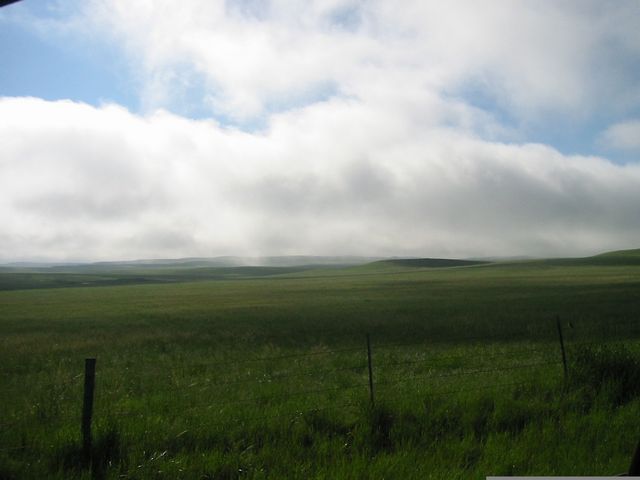 For reasons related to the climate where they evolved, perennial grasses regenerated from their roots and do not put most of their energy to seed production. They build a very extensive root structure from which the vegetation springs every year. In sharp contract to annual grasses, the total root mass of perennial grasses is often many times the mass of the visible plant. Most of a healthy, sub-terrain prairie consists of roots that remain in the ground. The carbon in those roots is sequestered and can not escape into the atmosphere.
Some experts believe that healthy grasslands sequester even more carbon than those much publicized rainforests. Insisting that buffalo be raised on native grasslands creates a beautiful symmetry of health. Our bodies respond favorably to the taste and the nutrition of the meat, our minds feel the joy of being part of a great wild restoration, and the environment remains viable for future generations because it is protected from a massive relocation of carbon.
Sometimes when I look out over our ranch I imagine the six or eight feet of thick roots of western wheat grass, bluestem, grama, buffalo grass, and dropseed. No other place on earth grows those grasses so successfully. That huge, invisible layer of roots is made up of carbon that can not escape as long as the prairie is safe. It is the buffalo grazing above that keep it safe. Nothing can utilize this landscape like the buffalo can. As long as they have economic value, they can protect the grass and the layer of carbon from which it springs.
Comments 10
THE BEST EVER!!!!!!!!!!!!!!!!!!!!!!!!!!
Ohhhh yes ! This is such a good article. I love reading about chemicals and compounds and the earth. I love buffalo. I love reading your writings.
Very , very interesting for french people .Thank you .
Very good article. Thanks for all you do; for being a friend of the buffalo, and SD lands. Keep up the good work. We need you guys. I first found out about you when I read, “Buffalo for the Broken Heart”. It’s one of the best books I’ve read.
Dan,
Once again, you give us reason to eat buffalo (Wild Idea Buffalo that is!) and to “go native” with all of our grasses and plants.
Thanks for all you do!
Audrey Cullen
Thanks Dan I look for the Wild Idea news letter in my inbox every month,
I enjoy reading it as much as I enjoy working for you, the grasslands, and the buffalo.
Thank you, Dan, for putting this in an explainable reason that I can share with all those who ask me why I eat “Wild Idea” buffalo, and why your buffalo is better than any other. I’ve been “selling” the Wild Idea for years… I have tried other “Grassfed” buffalo but none tastes anywhere near the “Wild Idea” buffalo. Thank you for being such a good steward of our prairie and of the beloved buffalo.
Love the new website!!!!
Cool! You are really keeping up with technology, I am impressed with your new web site, my name and e-mail is right there ready for me to comment.
Enjoyed reading another one of your thoughtful messages.
All the best
Angela
Dan,
That last sentence….makes me realize one of the reasons, why, even though I am a vegetarian…I follow your website and read your books.
How the animals humans eat are treated while alive is as important to me as how & if their lives are taken. You are providing a moral and spiritual haven, for the animals & the prairie, which is much appreciated in this feed-lot & factory farm country.
My father says you are a good story teller.
You just told a very important one …