I watched my paint horse, Camo, stretch his nose out and sniff the nose of a young bull buffalo. They sniffed deeply and then, in unison, turned to look across the Cheyenne River and into infinity. It was hard to tell what was in their minds but I want to think that their daydreams are like mine: an enormous blue sky and rolling grasslands to a distant horizon. There is a steady breeze bringing the scent of possibilities. There are no restraints, no boundaries, and no limits. History merges with the present and the past.
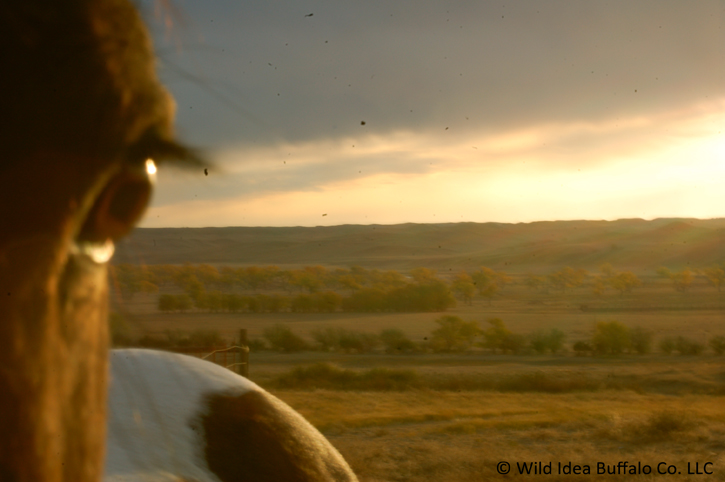
I don’t think that my daydreams are unique. I think that, many Americans dream like horses and buffalo. It is as if we can stand in their skins, stare with their beguiling dark eyes, and let the rare prairie rains drip benignly from our sturdy coats. We imagine ourselves as country boys or strong, young women with long smooth muscles – solid bodies, and steady hands. We feel a kind of innocence, tempered with confidence and power. There is the thousand-yard stare of wisdom, patients, and endurance. When we dream like horses and buffalo we can imagine ourselves as the center of the world.
Yet the horse stands a little taller than the buffalo and there is something sad about the buffalo. They have long been misunderstood, exploited, commoditized, mystified, and abused. Even their identity has been hijacked by a succession of cultures. They are the animal with two names, buffalo and bison. The first name stems from the confusion of the Europeans who landed their puny boats on the eastern shore of America. Those crude men thought they were on a different continent and that the large, shaggy animals they found were a variant of the water buffalo they knew from Asia or the Cape buffalo they had heard of in Africa. It was centuries later that stuffy European taxonomists decided that the American bovine was a unique specie and named it Bison bison. A better name might be Tatonka, the name given by the nomadic natives of the Great Plains that, at least for a time, knew the buffalo best. It is a word that embodies not only the animal but also the habitat and the spirit of the animal. There is nothing erroneous or taxonomical about the name Tatonka.
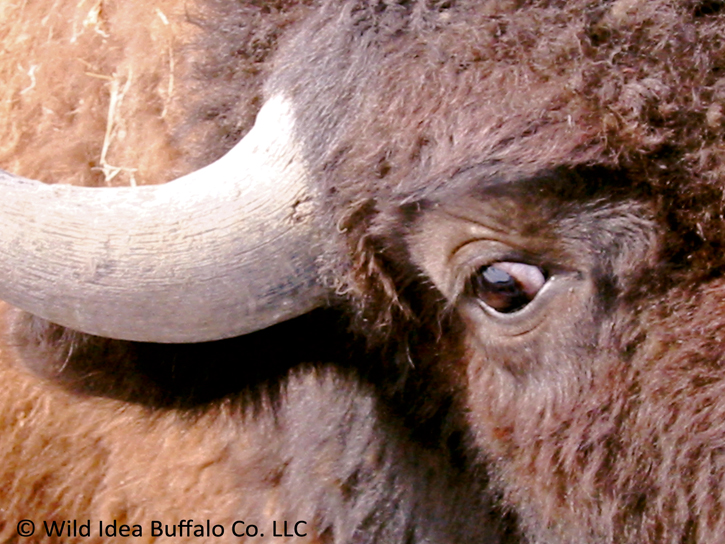
The buffalo that we know have been the center of a huge, continent-wide drama for perhaps 5,000 years but, before them, there were several other varieties. The first buffalo were native to what is now Asia and Europe and crossed into North America on the famous Baring land bridge. It is hard for us to imagine how different the world was back then – the continents all ajar, molten rock surging up from below, and sea levels rising and falling as a result of ice caps varying in thickness from mere ice sheets to gigantic water repositories many miles thick. But there was a window of about 50,000 years that all sorts of creatures made the trek across the land bridge. Hundreds, perhaps thousands of species moved. They traveled both ways – the ancestors of animals like camels and cheetahs heading for Asia and mammoths, ground sloths, and like on their way to America. Later, a few wretched humans trailed along behind the mammoths. I like to think of the tiny, eight inch tall great-grandmother of the modern horse moving carefully beside the giant ancestor of our buffalo, Bison antiquus. Did they size each other up in a long grassy valley between two mountain ranges somewhere in what is now Alaska? The ancient buffalo was a thousand times larger than the tiny Pleistocene horse. Did an adolescent buffalo, the giant ancestor of the one that sniffed Camo’s nose, make a playful charge at a herd of tiny horses, send them scurrying along their way to Asia? Did that horrifying experience stick in the memory of Camo’s Lilliputian ancestor and flair up 50,000 years later, when the horse returned to North America in the hold of a Spanish Galleon? I can imagine a genetic grudge enduring for those eons and igniting when the first Conquistador killed a buffalo with a lance. When Native Americans swung up on full sized, Spanish horses and heeled them at top speed toward a herd of grazing buffalo the grudge exploded. The slaughter built in magnitude for the next couple centuries and culminated with Europeans in the saddle and long lines of packhorses loaded down with hides heading for Dodge City and Santa Fe.
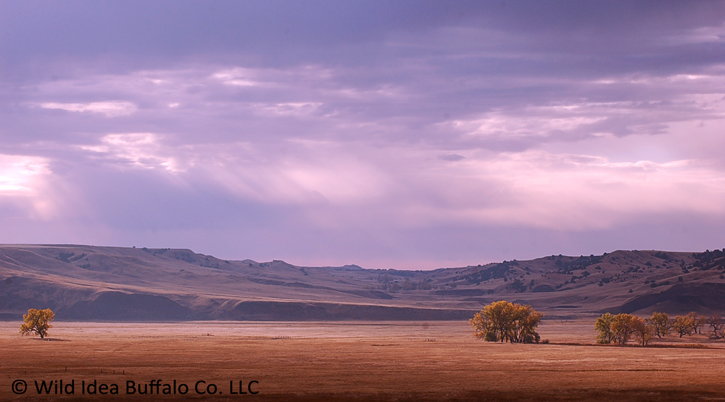
I watch the contemporary horse and the buffalo in the pasture below my house. They are still staring at something that I cannot see. For centuries we Americans have pitted them against each other, like ancient gladiators. But today they seem at peace. The ordeal we put them through has served to mix their essence with ours. We share a story: past, present, and future. But Camo and the young bull seem to have learned more from their experience than we have. They stand side by side and stare off into what seems, to most people, like nothing. But, I am afraid that they are seeing things that humans can no longer see, or perhaps, more frightening still, something that we have never seen.
Comments 15
Great thought that we ALL should relate to. Unfortunately a lot of us are
caught up in our struggles to survive and figure out who we are. The funny
thing is, just taking a few minutes a day to “reflect” could solve a lot of
our inner turmoil’s. Eating right (which I didn’t back in the day), is
something my wife Dianna had figured out years ago! She’s got me on the
right track and we eat nothing that is processed from a CAFO type
environment! It’s been awhile since our last flight together looking for a
free spirited Falcon and am looking forward to reading your new book. John
I enjoy your photography and writing style Jill.
I also like the pictures and the writing, I’m from MN & like the western stuff from out in your country side God’s great earth.
Pure poetry of the mind, spirit and heart!
Thank you for sharing.
Great writing, Dan, and a refreshing perspective. The face-to-screen world that so many of us live in has a very short perspective, and the horizon is sometimes obscured if even visible at all. We all need that longer view; we must begin to look into the next century, to see across time and place so that we can better assess our own impact and befriend the animals who see it better than we do. Enjoyed the beautiful photos today, too.
Even if we are not aware off, we all belong to the cosmos, and are related to it.
Thanks to the dramatic and beautiful space you are living in.
Sometimes we can feel that, and that makes us happy, or not…
Thank you for the “mood” of the great plains we never see, but only in our spirit. It is coming toward us when we read your letter.
Continue your task. The world need people like you.
Dominique-Charles (France).
I almost hate to read your commentary as it makes me so darn homesick I nearly have to ‘take to bed!’ Yearning for seeing more than other people and houses when I look outside! Need to mention that, although rarely do I see a typo, I believe it should be Bering Sea!
Thank you Dan. I always look forward to your monthly writings. Your dream is a good one and it’s a vision we should all embrace. Ted Turner could learn a lot from you.
Why do I always look forward with anticipation to Dan’s writings. I know that as I read I will be taken, with words, to some place I have never been or forgot that with my own thoughts had been there before. It is refreshing to be transformed to a place in our mind by a writer. Thanks once again for the trip. Jerry.
Interesting thoughts. Oh to be able one time to understand what a horse or buffalo thinks and why. Perhaps reincarnation but am not sure i am aboard with that concept.
Hope things are going well at Wild Idea. Regards, Gary
Thanks,very beautiful.
Harmony , balance between nature and animal .
Sense,feeling of the Life .
Most humans have lost this.
What a pity…
They are tied, still, to the creator! Unlike humans they have fewer distractions, and live only for what is basic, as should we all.
I love your writings, please continue!!
Rêve da paix , rêve d’éternité dans ces beaux paysages …. J’espère vous lire bientôt Dan , mais en français dans vos livres , car je butte encore sur quelques mots américains
No doubt their epigenetic propensities favor sensing the primoreal hint of wolfpack, cougar, and bear on the breezes of bygone days. These descendent beasts of the truly wild prairies have their own awareness coursing in their fluid, sinew, and bone. Sadly, we’ve lost our buffalo in Southern Arizona, but the jaguar is gradually evermore stalking the land. Bless your bison-ness and all it helps inspire you to do. Maybe one day we can witness a significant increase of the southern herds, as well. El tigre awaits!
Parisien, je passe mes weekend et le mois d’août dans l’oise. Je viens de finir votre dernier livre j’adore la campagne mais, ici, en France à 100 kms de Paris c’est encore les :”pesticides” et autres aberations …Que faire ? Je pourrai offrir vos livres (que j’aime depuis :le premier,mais ils vont me prendre pour un fou. Un jour je viendrai dans le Dakota du sud mais je ne le vous dirai pas j’observerai en silence et je rentreai heureux mais avec,toujours, ce desespoir de ne rien pouvoir faire ici à Paris et dans l’oise sauf être un”rêveur ” qui lit des livres… je vous embrasse ,vous, et tous ceux qui vous accompagne.