The fall and early winter of 2014 will always be remembered as the time when police violence against young black men boiled to the surface of the national consciousness. The tragic deaths of Michael Brown and Eric Garner became symbols of an epidemic of violence that has simmered in America for a very long time. Many of us in South Dakota watched the furor of marches and riots on television and, though we were concerned for our nation, did not feel personally touched by the deaths in far off Ferguson, MO and Staten Island, NY. For me, that all changed on the night of December 20th, 2014, when Allen Locke was shot by a policeman in the doorway of his Rapid City home.
Allen had worked for us at Wild Idea Buffalo Company for only short time. I did not know him well. He was a big, quiet guy that we had recently hired to help process buffalo meat. He was married with three children. He’d had some trouble with the law. He was working to get his life back in order. In a lot of ways he was like Michael Brown, Eric Garner, and a host of other kids trying to find their way in life. But he wasn’t a black kid. He was Lakota.
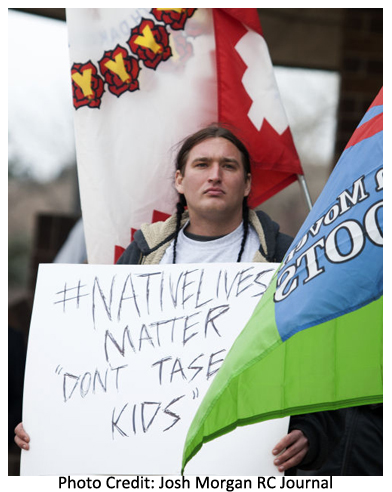
One of the ironies of what happened on December 20th was that, 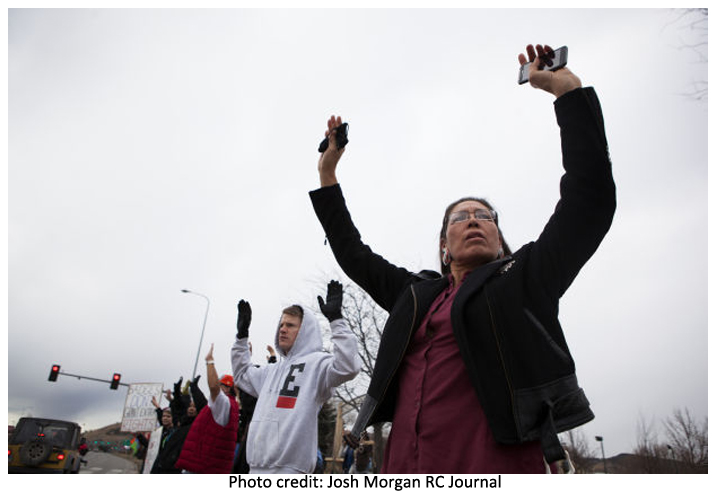
in coordination with other groups around the country, about one
hundred Rapid City residents held an anti-police brutality rally in
support of Michael Brown and Eric Garner. Of course, in addition
to their support of Brown and Garner, their rally was aimed at the
relationship between local police and the Lakota people of western
South Dakota. It was at that rally that Allen Locke started drinking.
 Over the years I have had a lot of Lakota friends and I know that they often get unfair treatment from the police. But I really never grasped their relationship with law enforcement until one day when I was driving with Shane Brown, a Lakota guy from the Cheyenne River Sioux reservation that I’d known for years. We were driving toward the Rosebud Reservation and Shane had already pointed out a couple of times that I was driving too fast. I was only going a few miles per hour over the speed limit, but he was nervous and I chided him a little. “Relax,” I said. “We haven’t passed a car for fifteen miles.” Just then we topped a hill and there sat a highway patrolman with his radar gun aimed right at us.
“Damn,” I said. It struck me as funny that Shane had warned me just a minute before. But when I looked over at Shane I saw that he found no humor in our situation, he frozen in his seat – as still as a jackrabbit beneath a soaring eagle.
I was pleasant to the patrolman and when he took my license and registration back to his car I looked at Shane. I was hoping that he would at least tease me, but he didn’t even let his eyes meet mine.
When the patrolman returned he handed me a warning ticket and told me to slow it down. “Have a nice day,” he said.
We were miles down the road before Shane spoke. “Son-of-a-bitch,” he said, “he didn’t even shake us down.”
According to the police account, Allen Locke’s wife called the police because Allen had been drinking and she was afraid for herself and the three kids. They say that, when the young, white policeman approached the house, Allen came through the front door with a knife. That is all probably true. My question is: why did Allen come through that door with a knife and was there any way the policeman could have warned him?
I’m not naïve about these things. I know that when people have been drinking for a couple days that they do crazy things. I also know that when you really believe that you are about to be killed it is not like in the movies. The adrenalin explodes from every pore and there is no time to neatly step aside and apply a fantasy karate chop. There is not enough time to think.
There was just that one split second with those two young men confronting each other on the stoop of that house in Rapid City, South Dakota.
At Allen’s funeral in the tiny reservation town of Kyle, South Dakota I thought about when that one young man killed the other one and I knew that two hundred years of history had led to that moment. There were a hundred and fifty people in the gymnasium of the Little Wound School and I believe that I was one of only two white men. The other white man was a kind Catholic priest, there to officiate the Christian part of the service. The Lakota Holy man, George Apple, was there to do the Lakota part and he was already sitting with the drum group at the front of the gym beside the open casket and the tables filled with pictures of Allen and his family. Above the tables, star quilts hung from a rope secured to the basketball rim. The quilts had been brought as offering for the family from supporters and, from experience, I knew that they would be given away to the attendees at end of the ceremony.
The drumbeats filled the gym with the music that I have always felt is a perfect match for the sad and savage plains of South Dakota. The singers chanted and the Catholic priest tried to make the bible reading heard above the murmur of the crowd and the squeals of playing children. The people quieted as George Apple spoke to us in Lakota.
I had no idea what George was saying so I looked at the eight pallbearers who sat a few feet away. They were all big, young guys with tattoos on their arms, necks and a few showing through their buzzed haircuts. Some wore do rag bandanas and others wore those straight billed ball caps that I’d seen on the marchers in Missouri and New York. They looked a lot like Allen Locke: quietly, defiant and cocky. They could have been the followers of Crazy Horse – scary enough to frighten any young white man with a gun and a fervent desire to defend his community. 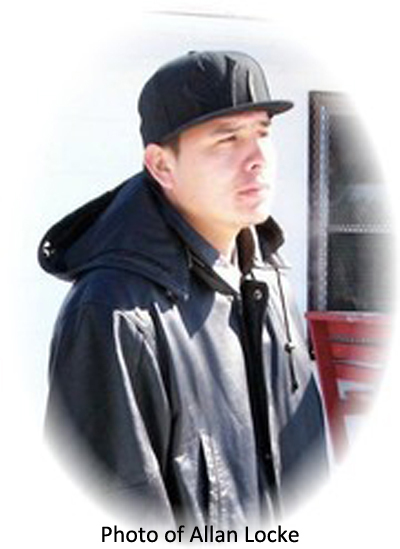
When the Lakota part of the ceremony wounded down, the drum group started
up again. They sang a song with words that I could not understand, but felt the
song just the same. The pallbearers rose and went to stand on either side of
Allen’s body and the people rose to file past and shake their hands. I fell in
line and one by one I shook the hands of those steely young friends of Allen
Locke. In the Lakota way, their handshakes were limp and, if their eyes met
mine at all, it was with apathetic contempt. Seven of them held their heads
high and focused their eyes through me, to the back at the gym. But the last
pallbearer’s eyes were full of tears, and for a fleeting millisecond, as I passed
his hand clung to mine.
Comments 23
All lives matter. If you get that your life matters, you will act in accord with that belief. You will walk the walk. A person who thinks that his life matters will act with dignity and integrity on a consistent basis. A person whose life matters acts with self-discipline and self-control. He pursues a course of productivity and responsibility. He rarely gives in to base and destructive behavior.
A person whose life matters accepts responsibility for his circumstances, his actions and where he is in life. Responsibility goes hand in hand with power. You grant power to whom you give responsibility for your life. People whose lives matter take power over their lives by accepting responsibility for those lives.
A life that matters does not blame others. A life that matters is a life lived in appreciation and gratitude rather than resentment, hostility and ingratitude. A life that matters chooses to be productive and is committed to improving itself, its family and the world around it. The person who thinks his life matters is on a path of growth and improvement. If your life matters, you will not waste it. You will not waste your time and energy on the nonproductive or destructive, the low and the dark.
A life that matters acts with honor, dignity and respect — self-respect and respect of others. All lives matter. But all too few actually accept that their lives do matter.
Dan, thank you for writing this piece. My heart breaks with every story like this. Why can’t policemen shoot to disable first and not to kill? I hope they at least try.
As a law enforcement officer, we are not taught to “shoot to disable.”
You shoot to end the threat.
It is a tragedy that there was a killing. It would have been an even bigger tragedy had the suspect stabbed the woman or one of the children.
Dan, thanks for your words, for expressing your heart. I have read your books and have been deeply touched by them, by the sincerity of your writings and how you put me in touch with a land and poeple I’ve never seen, writing about the experience of life. Your words today touched me deeply too, and connected me with you by the fact that I, too, watched the events surrounding the deaths of Michael Brown and Eric Gardner and how we as a people handled it and was troubled by what I saw, not able to undestand it.
Thank you for sharing and honoring this young man and The Lakota Nation. We can all do more to stop the violence and keep striving for a more peaceful nation. Your writings this month are an important part of that process.
Dan, I feel the same way. Each and every man woman and child, red,white,brown or yellow are precious in His sight! One is not any more or less important than another. As Jesus said, If you do it to the least of these you do it unto Me.
Very sad. 🙁
Dan, you have penned this story well. I sit here in the North Georgia mountains wondering when these tragedies will stop. It hasn’t appeared that these cops were engaged in hand-to-hand combat, when they pulled the trigger. Additionally, a “special” prosecutor may well be in order in these type of cases. As a former educator, a little more education and training might be helpful. Stay warm.
Thank you for letting us know what happened in South Dakota. I have not heard about this in any news coverage, yet now when a black or white man gets killed by police for whatever reason its on all the national news. Why is there not the same coverage for Indian people? I have been reading books on what really happened to Native tribes all over North America during the 1700 and 1800’s and what we were taught in public schools as children is a far cry from how they were really treated. Seems like the injustice never ends.
Dan, your report is very well done! As one who has had contact with Lakota Nation for a number of years as well as tribes in my state of Washington, I have worked over the years as a academic, writer, and community organizer to deal with the institutionalized and systematic oppression of indians in and out of their tribal communities. If anything events have gotten worse in recent times! Special prosecutors, education, and training will not get at the fundamental problem and such efforts often advanced by non-indians serve to avoid it. The dominant culture in this culture needs to be directly confronted . Indians and other “non-whites” need to “stand up” and take the lead and stop wasting their time trying to “fit in”! People like you Dan and me can help by joining this effort . Cheers! Jim
dont do drugs and stay off the beer and wine . follow what you have been told to do. dont blame race.
Tragedies. We all walk different paths, but if we would take just a moment to walk a mile in another’s shoes before passing judgement, the world might be a better place.
Dan, well done. I read of incident after incident , as I sit here in Texas, and I’m often reminded of growing up on the edge of the Lakota reservation, sitting next to Lakota children in classes grades1-12, and of the general attitude in my ‘white’ culture about ‘natives’ in the 1950’s. It was segregation -pure and simple. Not unlike the South with those with black skin. The levels of trust and feelings of threat on both sides remain. As a people, regardless of skin color, it is up to us to create a new place and culture and safety. It will take courage and wisdom or we won’t survive and will continue to tear each other apart!
What a tragic, tragic story. I’m so very sorry for everyone involved. Dan, is there a way to get an anonymous sympathy card or any assistance to Mr. Locke’s family?
There is hope and faith that someday we will finally learn that we are ONE, linked by the force and energy that creates us. Meanwhile, we can learn to walk different paths toward learning again that love is always there waiting for us to let go of fear. Thank you, Dan, for giving us yet another insight into our faulty paths. David
Dan
Thank you so much for writing this. As I read it my heart hurts and tears fill my eyes. I worked side by side with this young man and felt we should address this issue. It warms my soul to see that you have honored him here.
These stories are so unbearably sad it is hard, sometimes, to deal with them. Heartbreak for all of us.
Dan,
One of the best and most heartbreaking pieces I’ve read about this pervasive challenge. It’s a disciplined and searing witness to this national tragedy.
I understand this situation first-hand……..I was alone with a Lakota man who was a friend of my roommate when he came after me with a hunting knife after drinking too much whiskey he had hidden away. We were not strangers and had done a sweat together. But alcohol can release those inner darknesses that float below the surface, out of sight, most of the time. My roommate had told him that we were not supportive of his drinking but that didn’t seem to matter. Fortunately, I did not “run out the door” when he told me he’d ‘give me a head start’. I had had some counseling skills and used all of them…..and after an hour or so, the situation was resolved without incident. After that we all went our separate ways. Years later, I had heard from my former roommate that our friend had moved back to Pine Ridge and had eventually passed on from alcohol-induced liver failure. I felt sad when I heard this. I know other Lakota people who have gone through similar “Hell”. Fortunately, some have come out the other side stronger for it. One of them is a Lakota Brother who now KNOWS the depth of Light that he has within himself. He has touched that part of himself that speaks of Honor and Light and Self-value. As was stated above, THESE are the things that must be fanned into Flame within each one of the People. Then, outside influences cannot get a grip………and death by liver-failure will not be an option.
this is a very sad story, but let’s not forget that the dead man’s wife had called the police.
she did not do that just to amuse herself. she did it because she had feared for her life and those of her children. the drinking killed the man. the police man and his gun were just an unfortunate accessories to a very sad chapter of that man’s life. note that the wife did not called “an elder” from her community of lakotans. the fact is that domestic violence is often ignored in these and other communities; this is really the saddest fact of this story.
a dead man is not the same as an honorable man. that sort of man does not need to have his wife call the police for protection. we as a community should not confused “grief” with the unintended consequences of “domestic violence”.
may god have mercy on everyone.
this was a beautifully penned narrative. It is heartbreaking. So sad, and I have no doubt that Native Americans are subject to being looked at with more scrutiny and probably prejudice at times. I will also add something that may not be popular but…as an Arizonan I also know that we are warned not to do anything that will get us stopped by the Tribal Police either. It doesn’t always go as well as a regular civil stop off the reservation.So then you wonder, what came first the chicken or the egg. I have no answers but wish, hope and pray that the racism, anger and lack of unity would stop.
Dan, I am so sorry. Sorry for this young man, his family and his community and for all of us. When a life is taken needlessly we are all diminished. As one born in South Dakota I am ashamed of the racism which is so prevalent in my home state. Why are we so afraid of one another?
I’m sure you realize that you and others who are blessed to actively work at reintroducing native food sources on a grand scale are in place to help right the injustices meted upon indigenous peoples who have knowingly maintained the stewardship of their country as best as they are able in the face of horrendously bigotted policymakiing, all too often contrary to responsible stewardship, and sometimes overtly destructive to our lands. If only our U.S. leaders had an ear for sage elders who bare witness to the tribal peoples who can still speak these truths. But then the only other minority within a minority who weather more prejudice than these would have to be young children.