My Sibley’s Field Guide to the Blue Bird says that there are three kinds of bluebirds in North America: Eastern, Western, and Mountain. The first bluebird that I remember seeing had to have been an eastern. It was standing on an Ohio fence post in the late 1950’s. Two posts down there was one of twenty-five bluebird house that I had helped build. It was a controversial grade-school project dreamed up by my biology teacher. Looking back over the last fifty-five years it is hard to imagine, but the idea of increasing the population of songbirds by supplying them with nesting boxes was a new concept.
Those were different times. Bird watching was not an industry when I was a boy. I had heard of only one person who had a bird feeder in his backyard. He was a kooky, bespectacled, old guy named Mr. Price who had a low-level job at a local newspaper. He was thin like Ichabod Crane and he had gained renown as a whacko for approaching a group of high school kids who were picnicking in their car and throwing all their trash out the windows. Another thing that is now difficult to believe – littering was perfectly accepted. There was no such thing as a trash bag in a car, no roadside waste receptacles, and no such thing as a ticket for littering. The road ditches of nineteen-fifties Ohio looked a lot like the highways in many third world countries – bottles, cigarette butts, hamburger wrappers, and steel beer cans strewn with abandon. Mr. Price was ahead of his time. He had a big, brown, paper bag and walked all the way around the teenager’s car, picking up the trash. When the bag was full he went to the driver’s window, leaned in, and dumped the whole mess in the kid’s lap. Our little community went ballistic. Who was this guy that thought he could infringe on other people’s rights? What gave him the right to impose his views on the youth of our community? Complaints were aired on the Ed-op page of the newspaper where Mr. Price worked. His job was on shaky grounds. The sheriff’s department interviewed him and he got off with just a warning. Besides the biology teacher, Mr. Price was the only adult who helped us build the bluebird houses. By the time I graduated from high school and was on my way to spend the rest of my life on the Great Plains, eastern blue birds lined the roadsides of most of Ohio’s neat and tidy roads.
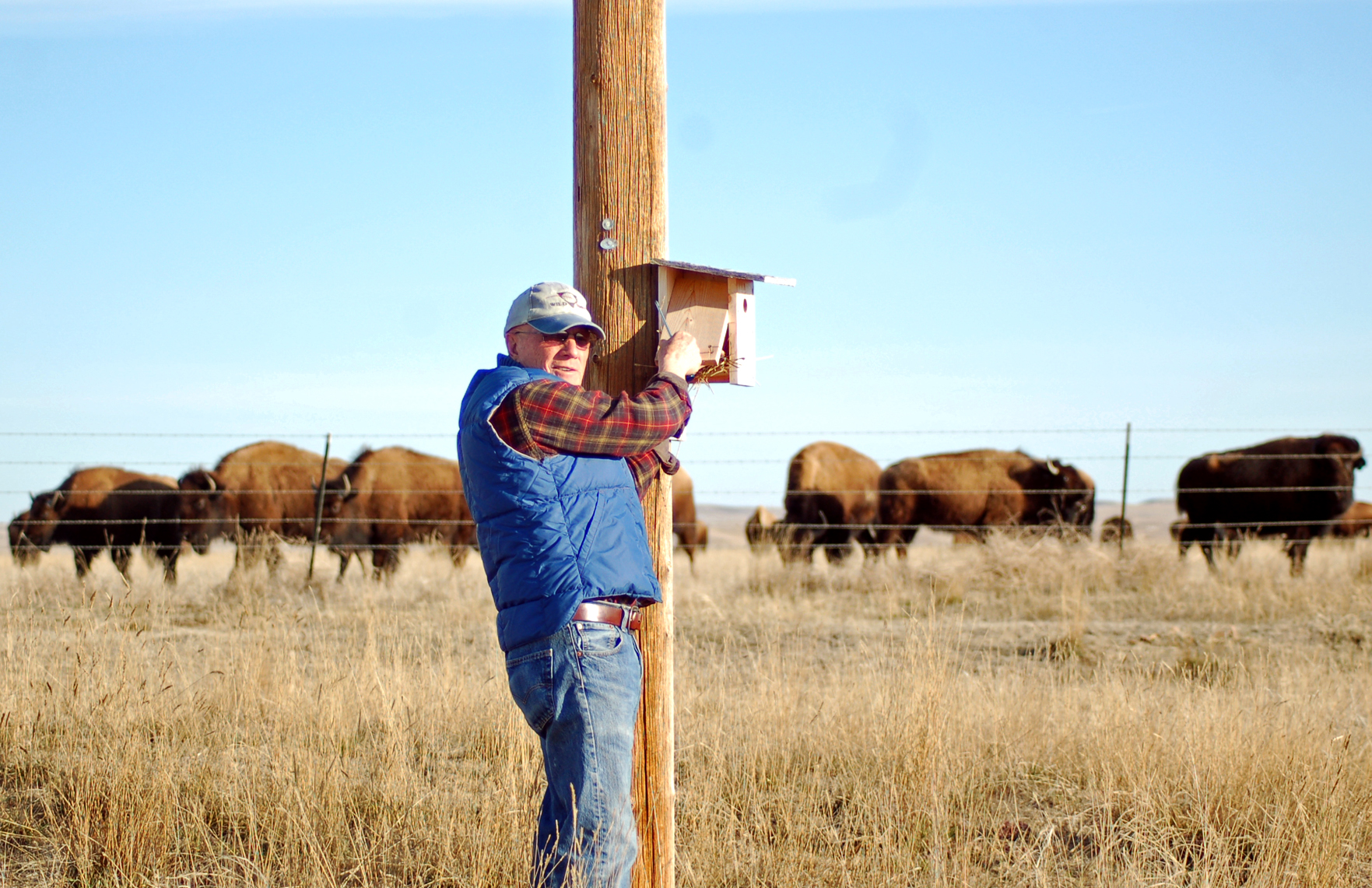
From then on bluebirds were scares in my life. The distribution map in Sibley’s Field Guide indicates that there are eastern bluebirds in South Dakota, but the South Dakota Ornithologist Union says they are uncommon, especially in the western half of the state. I’ve never seen one out here. But on the grasslands, in mid-April we have an invasion the subtle, powder-blue cousin of the eastern bluebird, the mountain bluebird. They are common nesters in the high meadows of the Black Hills and farther west in the Rockies, but I have never seen one nest on our ranch. It is frustrating that every spring, for the past thirty-five years, a day comes in April when they are suddenly everywhere – ten or twelve to the mile, flitting iridescent blue along our fence lines. I want them to nest on our ranch but, when I look closely at Sibley’s distribution map I see a thin but ominous crescent of yellow arching from extreme southwestern South Dakota up and into central North Dakota. It is hard to tell from the map but it looks as if the yellow slash might include our ranch. That shade of yellow is so rare in the distribution maps that I had to look up what it means.
In the Key to the Range Maps I found that the yellow means – MIGRATION. To the east of the yellow, bluebirds RARE, to the west is their SUMMER range, i.e. their breeding range. Who’s to say that that yellow smear is accurate? Who could even say that our ranch is included? Sibley seems to be saying that in their two thousand mile range that there are a few miles where bluebirds are neither rare, nor breeding. I know that I am beginning to sound like Mr. Price but that is okay. I want a couple of those bluebirds to stop on our ranch and raise little bluebirds. It would make my life, my kid’s lives, and the few people who visit us a little brighter. That is why I’m putting up bluebird houses along our driveway.
I expect that the bluebirds will begin to migrate through here any day now and I’ll be ready for them. If I’m successful, I’m going to hang out up there on the driveway and watch the blue birds courting. I’ll watch them forage for insects to feed there chicks. I’ll watch the chicks fledge and I hope that a few carloads of people will stop to watch them too. If they throw trash out of their cars I’m going to gather it up and toss it back in through the driver’s window.
Comments 11
I haven’t seen an Eastern bluebird in 10 or more years – I last remember a flock of a dozen or so in an abandoned farm across from our much smaller farm in CT. But the answer to their scarcity may lie, not in the Northeast or The Great Plains, but in Central and South America where, I believe, their winter ranges in the rainforest are being severely cut back for logging and grazing. That said, couple the birdhouses with the kinds of native shrubbery that attract the types of insects they like and will also act as cover/food/nesting sites for other prairie birdlife. Look forward to a progress report.
Good news Dan, Mr Price is alive and well and living all over the UK! I had to look the Bluebird up, its a very attractive bird. Hope this latest project go’s well.
I enjoy eastern bluebirds here. They like to perch on the topmost branch of the lilac bush and survey the yard. They are beautiful.
I am SO EXCITED! We have mountain bluebirds at the bottom of our hill (at the line between the hills and the prairie) and I’m trying to coax them up the hill (into the trees) by putting up bluebird houses. I’ve cleaned out the houses – some had twig nests, others had fibers and hair – to dissuade squatters. I am SO HOPEFUL!
You tell me when and I’ll bring a litter free car down to visit the birds and the humans!
Eastern bluebirds are alive and well in this part of Virginia, at least. They should be showing up in the Roanoke Valley in another couple of weeks. I built only one box in my yard for them but they seem not to like it even though I built it to all the rigorous specs. They hover and fuss and go into it and quickly come out, and eventually leave altogether and settle somewhere else. But they invariably brighten my days, albeit briefly.
Good for Mr. Price and good for you in creating some habitat for some beautiful birds to keep watch over the bison.
I assisted with the South Dakota Breeding Bird Atlas II which was conducted by Rocky Mtn Bird Observatory a couple of years ago. I found Mountain Bluebirds just east of Badlands National Park on a couple of occasions. They’re not very common in that easternmost part of their range, but they’re certainly present.
Would love to hear your thoughts about Cliven Bundy in Nevada….
Many species of birds have expanding ranges. They’re more dynamic than you would think looking at the maps. Back here in central Ohio, I ‘ve heard it said that all the bluebirds you see now are due to the nestboxing efforts of one person over the last few decades. I hope you’re rewarded with bluebirds!
Eastern Bluebirds nest in my town, but alas, not in my yard. They come and check out the Bluebird boxes and find them somehow wanting. Maybe is has something to do with all the nesting hawks??
Your beautiful bluebirds (like Mr. Cooke, I had to look them up) remind me of our robins here… Though the colours are different the character and plump good natured-ness of the one I saw in National Geographic’s page (http://animals.nationalgeographic.com.au/animals/birds/bluebird/) put me in mind of our Eastern robin and the Mangrove Robin. Let’s hope your nest boxes do the trick…