Last month I mentioned that Dan and I had been to a Sustainable Food Summit, where we were educated on what other companies are doing to be sustainable and how to identify sustainable actions with label certifications. We heard from Safeway, Nature Valley Farms, and Coca Cola, just to name a few. You may be asking yourself, “What was Coca Cola doing at a sustainable food summit”, right? Well, they are using re-usable materials to make their bottles and a couple of other things that I have since forgotten.
There was a marketing expert and several companies that do third party certification. The certifying companies gave several presentations as many specialize in specific certifications, such as: palm oil, humane treatment, rainforest, grass-fed, organic, non-gmo, and such. These third party certifiers were on deck to help producers find the best certification or certifications that would help their consumers know what was in, or not in, the products they produce. We were swimming in options, and felt that the certifiers should all get together and establish ONE certification that stated the food produced was clean, and caused no/minimal harm. I realize this is an over simplification and I do feel that labels are a way of educating the consumer and identifying some truths, but the truths are sometimes a little muddied.
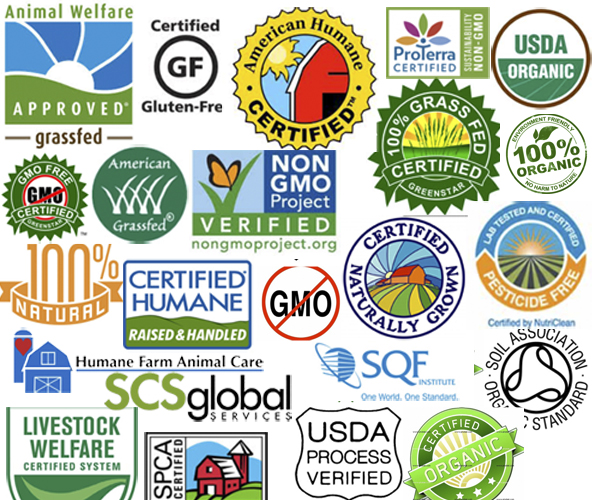
For instance, we were certified with one of the “humane treatment” certifications listed here, and some of the questions we had to answer in the numerous pages of paper work , were: 1.) How many months do your animals have access to pasture? 2.) How many months are your animals confined to a feed yard during the non-growing season? 3.) Do you provide birthing sheds for you animals? I’m certain this criterion was written for beef cattle, but still, I was surprised. Another example would be grass-fed. When we think of grass-fed or organic, we think of wide-open pastures, but animals can be confined and fed grass or organic feed and still be considered grass-fed or organic. Do not get me wrong, I am supportive of many of these labels, and believe that the perfect should not stand in the way of the good. We were very proud of our humane certification, as we believe in it and practice it whole-heartedly. But certifications can be expensive and our previous one had become cost prohibitive with the collections of annual fees and percentages of annual sales.
We are currently seeking out a different humane certification, which does not have such excessive fees, to add to our state inspected claims of: “100% grass-fed, Raised Without Antibiotics, and 100% Humanely Field Harvested”, (no fancy state logo’s).
All of this attention to certification, got me thinking: “Why do the folks that are really trying to produce clean, healthy, sustainable products have to go through all of the certifying?” Why isn’t it reversed? Shouldn’t many processed products, or products produced with chemicals, come with a skull and cross bones? How about proteins from CFO’s (Confined Feeding Operations), perhaps they should have a stamp of a sad/sick animal, and a green house gas admission certification? Alcohol and tobacco companies are regulated and their products come with warnings, why don’t other products that are harmful to human health, harmful to animal health, and/or harmful to environmental health come with regulations or warnings? In addition to them not having regulations or warnings, they can actually use claims that can be confusing to the consumer. Hormel Hams are “100% Natural”, Orange Juice is now “Gluten Free”, and so on.
I think we may all have a pretty good idea on the answers to the questions above. There are a lot of folks out there who are trying to make a difference, and many consumers who try to weed through the layers of information and make the best available purchases for their families. I guess it’s all we can do.
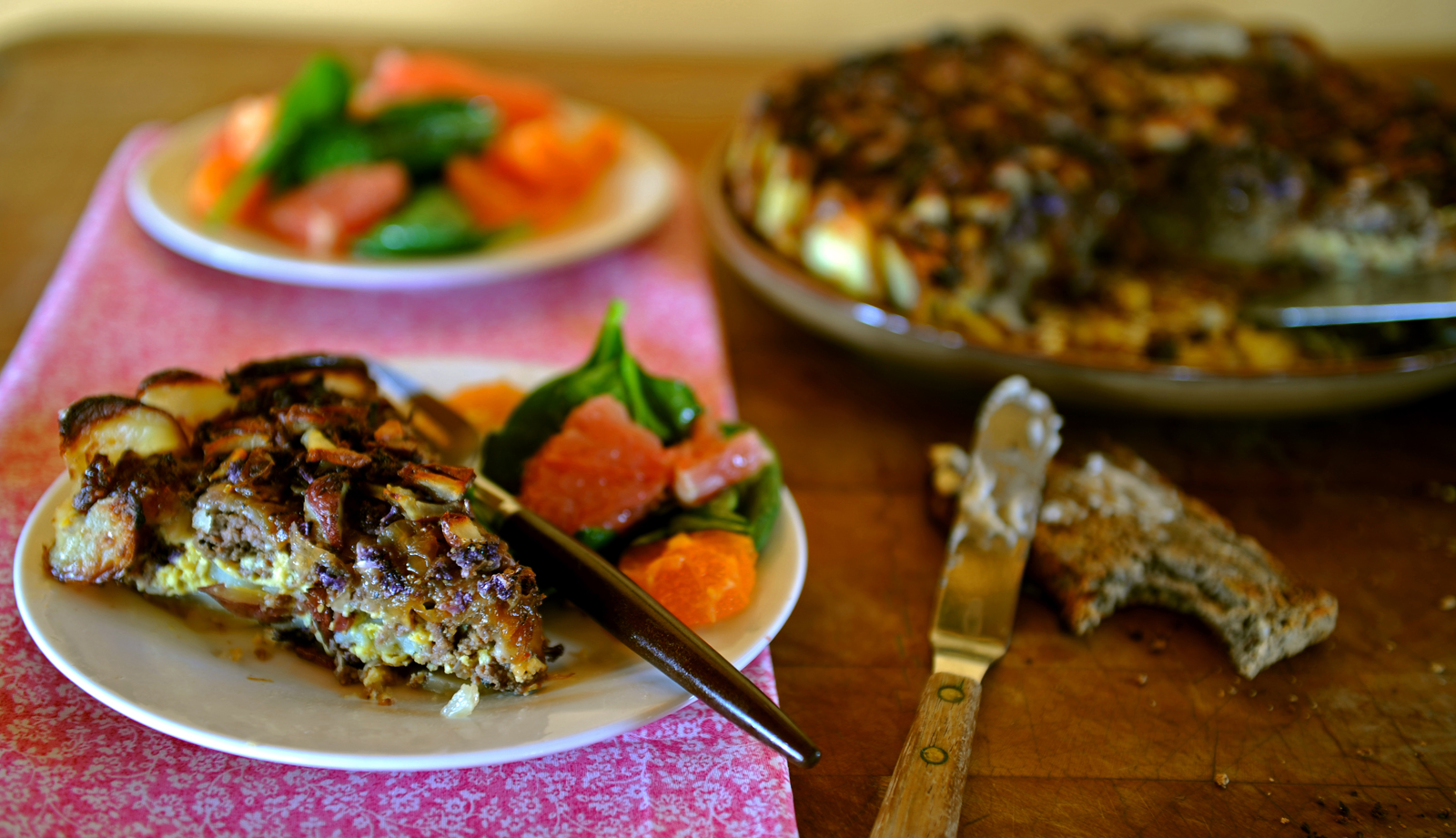
This month’s recipe is made with 100% grass-fed, 100% Antibiotic Free, and 100% Humanely Harvested bison meat, organic potatoes, organic cream, last years onions from the garden, and farm fresh eggs. It’s the perfect dish for a casual Sunday brunch, and it’s 100% delicious! I’ll let you be the certifier of that last claim! Happy Spring everyone! Jill
Buffalo Blue Potato Pie (serves 6 to 8)
Ingredients:
- 1 – 1 lb. Wild Idea Buffalo Breakfast Sausage
- 2 – tablespoon olive oil
- 1 – tablespoon butter
- 2 – onions, chopped
- 1 – tablespoon maple syrup
- 6 to 8 – potatoes, par-boiled and sliced thin
- 2 – teaspoons rubbed sage
- 6 – eggs
- ½ – cup cream
- 1 – cup blue cheese, crumbled
- salt & pepper
Preparation:
1) In oil rubbed heavy skillet over medium high heat, crumble in buffalo breakfast sausage. Stirring occasionally to brown. About 5 minutes. Remove sausage from pan, lightly cover and set aside.
2) Return pan to stovetop and add 1 tablespoon, olive oil and butter. When butter is melted add onions. Stir in maple syrup.
3) Reduce heat to medium and allow onions to caramelize, stirring occasionally. About 20 minutes or until onions are amber colored.
4) While onions are caramelizing, slice potatoes into thin slices, keeping slices close together. Remove odd shaped pieces and ends, and coarse chop.
5) Using remaining oil, generously oil a spring-form pan or skillet. Fan potatoes to cover the bottom and lower sides of pan. Season the potatoes with salt, pepper and rubbed sage.
6) Layer in the following order; browned buffalo sausage, crumbled blue cheese, and caramelized onions.
7) Mix eggs with cream together and add a pinch of salt & pepper.
8) Pour egg mixture over the onions, and sprinkle with chopped potatoes.
9) Place in 400* oven and bake for 45 minutes to an hour, or until potatoes are golden brown and center feels firm.
10) Remove from heat and let rest for 10 minutes before serving.
Serve with a citrus green salad, whole grain toast and Prosecco.
Comments 5
Actually, speaking as a consumer, the certifications are somewhat over-rated, because one needs to know and completely understand the rules in detail in order to decide if the certification means what it is trying to say. In many cases, the rules are so watered down or bent, that the certification is worthless, or worse, downright misleading. (This is how we have “Organic” frozen dinners in some supermarkets, for instance).
My wife and I have extensive scientific backgrounds, and can make sense of all of this, at least to the degree that rules are published, but I think that many consumers are helpless against the invasion of marketing machines into certifications.
I have come to the conclusion that it is better to know the people who produce your food than to rely on certifications, and this applies doubly to meat.
When I recommend Wild Idea to people (I do that a lot), I tell them about Dan and Jill, tell them about outré visit to the ranch, and don’t bother with the certification.
Sorry, “our visit to the ranch”, which was not at all “outré”
Right on Jill, what we need is truth and transparency, not pretty words. And I agree with the writer above, know who grows your food and go for small scale even if they are not 100% organic.
I just read an article how factory farm hog raising in Iowa pollutes the groundwater there just so Hormel can sell cheap spam to China en masse, disgusting!
Angela
Side benefit of being a sustainable small producer, you get to know who your customers are. Appreciate the support. 🙂
Pingback: Wild Idea Buffalo Recipe of the Week – Buffalo Blue Potato Pie | My Meals are on Wheels