Heading east leaving Rapid City, High Way 44 shoots through the middle of a valley that lies at the base of the Black Hills. There are driveways every half mile that are accompanied by little houses with big green yards. The road ditch is kept mowed and the grass around the mailboxes that line the asphalt is always kept neatly trimmed around. Continuing down the highway past the turn off for the airport, the houses become more scarce, as do the driveways, big green yards and mailboxes. Instead, the landscape is punctured by a different kind of man made contrivance. A line of fence that races the blacktop extends beyond the horizon.
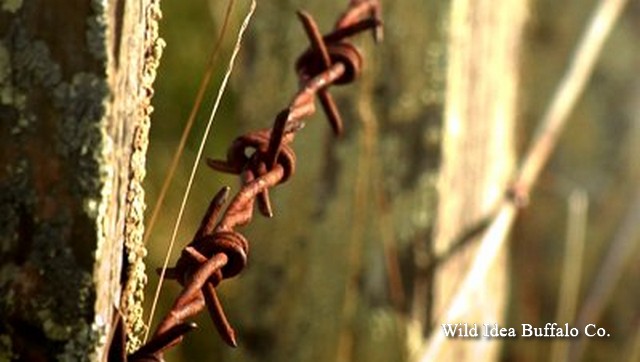
Old Barbed Wire
In 1892 the birth of barbed wire fence sculpted today’s ranching practices. Consequently it also became a physical representation of private ground versus public ground, one individual’s property versus his neighbor’s property.
For over a year now I have been working on a fencing crew that consists of two other gentlemen. Dusty Smith, a shy soft spoken kind of guy that stands about 6 foot tall and 200 lbs. His teeth glow white (when he actually does smile) due to his darkened sun tanned face that border his ivories. Terrance, Jill’s nephew, is the elder of the crew as he is nine years older than Dusty and me. He and I share a similar stature of about 6′ 2″ 220 lbs. He has jet black hair and a friendly face which is composed of jaw bones chiseled from stone. He is responsible for turning Dusty and me into his “competitively efficient” two thirds of a three man crew. We all wear the same apparel to work this time of the year, cowboy hat, white t-shirt, jeans, boots, and leather gloves.
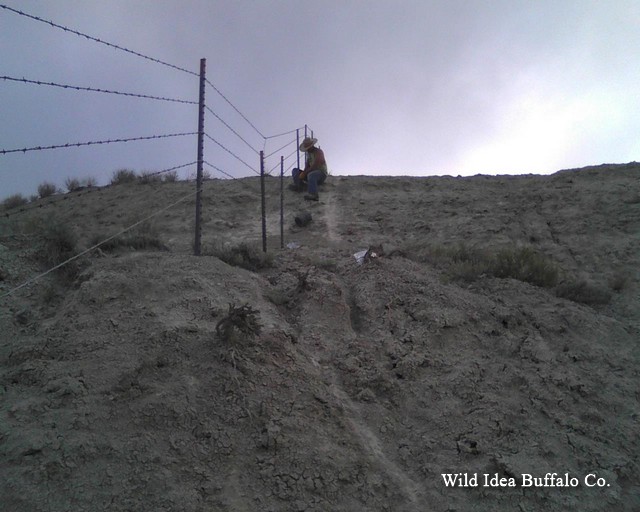
Buffalo Fence on the Badlands
The three of us are currently tearing out miles of old barbed wire fence and replacing it with standard 5 strand barbed wire buffalo fence. Before the pretty new wood posts, shiny steel posts and tight wire are sunk in the ground and clipped up; the splinters of the old wood posts must be detached from the rusty wood staples in order for the kinked and tattered wire to be rolled up. We work down the fence line from one H brace too another in a consistent frog leap pattern that ensures that every steel and wood post is freed from the wire for removal. As we move parallel with the three strands of drooping roan colored wires, we read a sort of story put together over generations from members of each side of the fence. Rusty old style Hamm’s beer cans, Copenhagen lids tacked into the tops of wood posts, and an old steel tractor wheel that someone had tied to the fence to pull the wire down in a steep draw.These are all signatures of multiple generations contributing to the effort of keeping the fence erect.
The process is tedious and tends to get boring. About the time we get to the quarter mile H brace I realize how silent the three of us have been so I usually try to implement a joke; “Terrance, why don’t we use fancy clips like these? I asked holding up a piece of old telegraph wire that undoubtedly ran the width of this country at one point and time but was currently being used to hold up a single strand of old barbed wire. They both look up at me with sweat weeping out of their bronze foreheads, they smile and chuckle and then return to their hunched over position of removing the wire from the post.
All three of us curse this tedious process, but relish the outcome more so than the new fence itself. Two pieces of land are finally reunited for the first time in decades, one big open prairie once again. The site is seen only by a few and cherished by even fewer so we sit and stare at the open ground for a little while. “Cattle are headed this way, we better get her sewed back up”, Terrance said. The process of building the new fence marks a new beginning for the pasture; new residents will soon be calling her home once again.
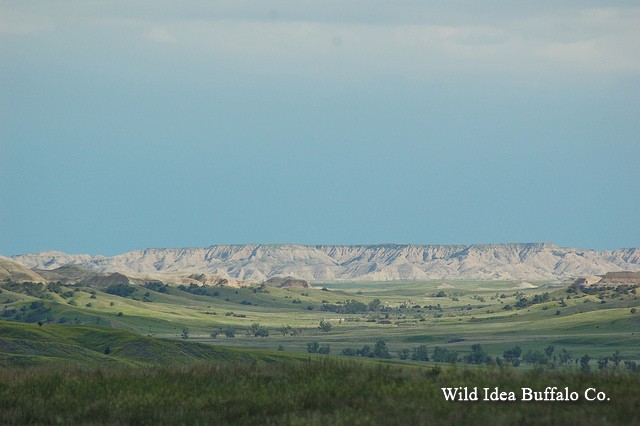
Buffalo Pasture
Comments 12
Great story.
What a descriptive journey that was along the fenceline. Growing up in Kadoka. The photo was so mesmerizing. – and as usual made me homesick. Hope you get the rain Dan prayed for!!!!
Well written It would be interesting to know what parcels of land are being reunited if you are replacing the existing fence. What a beautiful picture of the buffalo pasture!
What a fine fence you weave! Enjoyed reading your story, well done!
Colton, great story! It took me back to when I was a kid and we used to ride the hay rack. Stacking bales 6-7 high. Most of the time it too was quiet work, but every once in a while to break things up, my sister or brother would try and crack a joke to my Dad. It was always fun to see who could make Dad stop or at least laugh. It was hard work but good times. Thanks Colton!
Well now I feel like I did see you guys fencing! Great story!
Hey Colton, Yes, I believe that I know what you are talking about. You got it just right. Hi to the crew from me.
What a great story, so nice to actually see where you guys are working.
It’s BEAUTIFUL !!!
Colton Jones – Loved your story, so personally told. Nice to know there are not only future land managers, but future writers to pass the baton to.
Enjoyed reading about you hard working hands! I’d like to see this country some day. I was raised on a ranch that had miles of barb wire. It’s beautiful in a rugged sort of way.
South Dakota and it’s people ….. the nation’s best kept secret!
Hi Colton !
I remember you this summer, telling us that you were working on fences on the Badlands. We were with Jillian on Dan’s terrace, where you both made us feel at home…and yet we were coming from far away : we had just arrived from France, and you told us how the Badlands were beautiful. The day after, we left the ranch and drove through the area. You were right : this is one of the most beautiful thing we ever saw. Time has passed, and yesterday, we opened this blog : your text is absolutely “magnifique” !!! It makes us almost come to tears … through your words, we feel the dust, the stormy light of the summer days, and the outlines of bisons and working cowboys : but you are not only a cowboy ! this text is nature writing… thank you so so much to make us feel your awsome Dakota . Jacques and Isabelle