We harvested buffalo just north of the small southwestern North Dakota town of Bowman. It was our first time harvesting in North Dakota and we drove up the night before to meet the Director of North Dakota’s Meat Inspection Program and her Senior Inspector. Though a lot of paperwork had passed between my desk and theirs, it was the first time they had actually walked through the Mobile Harvester. They liked what they saw and we spent an hour and a half ironing out the slight differences between South Dakota’s meat inspection regulations and North Dakota’s.
The whole crew was tired when we hit the sack but we were up at five o’clock to get out to the buffalo ranch by six o’clock and be set up at seven. The inspectors were there by seven-thirty and we checked and cross checked to be sure that everything was just right. Before Jerry and the Senior Inspector drove out to shoot the first buffalo we all stood at the rear of the Mobile Harvester and went through the safety procedures. Shane went down the list. “Always be thinking safety. We got sharp knives, guns, slippery floors, and heavy buffalo on high rails. Steady is better than fast. Everybody think.”
Jerry drove the semi and carefully shot the buffalo, Shane and Cory were on the skinning floor, and my brother, Scott, and I were there to move the heavy offal barrels, hides, and heads away from the Harvester as the animals were processed. By the end of the day we had moved over two tons of not very pleasant material to sanitary places. It was hot, dirty, and windy work but the day sped by. By three o’clock eight perfect buffalo carcasses hung cooling in the refrigeration room of the Mobile Harvester.
The inspectors were gone for the day but they would be back the next day to do it all again. We finished sterilizing the harvester and pulled it out of the pasture. Everyone was tired and needed a bath, but the skinners were the most tired and ready to go into town to eat and get some serious rest for the next day of harvest. But Scott and I weren’t ready to quit and it occurred to me that we were only sixty miles from one of America’s most interesting historical sites. “You every been to Medora?” I asked.
“What’s Medora?” he asked.
“Medora was just an old cow town. But the area is all about Theodore Roosevelt. The national park is named for him and he had two ranches in the Little Missouri River badlands.”
“How far?
“Hour by the asphalt and maybe two by the gravel.”
We took the gravel and as soon as we turned west the land changed from huge islands of grain fields to rolling prairie that soon became the breaks of the Little Missouri River. Our gravel road converged with the deep and beautiful portion of the badlands near where Deep Creek and Sand Creek snake down from the south. In a matter of a few miles we left the grain fields behind and burst onto the high ground overlooking the hundreds of square miles that were the domain of Theodore Roosevelt between 1882 and 1887. Here, not forty miles from where we had harvested that day, was the site of Roosevelt’s first meeting with the last of the great herds of buffalo that for centuries have defined the Great Plains. 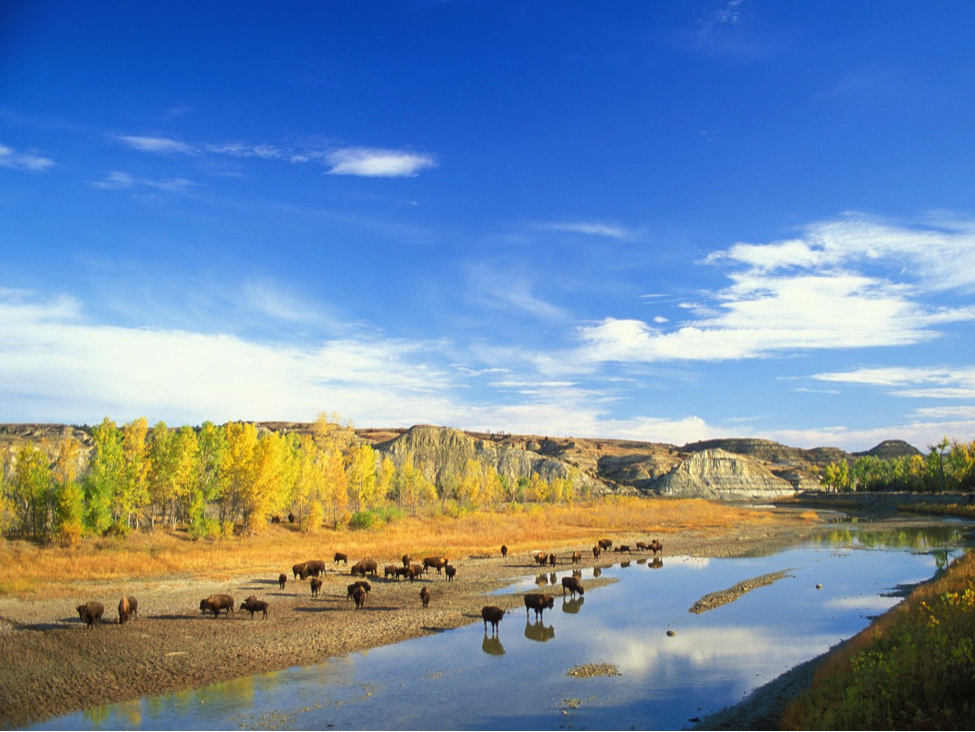
Roosevelt arrived here when buffalo numbers were at their lowest ebb. The remnants of the millions had found temporary refuge in the rugged badlands that stretched out in front of us. Even then it was a stronghold of pre-industrialization Great Plains habitat and the place where a frail young Roosevelt developed the character not only to become the 26th president of the United States, but also to formulate a model for living a vigorous life. Ten years after he left his badlands ranches he gave a famous speech in Chicago where he articulated his belief that the character of all Americans should be forged in the furnace of physical hardship and energetic exertion. He named the speech “The Strenuous Life” and he began by saying:
I wish to preach, not the doctrine of ignoble ease, but the doctrine of the strenuous life, the life of toil and effort, of labor and strife; to preach that highest form of success which comes, not to the man who desires mere easy peace, but to the man who does not shrink from danger, from hardship, or from bitter toil, and who out of these wins the splendid ultimate triumph.
Roosevelt turned out to be a tremendously successful president. He could be kind, political, and intellectual but he was also forceful, pugnacious and doubtlessly the president that best understood the natural world. Along the side of the gravel road that we traveled toward the tourist town of Medora were turnouts overlooking the land where Roosevelt learned, and lived out his belief in the 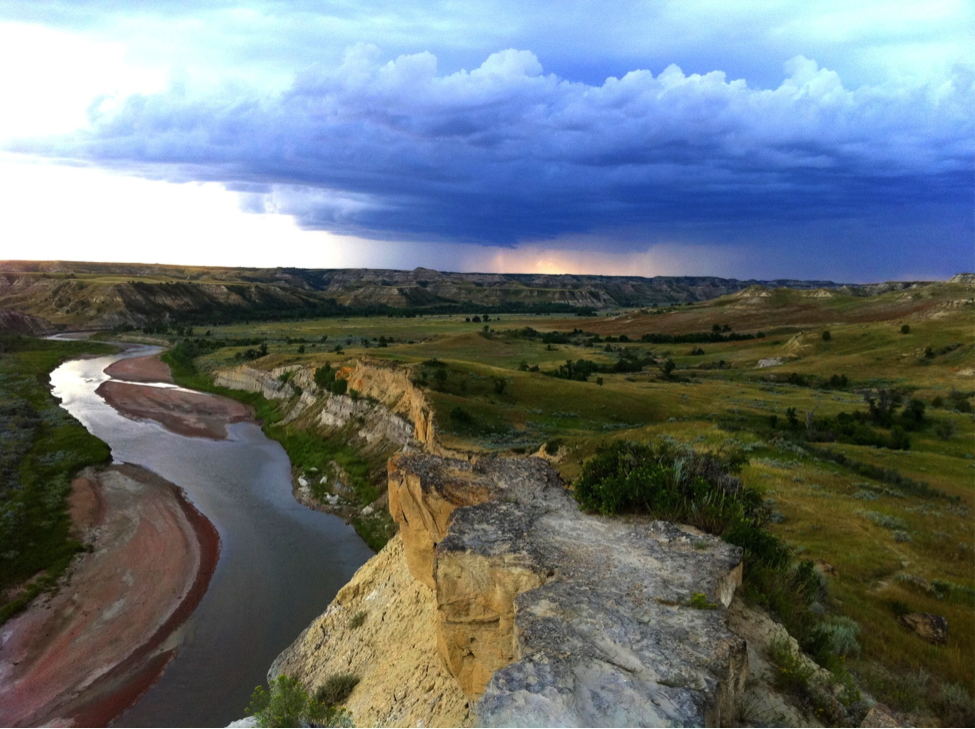 strenuous life. I recognized some of the designated campsites and trail heads as places where Roosevelt hunted day after day in the pouring rain, where he gathered cattle for weeks at a time – sometimes spending thirty hours straight in the saddle and wearing out a half dozen horses. He worked, sweated, and slept under the stars with the common cowboys in the land we drove through. Occasionally Scott and I could see a parenthesis of blue where the Little Missouri River made a turn far below and I wondered if, in the sub-zero winters that did not faze him, Roosevelt had crossed the ice clogged river at that very spot. We crossed drainage after drainage and noticed a trailhead and parking lot at each intersection. But the camping areas and parking lots were empty. For thirty miles through Roosevelt’s training ground for a strenuous life we did not see a single person.
“Where are the people?” Scott asked.
I shrugged. Having the Little Missouri breaks to ourselves was fine with me – but it was kind of creepy too. It was the beginning of tourist season, the tourists came here because of Roosevelt and right there, winding through the country that built that icon of national character, we did not see a solitary American. Not until we came to the outskirts of the tiny town of Medora did we even see a car.
It was early evening and we were tired and still dirty but still we had to knock on three motel reception desks before we found a room. We drove around town for forty-five minutes but the streets were nearly abandoned. “Where is everybody?”
“They have to be here somewhere. We got the last motel room in town.”
We need a bath and a change of clothes but knew that, if we went to the room, we’ll fall asleep and not even get anything to eat. Instead, we went in search of the tourists.
When we stopped for gas at the only convenience store in town and we asked where everyone was. “No sign of anyone in the National Grasslands,” I said.
The attendant shrugged. “No, you won’t find anybody out there in the breaks. They stay close to town.”
“Well,” Scott said, “Where are they?”
He looked up at the clock on the wall. “Seven o’clock, he said. “Probably out at the Musical and the Pitchfork Fondue.”
Scott and I looked at each other. “Where is that?”
“Other end of town. Up on the hill. You guys hungry?”
“Starving.”
“You’re going to love it.”
There were several historic sites that we would have liked to check out but they were closed and we would be gone before they opened in the morning. There was a sign for the Musical and the Pitchfork Fondue and we followed a road up the side of butte that rose over the river where it meanders passed town. As the road rose we began to anticipate the view we would have of the river and of the testing ground for Roosevelt’s strenuous life and, when we leveled off at the top of the hill, we both gasped in amazement. The view was truly incredible but that is not what we were gasping at. We were suddenly in the middle of a huge, paved parking lot with hundreds of cars, pickups, and recreational vehicles. There was a row of busses strung out between two beautiful modern buildings. One was a gift shop and ticket booth for the amphitheater above the miles of wilderness trails and campsites that we had found completely empty. The other building was designed to match the gift shop and hundreds of overweight people in Bermuda shorts waited in a serpentine line for their feedlot, rib eye steak, deep fried on the tings of a pitchfork.
We parked the car and, not quite ready to look closely at the Pitchfork Fondue, inspected the Musical. It was a play about Theodore Roosevelt in the North Dakota Badlands. Hundreds of tourists were about to pay for tickets to be spectators of a musical celebrating the strenuous life of Roosevelt. But not before they had a little snack of fatty meat, fried potatoes, and desert.
We walked along the line of grinning tourists that looked more like a line outside a diabetes clinic. A surprising number tapped away at iPhones while below us, and stretching to the far horizon, was all that beautiful river break country – completely devoid of people. The greasy cloud above the fondue kiosk was drawing people like flies and Scott and I had to have a look. Twenty-five pitchforks, with three or four sixteen ounce rib eyes on each one, leaned up against the railing. A half dozen foreign student workers, sweating profusely and wearing tawdry replicas of cowboy outfits shuttled pitchforks laden with raw rib eyes to the huge vats of boiling oil and hurried the mud-brown, deep-fried blobs to the waiting plates of clambering tourists.
We were awfully hungry but we just couldn’t do it. I’m not sure what Scott was thinking as we made our way back to our car and down the hill toward our motel room. But I was thinking of two things. First, I vowed that I would do everything in my power to see that none of the buffalo meat we were harvesting there in North Dakota would have a fate like those rib eyes and, second, I was thinking of the last line of Roosevelt’s Strenuous Life Speech:
Above all, let us shrink from no strife, moral or physical….. for it is only through strife, through hard and dangerous endeavor, that we shall ultimately win the goal of true national greatness.
Comments 16
Thanks for a wonderful commentary on our “modern” way of life. My husband and I visited Theodore Roosevelt National Park last year and loved the wildness and loneliness of the terrain.
Keep up the good work. We enjoy the buffalo. bobby & Sandy Lynn
Dan, love your writing. Man, it just says exactly what needs to be said but in such a beautifully poetic way. I’ve experienced this scene at many national treasures as well. I live by Glacier Park and same thing here (statistically, only 1% of the tourist get out of their cars and venture off the asphalt). It’s an entirely different world just a few steps away! It makes me so sad, almost to the point of not wanting to travel in the States anymore 🙁 I question what we are becoming, how we are becoming a “numbed and dumbed” society that must constantly be stimulated by a screen instead of ‘looking’ at well, Life. It scares me, bums me out and just plain ol’ frustrates me. I almost feel as though we are evolving into something else (or de-evolving). And don’t even get me started on the ‘food’ the majority of Americans consume. What happened to respect for nourishment, which gives us life, which gives us…oh you get it. All I can do is send love and positive thoughts to the world in hopes it will ‘click.’ I’m so glad you do what you do and say what you say 🙂 Be well. Hugs to the Herd.
Holy wild. Amen brother.
Dan, thanks for this story. I have found it interesting how a dirt road eliminates most tourists. A few years back my son was working for DRA in Brookings and recommended your book, Buffalo for the Broken Heart. I loved the book and am also an ongoing customer of Wild Idea. My son is now in Africa in the Peace Corps and missing certain luxuries of the US even though he knew the choices he was making. I struggle with what to tell him sometimes. I think I will just forward this great story to him.
Dan what a wonderful piece on the denial of our culture – our blindness to the facts of health, healthcare, exercise, and what we put IN our bodies.
I watch the reports that now place the USA in 27th place in the world this year! This is the USA, ladies and gentlemen! And we spend 20% of our GNP on healthcare!
If you have never read the blog of Dr. John who is a cardiologist in Lewisville TN treat yourself and check him out…..balanced, wise choices. That is his topic today…thus my stats!!!
Dan,
One of your most searing and memorable essays yet. Makes me weep.
Doug
Sounds like a great adventure. I’m so proud of you for not eating the beef!!haha Your harvesting in-site was as good as the adventure story. I have so many friends that are Vegans, I just don’t have that will power, so your Buffalo meat is all I eat. I will google this area for sure and learn more about this park you talked about. Thank you for your story.
Just wow.
Thanks, Dan. I appreciate you and your team’s lack of enthusiasm for the pitchfork fondue. I never encountered that in Medora. I was only in the town for a bit on my way through to camp in the North Dakota Badlands, along the endge of that beautiful river. Thanks for the photos – it is a lovely spot. You’re right – it’s pretty deserted. During the time I was camping there I ran into only one other camper, a Canadian.
Dan,
Esther, , Cris Fulton an artist friend from Bowman and I also made the same trip up the east river road to Medora, God’s country Love it. this was in May it was raining off and on. We also made the loop on the S Unit of Teddy Roosevelt Nat’l park it was a great trip wouldn’t change a thing.
I saw the mobile harvester in action. the following week same ranch that is the only way to humanely harvest animals. Next time you are up in the Bowman area let me know
Another beautiful piece of writing, Dan. My eyes, like Doug’s, often sting with tears when I read about your life.
This is a wonderful piece to read! My family lives a little bit east of Medora near Belfield and Fairfield, and I’ve been back there 3 years in a row to visit and do genealogy research. They have fabulous grass-fed beef and would take the Pitchfork approach to any of it. I’ve seen a few buffalo on ranches nearby but don’t know that anyone is selling it. The country there is beautiful – I love the badlands and the starkness of the landscape, as I was born there. I’m so grateful that you take such care with your buffalo – it’s a real treat to get that package on my doorstep!
Dan,
One of your best columns. I felt like I was right there harvesting. Having been to visit you & stay in the ranch house and ride the hills with Gervais in 2004 and photograph the thundering herd with my husband Richard, columns like this always take me back,
However, more important was your commentary on the habits and mentality of tourists and unhealthy lifestylized America. Well, get ready. If the House passes the so-called immigration reform act (S744 already passed the Senate) we can expect the changes in visas/green cards to invite and subsidized 30-33 MILLION more people from all over the world to come to our country in the next decade to look for jobs (never mind the current unemployment rate) and then we’ll eventually have even more overweight, unaware, materialist humans to overpopulate our sacred continent. See http://www.numbersusa.com for a population map by county to see how the population in every county in the US has grown since the 1980’s (keyword population map) and how anyone can protect and defend our country from the debacle.
There comes immortality in your prose. A constant flow in this beautiful piece of work. Provocative, inspiring, noble observations. While I look forward to it being on my shelf someday, I dream of millions being able to consider the value of ‘the strenuous life’ through a film production.
Thanks DH
Interesting observation. It makes you wonder if there is any sense in adding any more “wilderness” type of areas here in western South Dakota if they are not going to be used by anyone.