Last winter I wrote a monthly musing that talked about a group of buffalo that had recently been gathered on a cattle ranch in south Florida. A buffalo producer that we work with here in South Dakota had sold some buffalo to that ranch and, since I had driven around those buffalo as they happily grazed on big pastures of native grass in northwestern South Dakota, I wondered where they ended up and how they were doing. My brother and his wife have a retirement condominium in Fort Myers and during a visit, when I got bored with all that humid sunshine and sea food, I set out to try to find that lost tribe of South Dakota buffalo.
There isn’t much farmland in the immediate vicinity of Fort Myers but I knew there were fruit orchards and some cattle farms north and a little inland. I set out in that direction and by asking gas stations cashiers and guys with cowboy hats, I finally found myself out of the urban clutter and into an odd, savannah-like country, surrounded by citrus trees and dotted with short haired, long eared cattle that looked as if they had come from Africa, or India. I wandered around hard surfaced country roads, searching the horizon for buffalo as I would do on the Great Plains. But the earth down there has none of the gentle curvature or grand vistas that buffalo have thrived on for tens of thousands of years. It’s difficult to see at the scale I’m used to, so for a couple hours all I saw were those floppy eared cattle and the strange palm trees that rim the pastures.
I had nearly given up when a familiar dark line of animals appeared a mile ahead and another mile off the road to my right. I was pretty sure they were buffalo even before the rusty cattle fence along the road turned to new, taller, buffalo fence. I pulled into a set of buildings and right into the noontime break of a group of Florida cowboys that was the most familiar thing I’d seen all morning. They were a fencing crew and they told me that they had been building buffalo fence for months and had miles more fence to go. I asked questions about what they thought of the idea of bringing buffalo into that country and I got the universal cowboy shrug and non-committal comments. They weren’t too sure about the whole idea. They didn’t see what was wrong with the cattle that were being moved off to make room for the buffalo. “Them old brahma crosses are kinda bred to stand the heat,” an older man said.
“Bugs too,” an Hispanic looking guy added. “There’s some nasty bugs around here.” He shook his shoulders like a spider might be crawling up his back and they all laughed.
When I asked about the plans for the ranch they shrugged in unison. “Boss is over in that building. We’re just workers.”
The boss was a pleasant young man who was happy to show me around. He had no previous experience with buffalo or ranching but was building a big ranch with grand plans to market grass-fed buffalo to the population centers in south Florida. I wasn’t sure how well buffalo would do on the semi-tropical Florida grasses after evolving to eat only the grasses of the temperate Great Plains. I figured he was in for some tough lessons but I had to admire his positive attitude and entrepreneurial spirit. He was rightfully proud of his ranch and proud of the changes he was making. He showed me the map of the ranch; where all the water was, what was fenced for buffalo and what was yet to be fenced. We drove out to see the loading chutes where buffalo were being unloaded from all over the west. I explained that I was anxious to see the South Dakota buffalo. I wanted to be able to tell the folks back home that I had seen their buffalo and I was curious to see how they were doing. I planned to tell jokes about how I’d seen their buffalo when I was on vacation in Florida – I’d say that they were all wearing sunglasses and Bermuda shorts.
And when I did see them, they looked pretty good. They had only been off the trucks for a week or two – just a couple weeks since they’d been standing in the freezing winds of the Great Plains – but they looked better than some of the other buffalo who had come from all over the country and had had more time to rest.
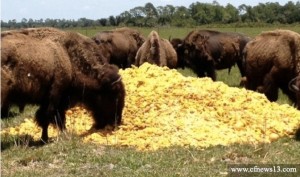
I thought about those displaced buffalo on and off for the last six months but hadn’t heard how they were doing until a friend emailed a web link to an article about them. The article said that the buffalo of south Florida were lethargic and a vet had been consulted. The vet recommended that they feed them some oranges. No lie – he said they needed orange pulp. I am amazed that there is a vet in south Florida who knows anything about buffalo. South Dakota has more buffalo than any other state and even out here it’s hard to find a vet that knows much about them. I guess that is because our buffalo never get lethargic enough to need a vet. Heck, I didn’t even know oranges were a good substitute for wheatgrass, grama grass, and blue stem. I had no idea that citrus could take the place of a stiff, cold wind or that orange pulp can cure homesickness.
Comments 17
I am a new customer and have enjoyed your bison very much.
I am a 68 year old lawyer in Burnsville, NC. I was bragging on your product to a mutual friend Tom Trout. I just though I would I would pass on that he is ill. He has an aggressive form of prostate cancer probably caused by Agent Orange exposure in Vietnam.
Keep up the good work .
Robert A Phillips
That was a great, sad read, Dan. Whiskey, Tango, Foxtrot.
I hope the orange pulp doesn’t have a lot of pesticide’s in it.
Thank you so much for the story. We live in Alabama and it is hot and humid here. We are Cherokee Indians and we love the buffalo. I could not picture Buffalo in Florida, but I guess the story has a good ending. I know that they’re rather be in the Dakotas where they’re at home but I guess like us humans, they do adjust. Thanks again , Rosa Jones
Sounds great! There are alot of bison in Florida and are well cared for. They won’t be starving or freezing to death. Once their coat adjust to climate, they will thrive
Bisons coats were made for colder climates. Their relatives migrated form Siberia. Although they may survive in Florida, the Great Plains, their home is where they thrive.
I love buffalo…
Orange peals, lemon peals and perhaps palm branches. They’ll adjust. We’ll all adjust. Or will we? Don’t you wonder how much ecological mischief is engendered by this kind of “engineering.” Irony galore! How quickly can you transfer a hundred generations of biological harmony by such transplantations? Whether rabbits in Australia or penguins in south Texas or crocs in Alaska, there is something about home, habitat and belonging. You gave us the irony. It takes! Alan
No disrespect intended, but the idea that it will be just fine, the buffalo from Dakota will “adjust” to Florida, needs to read, or re-read Dan’s book, BUFFALO FOR THE BROKEN HEART.
I live less than a mile from the Tupelo Buffalo Park in North Mississippi where a herd of buffalo have been living for years. They all do just fine and look healthy although it gets really hot here in the summer – usually starting in early May and ending toward the end of September. There are many other animals there, too, since it is a kind of zoo, although most of the animals, including the buffalo, are not caged but roam about the pastures as they please. I’ve never seen them feed them orange or lemon peels.
Perhaps the buffalo will survive. Maybe they will even thrive. The question is,” Why?”
This is a heartbreaking story.
I agree., A heartbreaking story. We all, including animals, need to be Home, where the Heart is. Yes, and why was it again that they needed to be in Florida in the first place?
Nancy – You hit it on the why? The idea is to bring “local” buffalo meat to the 19 million plus people that live in Florida. Local is a good idea and we are supportive, but it does not work for everything. We have no intention of plowing up native prairie to put a citrus orchard in, to provide local citrus to South Dakotans. But others missed the point of Dan’s story too. It’s not just about an unhappy animal,in an unfamiliar environment, which could very well lead to an unhealthy animal, but it will also lead to an unhealthy eco-system. Things thrive where they belong and all the other things that co-evolved with them thrive too. Removal of a specie, or the addition of a specie disrupts natural habitat and natures way. The loss is costly or worse irreversible. It is unfortunate that humans are such slow learners.
Having spent some summers in hot South Dakota and having had a hell of a time to “adjust” – not comparing myself to a buffalo – there is always a “point of no return” – for everything! And this story about the displaced Buffalo just makes it all more clear! I just hope they are ok and my heart goes out to them, but really – who will care? Besides Dan and you and some other people who were touched by his book “Buffalo for the Broken Heart” – and the great work you do! The buffalo thrive at your places because you have a connection – to the land, the animals and the People – but what does the guy in Florida know about who the “Buffalo” really is?
I live in a small rural community in Germany and buying “local” as well as “organic” has become topmost priority – but even here some people fall for the easy scheme – as long as it it declared “BIO” which is the word Germans use for Organic” they comfort their social and ecological consciousness – doesn’t matter if the strawberries are from Spain and not from the area as long as they have the “BIO” on the package – same goes for eggs, potatoes,etc., and of course meat. Hell, we even have some people here in Germany who raise buffalo – can you believe it? (Now, these are really displaced, aren’t they?) I’ve tasted their meat and while it’s still good, it’s not the same as meat of a buffalo who lived on the SD plains……
Brought tears to my eyes. Yes, we all do adjust, but gotta think prairies are best.
Weren’t there bison in the eastern states at some point? They are just exterpated??? But maybe they just weren’t so far south as Florida?
olala, it is disgracefull ; making poor bisons live with the terrible humid Florida heat is a crime ; human stupidity has no limit !!!
Astrid from France