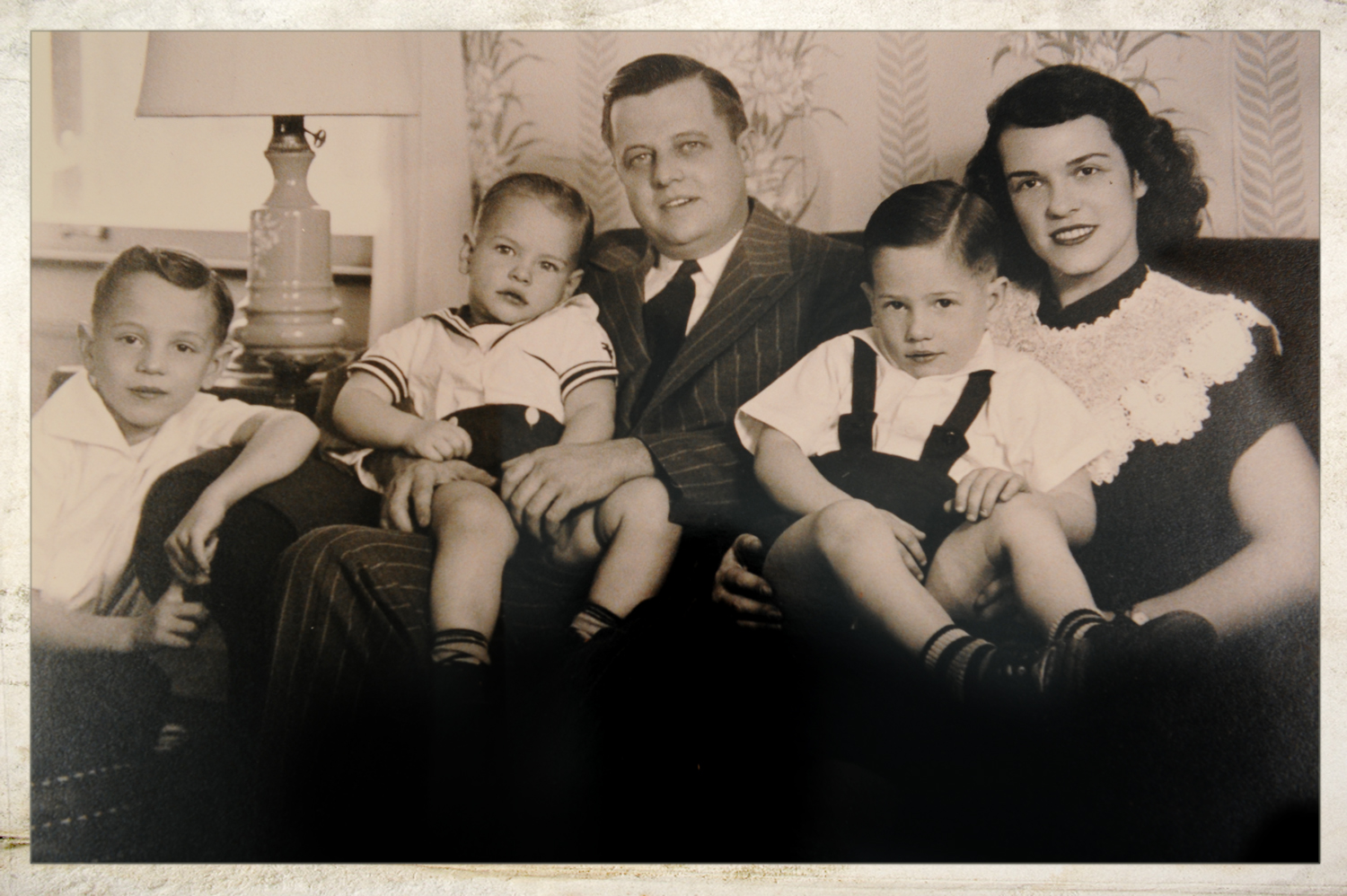
 Times and places are fuzzy to me. I have to think hard to remember when I graduated from high school and can only remember two words from Spanish class. I can’t remember street addresses where I lived for decades or the names and faces of old girlfriends. I recall very few details of Christmases past.
Try as I might, there is no recollection of a single Christmas present I received as a child. There is a vague memory of carrying a candle at a Christmas Eve service at the Presbyterian Church – driven more, I suspect, by latent pyromania than religious fervor. I can still feel a bit of the anticipation of Christmas mornings in those years between when my father served in WWII and our family began to fret about Viet Nam. There was a neighborhood cat that my mother let in for dish of milk that was chased up the Christmas tree by our cat. I remember the tree toppling over, but I can’t remember the cats’ names or the color of their fur. About the only thing that my mind has stored is the aura of the Christmas Eve meals at my father’s mother’s house.
Grandma Wesie lived alone in a huge Victoria home right beside our modest, brick house on the corner of Locust and Main. My father’s sister and her family lived a dozen blocks away in another modest house and so it made perfect sense to have the holiday gathering at Grandma’s house. In later years, the modest homes would be expanded, with two-car garages and patios build in landscaped back yards. And as my brothers, cousins, and I wandered off to lives of our own, the old Victorian that housed my grandmother would fall into disrepair. But in those most important years, between cognizance and college, that castle of a house would generate my only fully formed childhood memories of Christmas. And thankfully, those memories were not of simply material things – unless you consider food as merely material.
In fact, although we had much more than many people, ours was not a material Christmas. I recall very clearly the Christmas Eve when the food, the conversation – and, no doubt, the plentitude of drink – was so intense that the cousins were gathering up their hats and coats for the trek home when some forlorn youngster pointed out to the adults that we had forgotten to open our presents. That was the Christmas Eve that I first tasted oyster stew.
For the Christmas of 2012, oyster stew will not be remarkable. But for a mid-western Christmas in the late 1950’s it was about as exotic as it got. The stew was conjured up by my adventurous mother. She and my father had tasted them when they were stationed on the east coast during the war. Recently, she had been seditiously studying a great, heavy book that was so revolutionary that it was effectively banned in our mid-century Ohio hometown. The Gourmet Cookbook stood elegant on the shelf above her stove like a tomb on alchemy and I marveled at the fake, gold-leaf and the wear that was already showing on the embossed cover. I have no idea where she got the oysters. No doubt, in the middle of the country before there was anything like flown-in seafood, they were not at their peak of freshness. But the details of the oysters’ origins have faded to obscurity. What I remember is the stew itself – the way the butter floated on the rich, pungent broth, the nuggets of goodness dredged from the bottom of cup, the salt on my tongue from the nifty little crackers.
Though there were only eleven core members of the dinner party. I can remember two perfectly browned turkeys, a glazed ham, and steam rising from a dozen side dishes. There were candles, crystal, and gilt edged gravy boats with dark and light gravy in profusion. There was a giant bowl of mashed potatoes; mixed with loads of butter in the impossibly heavy, white mixer that mom would let us operate – if we were very careful. When they could, our cousins would procure, at the AME church, Ada Tate’s yam casserole. Pure decadence – cooked to a candied glaze and topped with the then-unheard-of garnish of chewy marshmallows. When it was all laid out in that thread bare, formal dining room with the built-in mahogany side boards and the massive chandelier, it was like a Bergman movie set.
In my earliest memories there are no fresh vegetables after winter killed the local gardens. Everything was in a can and, to this day, I prefer the taste of canned corn and peas. I was nearly in high school when the idea of frozen vegetables was finally accepted at that Christmas dinner table. It must have been about that time that I tasted my first shrimp cocktail – horseradish, my God. I can especially remember the cheese soufflé that mother made just for me. I remember learning to love Brussels sprouts and asparagus. Beef Wellington and goose with plum sauce was easy to love. Over fifty years later I think of twice-baked potatoes, crème brulee as a side for pumpkin pie, and that virgin sip of Cabernets. I can still see a Christmas table set with multiple forks and spoons.
If your memory seems to be poor, perhaps it is simply discerning. In any case, it is a good way to prioritize your life – a surefire way to puts things into perspective. Although I can’t remember my classmate’s faces, the name of my first grade teacher, the score of single football game, or the gifts under the Christmas tree, I do remember every loving morsel of food that was laid on that Christmas table. It is as real to me as if it were, just now, rolling over my tongue. Feliz Navidad!
Comments 8
I just loved reading this. It’s like I was there seeing you all and the house and the table set with the beautiful dishes. And oh the food! Thank you for writing this , it surely added to my Christmas!
Happy Birthday Dan!
Thanks, Dan. I thought I was the only one who could not remember what so many seem to vividly remember for the rest of their lives..e.g. school cliques and football teams. I remember my pets, my children’s witty comments, Pop-pop’s pipe (and my husband’s), details of remodels of old houses, deserts, mountains and sunsets. Geography and minute details of nature. Add in food and life is complete. Oh, and two teachers, Mrs. Bell in third grade who was soft and loving and Ms. Seagram in seventh who firmly fixed compound interest into my soul. All higher math was never as useful.
Dan,
I just wanted to wish you and the crew a joyous holiday season.Your doing an awsome job.best of wishes for the coming holiday season
Bob and Esther
Wonderful piece, Dan. And, yeah, wth with our childhood generation’s love of the canned vegetable? 😉
I love your description of the steaming dishes, the excess in the absence of resources. There is something about the holidays that makes even the most reluctant cooks go the extra mile. For this Thanksgiving, I decided that I would make it relatively easy on myself: small but beloved crowd, so just bison steaks, gravy, potatoes, veg, etc.
However, that meant that I spent the day before rendering buffalo fat, cooking down buffalo soup bones–in essence, recreating the “big cook” anyway. And I loved it.
Thank you for providing food we can feel good about cooking and eating.
¡salud!
For a man with a poor memory you paint a vivid visual though in my grandmothers home in upper NY state…where I was introduced to foods
new to me, like celeriac, or leeks vinaigrette or steamed scallions on
toast and the love of cooking fresh vegetables year around brought to
the door by a horse and cart every morning. Thank you for bringing your family food history, images alive this time of year prompting mine too to surface.
Oyster stew, lutefisk, lefse…all Norwegian delecasies in our house. They defined our Christmas celebration, added bonus was beet pickles and watermelon pickles. Thanks for your wonderful memories. A joyous and blessed Christmas to you and yours and a happy New Year too.
last night, I dreamed of watermelon pickles. Dakotans had little fruit and watermelon varieties then were not easily grown on prairies so many thrifty home keepers pickled many food items instead of throwing them away. Many in our family didn’t appreciate oysters but we still honor those who came before by having oyster stew on the night before Christmas.