The Sunday New York Times recently held an essay contest asking whether eating meat can be ethical. As conscious carnivores,this an issue we often discuss. The contest inspired Dan to share his thinking on this topic and explain why eating meat that is raised in humanely and in a responsible manner is in fact ethical. Below is Dan’s article as well as a link to the New York Times contest winner:
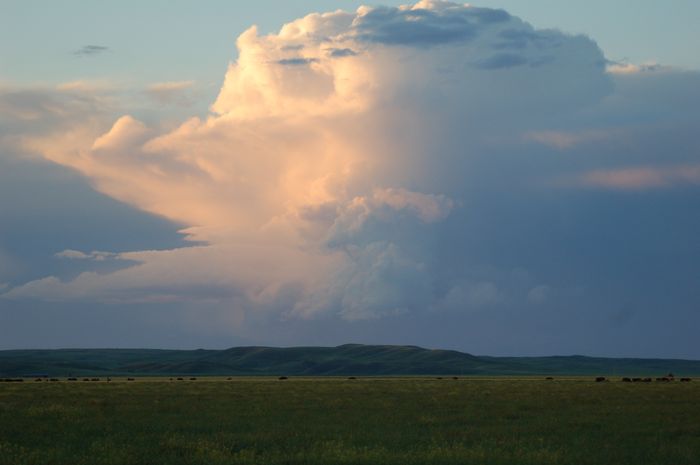 My perspective on the ethics of eating meat is anchored in 500,000 square miles known as the American Great Plains. I argue that raising free-range animals and eating their meat is a critical way to protect that vast midsection of our country from destruction.
The literature concerning our ethical relationship with animals contains little about eating animals per se. I find reasoned arguments on the ethical treatment of animals that render modern, factory-farming indefensible. Confinement feeding and production slaughterhouses are clearly ethically bankrupt. But eating animals and poor treatment are not necessarily linked. The Pine Ridge Indian Reservation is my neighbor and we both raise free-roaming buffalo. We have sacred codes concerning how animals are harvested and the importance of a bio-diverse landscape. We view buffalo and their eco-system as a single thing and we know that neither can survive without the other.
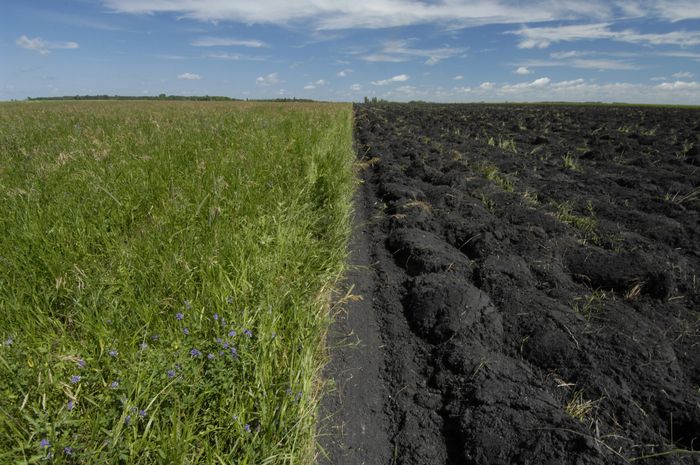
Photography Credit: Michael Forsberg
Cruelty to animals can never be ethical, but cruelty and death are not synonymous. The subtext of anti-meat eating rhetoric is that death is abhorrent and that killing is not ethical. But death is inevitable. The only real options concerning death are when, where, and how, an individual dies. Indeed, the humane harvest of individuals to preserve an entire ecosystem must be considered the ethical choice. A species can regenerate if the community is healthy but communities that perish, are lost forever.
The tens of thousands of plants, invertebrate, and vertebrate species that are indigenous to the Great Plains are, for the most part still intact. Their co-evolution make them co-dependent and so, from the smallest microbe to a two-thousand pound buffalo, one species’ survival depends on the next.
The perennial grasses that are native to the Great Plains are unique in their ability to sequester billions of tons of carbon. The native grazers keep this process functioning and almost any other land use would release that carbon and cause unimaginable problems for the entire world. This seething sea of grass can only survive if its suite of plants and animals remain whole. Aldo Leopold, one of our country’s premier philosophers, explains his famous land ethic in a simple sentence: “A thing is right when it tends toward the integrity, stability, and beauty of a biotic system.”
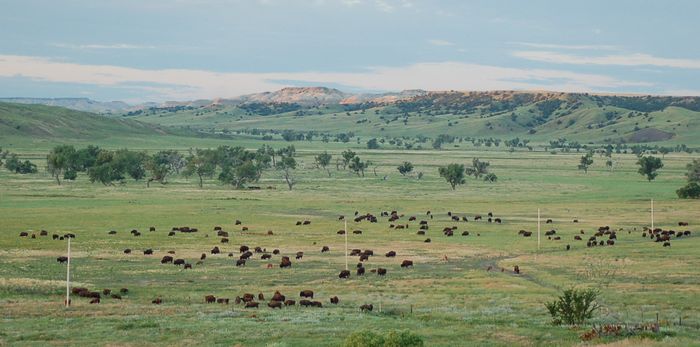 Do humans need to eat the herbivores that populate this ecosystem? No. But the ecosystem literality cannot survive without those free roaming herbivores. Because we have already altered the landscape by removing the large predators that kept it in balance – wolves, bears, lions, Indians – it is our ethical duty to restore the natural balance. Our response to this indisputable imperative has been to promote domestic herbivores on the Great Plains and harvest and utilize the protein that would have gone to the large predators. The ethics of this solution are problematic only because the factory-farming juggernaut tends to suck these domestic animals into its cruel, intensely stressful production chain of feedlots and slaughterhouses.
My neighbors and I believe that the most ethical option is to keep our buffalo on the prairie for their entire lives and harvest them with respect, where they are secure and where there is little or no stress. The folks on the Pine Ridge Reservation see it as a spiritual connection between themselves and the buffalo. I see it that way too, but also as a black-and-white ethical choice. It is not only ethical to eat the meat that these grasslands produce naturally but, moreover, such consumption is a powerful communion between humans and the ecosystem that we share with animals. Surely this puts us on the firmest moral ground.
Comments 17
Hey Dan O’
You have no idea how often your world crosses my mind.
I just been reading about the life on the wind river res “What You See In Clear Water”. I been out there to Pow Wow, crazy place. Can’t see my way west any time soon, what is up with Gervais did i miss somethng. Ken
This is why, even though I am a vegetarian, I follow your writing…you are spiritually & morally ethical in your quest to restore the prairie, the buffalo and the Indian ties to both. I would like to see the feed-lots and the commercial slaughterhouses closed . All living things have a right to live & die with compassion and dignity. Thank you for what you do.
Dear Dan… longtime fan of your writing and your buffalo. Just finished “The Omnivore’s Dilemma” and I agree completely. Thank you.
Warmest regards… Michael
You rightly intuit and state that what is at stake is health-wholeness, and a word derivative, holy. There can be no ethical nor religious wholeness without respect for the larger, unconquered (and ultimately unconquerable) world. Who are these people who want to tell us we ought not eat meat? Who are these people who insist that machines and slaughtering houses are the essential components of living? Your essay is right on, Dan.
A good read on the ethics of eating nature-grown meat, hunting and vegetarianism is Blood Sport, by Ted Kerosote.
As always, thoughtful, concise writing. Thanks, Dan!
Dan:
Your article’s sentiment touched a chord that rumbles deep within me.
Thank you for your words, your efforts, and your goodness toward
our four legged friends and the health of the prairie.
Thank you for the moral statement on how to eat meat and preserve the ecosystem. No vegan or vegetarian or anyone can argue this: We all have to die, it is how we live that is important. And more practically, if animals are not harvested, what will we do with them? They cannot all be pets.
Dan, Great to meet you last night. Yes that young Cocker will flush like Hell!. Tonight, I’ll have some venison and be thinking about the good life that deer had.
Thank you for tenderly and eloquently expressing our links to all… The wave and the particle are one. The critical mass to realize our links is amassing… slowly but surely thanks to your putting words to the truths we seek.
Dan, your logic resonates with me (to the point where I’ve recently reintroduced bison into a vegetarian diet – bison ordered from Wild Idea in point of fact!), but there is an implication that was left unsaid, methinks. If in fact, what makes it ethical for humans to harvest the bison for consumption is that fact that humans have killed off the other large predators that would have served this purpose – i.e. humans stepping in to maintain the balance, to serve as a sort of band-aid – then wouldn’t the next step be reintroduction of those large predators? This would be the ‘cure’ and key to a full restoration of the natural balance.
All well and good except for this: what if humans have in the meantime developed an economic interest in being the bandaid? i.e. What if to relinquish this functional role would prove economically disadvantageous? Then there would be an incentive to not restore the original balance by re-introducing those predation species. We see this sort of behavior playing out all the time – once humans establish an economically self-serving interest, arguments (generally anthropocentric in nature) begin to arise as to why that situation should be made to persist.
Obviously, bison ranchers aren’t becoming wealthy hand over fist, and I suspect most if not all, like yourself, made this move out of conscientiousness and not greed. But that potential for an ethical dilemma seems to me to exist, so long as bison ranching is paying the bills.
I wonder if this makes sense – or if I am starting at imaginary ethical monsters. If the former, I’m wondering if there are structures that could be put in place which would mitigate against such a set of circumstances.
Well said, with eloquence and passion. We are, in the end, one with nature unless we choose NOT to be, and then we AND nature will all die a slow death from ignorance and abuse.
Thanks for sharing your excellent essay…and for continuing to be one of the reasons I am proud to be a native son of SD.
U know I luv how you write, think and live…..DAN for President!
Hello Dan,
You don’t kow me but that was a great essay. Really enjoyed it. Haven’t been in south dakota since the 1970s. Keep the eassys coming, thank you
No offense to the good people at the New York Times, but Dan’s is way better than the essay they actually picked. Not only so well written, but such a vivid description of how an “ethical” food system looks and sounds.
Having read this I believed it was very informative. I appreciate you
spending some time and energy to put this short article together.
I once again find myself spending a significant amount of time
both reading and commenting. But so what, it was still
worth it!